
Fillings
Tooth-colored fillings: how composite bonding works
Composite resin fillings match natural tooth shade, bond chemically to teeth, and preserve more structure than amalgam. How they work, cost, longevity.
Cost figures in this article are typical ranges for the Chicago area, compiled from regional fee data. They are not quotes from Serenity Dental of Bloomingdale; your fee depends on exam findings, materials, and insurance benefits, and we provide a written, itemized estimate before any treatment begins.
Tooth-colored composite fillings are the standard choice for approximately 90 percent of fillings placed today. They match the natural tooth shade, bond chemically to the tooth structure, and require less healthy tooth removal than older silver amalgam fillings. Composite fillings cost $150–$450 depending on size, last 7 to 15 years on average, and work well on both front and back teeth. This guide explains how composite actually works, what makes the bonding process reliable, and how to evaluate whether tooth-colored is right for your situation.

Written by Dr. Husna Khan, DDS
Serenity Dental of Bloomingdale · April 19, 2026
Educational content. Composite fillings are the default material for most fillings at Serenity Dental — call (630) 359-0105 for a consultation.
For the broader picture of filling options, see the dental fillings service page. For a comparison of all filling materials, see filling materials compared.
What are composite fillings made of?
Composite resin fillings contain two main components: a plastic resin matrix that bonds to the tooth, and filler particles that provide strength and wear resistance.
The resin matrix
Primary resin in dental composite is bisphenol A-glycidyl methacrylate (Bis-GMA), a viscous polymer. Other resins used in smaller percentages include UDMA (urethane dimethacrylate), TEGDMA (triethylene glycol dimethacrylate), and Bis-EMA (ethoxylated bisphenol-A dimethacrylate). These resins are chosen for specific properties — some are stiffer, some more fluid, some more biocompatible.
Filler particles
Modern composites contain 60 to 85 percent filler particles by weight, suspended in the resin. Fillers include:
- Silica (SiO2) — the most common filler, provides hardness and wear resistance
- Barium glass — radiopaque (shows on X-rays), similar hardness to tooth enamel
- Zirconium — very hard filler used in premium composites
- Nano-sized particles (0.005 to 0.1 microns) — allow highly polishable surfaces
The combination of particle sizes matters. Nano-hybrid composites mix nano particles with larger particles for optimal polishability and strength. This is the predominant composite type used today.
Photoinitiators
Composite paste stays soft until exposed to blue light at specific wavelengths (~470 nm). Photoinitiators — typically camphorquinone — absorb the blue light energy and trigger free-radical polymerization, converting the resin from soft paste to hard solid within seconds.
Shade pigments
Composite comes in dozens of shades matching natural tooth colors. Dentists match the shade to the surrounding tooth before placement. Advanced composites include translucent enamel layers and more opaque dentin layers for multi-shade restorations that mimic natural tooth structure.
How does composite bond to tooth structure?
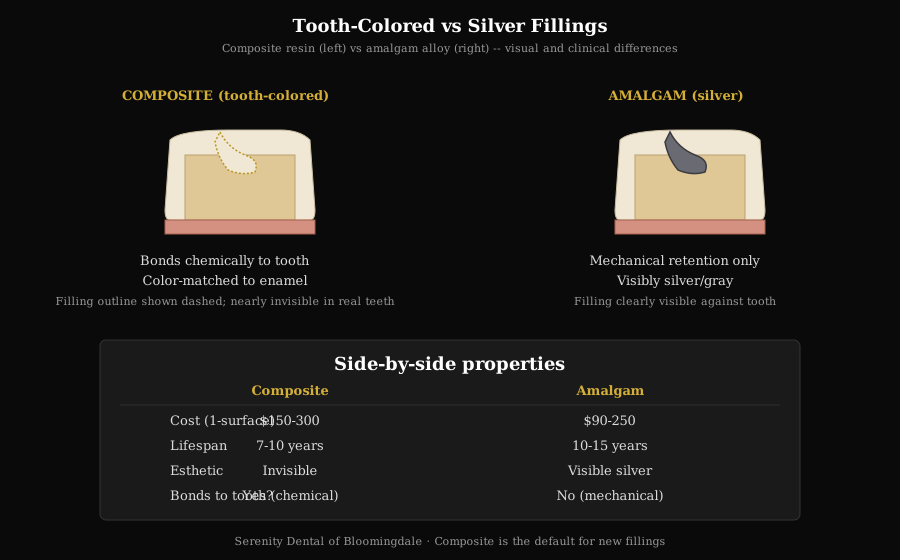
Adhesive bonding is what makes composite work. Unlike amalgam, which stays in place through mechanical retention (undercuts), composite bonds chemically to the tooth. This bonding process has specific steps that must be done correctly.
Step 1: Enamel etching
Enamel surface (outer layer of the tooth) is etched with 37 percent phosphoric acid gel for 15 seconds. The acid creates microscopic roughness by dissolving small amounts of the enamel prisms, leaving a porous surface.
Step 2: Dentin conditioning
Dentin (the softer inner layer of tooth structure) is treated with either the same acid etch or a specialized self-etch primer. The goal is to modify the dentin surface without over-drying it, which would damage the underlying tissue.
Step 3: Primer and adhesive application
A bonding primer is applied to the etched surfaces, penetrates the micro-pores, and creates a hybrid layer where resin and tooth structure interlock. The primer is thinned with an air stream and light-cured briefly.
Step 4: Composite placement
Composite is placed in small increments (2 millimeters maximum per layer), each layer light-cured before the next is added. This layering technique ensures complete curing and minimizes shrinkage stress.
The bond strength
Modern dental bonding produces shear bond strengths of 20 to 30 MPa — strong enough to resist normal bite forces indefinitely if placed correctly. American Dental Association evidence-based guidelines recognize adhesive dentistry as a reliable, long-term restorative technique.
Why bonding matters clinically
Bonding does three things amalgam cannot:
- Preserves tooth structure. No undercuts needed for retention. The dentist removes only the decayed portion plus a small buffer.
- Strengthens the remaining tooth. Bonded composite transfers stress across the remaining tooth, reducing the risk of fracture.
- Seals margins. The bonded interface seals out bacteria, reducing recurrent decay compared to the mechanical seal of amalgam.
Where is composite best used?
Composite is the go-to material for most fillings, but certain clinical situations are particularly well-suited.
Front teeth (anterior fillings)
Nothing matches the esthetics of composite on front teeth. Modern composite shading can replicate:
- Enamel translucency
- Dentin warmth
- Incisal edge effects
- Natural tooth shade gradients
Composite is the universal choice for front tooth fillings. The American Academy of Cosmetic Dentistry and the American Dental Association both recognize composite as the standard for anterior restorations.
Small to medium back teeth cavities
Composite handles the majority of back tooth fillings well. For 1-surface, 2-surface, and most 3-surface fillings on molars, composite provides excellent esthetics with adequate durability.
Conservative restorations
When decay is small and the goal is to preserve maximum tooth structure, composite is ideal because it does not require undercuts. A small composite filling can be placed in a minimal preparation that barely extends beyond the decayed area.
Replacement of old amalgam for cosmetic reasons
Replacing silver fillings with tooth-colored composite is a common cosmetic procedure. Dr. Husna Khan follows safe amalgam removal protocols during this procedure. For more on this, see replacing amalgam fillings.
Pediatric permanent teeth
Glass ionomer is sometimes used for baby teeth, but composite is the standard for permanent teeth in children and adolescents. The esthetic benefit and the ability to place conservative fillings on still-forming teeth make composite ideal.
Where does composite have limitations?
Composite is the right choice for most fillings but has some situations where alternative materials may be preferred.
Very large cavities on back teeth
When a cavity involves 3+ surfaces on a molar with heavy bite forces, composite can work but the filling’s lifespan may be shortened. In these cases, Dr. Husna Khan may discuss:
- Porcelain inlay or onlay — lab-made, bonded, lasts 15-25 years
- Full crown — covers the entire tooth, highest durability
For more on this decision, see filling vs crown vs inlay.
Subgingival margins (below the gumline)
When part of a cavity extends below the gum tissue, maintaining dryness during composite placement is difficult. Moisture contamination compromises the bond. Options include:
- Gingival surgery to expose the margin
- Glass ionomer base placed in the moist area with composite layered on top
- Crown or crown lengthening in severe cases
Patients with severe bruxism
Patients who grind teeth heavily wear down composite faster than patients who do not. Annual composite replacement rates in severe bruxism can be 3-5x higher than average. A custom nightguard extends composite filling life significantly.
Bulk-fill situations
While modern composites can be placed in larger increments (up to 5 mm with bulk-fill composites), very large restorations may benefit from other materials (porcelain, gold) for longevity.
Comparing composite to other tooth-colored options
Several materials are “tooth-colored” but composite is not the only option. Here is how composite compares.
| Material | Appearance | Bonded | Lifespan | Cost | Where used |
|---|---|---|---|---|---|
| Composite resin (direct) | Excellent | Yes (adhesive) | 7-15 years | $175-$350 | Most fillings |
| Porcelain inlay/onlay | Excellent | Yes (cemented with resin) | 15-25 years | $650-$1,500 | Large back tooth restorations |
| Glass ionomer | Good (less polish) | Yes (chemical) | 5-7 years | $100-$300 | Baby teeth, root surfaces |
| Zirconia crown | Excellent | Bonded or cemented | 15-30 years | $1,000-$2,500 | Significant tooth damage |
| Lithium disilicate (e.max) | Excellent | Bonded | 15-25 years | $1,000-$2,500 | Crowns and onlays |
For small to medium fillings, composite is almost always the right choice. For very large restorations, porcelain alternatives become more competitive.
What makes a composite filling last?
Not all composite fillings have equal lifespan. The difference comes down to five factors.
1. Isolation during placement
Moisture contamination during bonding is the #1 cause of composite failure. Rubber dam isolation — a thin sheet that covers everything except the tooth being worked on — virtually eliminates moisture contamination. Dr. Husna Khan uses rubber dam for nearly all composite fillings when anatomy permits.
2. Incremental layering
Composite should be placed in layers of 2 millimeters or less, each layer light-cured before the next. This:
- Ensures complete curing throughout the filling
- Minimizes polymerization shrinkage stress at the bond
- Allows proper anatomic shaping
Bulk-filled composite (single large increment) can work with specialized bulk-fill materials, but traditional composites should always be layered.
3. Curing light quality and exposure time
The LED curing light must deliver enough energy to fully cure each composite layer. Key factors:
- Light intensity (measured in mW/cm2, typically 800-1500)
- Distance from the tooth (closer is better)
- Duration (10-40 seconds depending on composite and light)
- Wavelength matching composite’s photoinitiator
Modern LED curing lights at Serenity Dental meet or exceed specifications for reliable curing.
4. Bite adjustment
A filling that sits slightly high on the bite bears excessive force, causing pain and premature wear. Thorough bite adjustment at placement prevents most of these issues.
5. Patient-specific factors
- Oral hygiene: Daily flossing especially critical around interproximal composites
- Diet: Limiting between-meal sugars reduces acid attacks on filling margins
- Bruxism: Nighttime grinding wears composite faster — nightguard extends lifespan
- Recall frequency: Catching early problems means small replacements instead of larger ones
The composite procedure timeline
For a typical single-surface posterior composite filling at Serenity Dental:
| Time | Activity |
|---|---|
| 0-5 min | Patient review, consent, tooth confirmation |
| 5-7 min | Topical anesthetic gel application |
| 7-8 min | Local anesthesia injection |
| 8-15 min | Wait for numbness, test for complete numbness |
| 15-19 min | Rubber dam placement |
| 19-30 min | Decay removal with high-speed handpiece |
| 30-32 min | Cavity cleaning, acid etching (15 sec) |
| 32-33 min | Bonding primer application and cure |
| 33-43 min | Composite placement in layers, each cured |
| 43-45 min | Final shaping and full cure |
| 45-47 min | Rubber dam removal |
| 47-52 min | Bite adjustment with articulating paper |
| 52-55 min | Final polishing |
Total: approximately 55 minutes for a careful single-filling procedure. Rushed fillings (15-20 minute slots) sacrifice multiple quality steps.
For the full step-by-step breakdown, see dental filling procedure step-by-step.
Composite fillings and insurance
Insurance coverage for composite fillings has some nuances worth understanding.
PPO insurance typical coverage
- Front tooth composite: Covered at 70-80 percent like any basic restoration
- Back tooth composite: Covered at 70-80 percent by most plans, but some plans “downgrade”
What downgrade means
Some older insurance plans have a provision that says: “We will pay for composite fillings on back teeth at the amalgam rate. The patient is responsible for the difference.”
Example:
- Composite filling fee: $250
- Amalgam rate the plan would pay: $180
- Insurance pays 80 percent of $180 = $144
- Patient pays: $250 - $144 = $106 (higher than a straight 80 percent composite coverage)
Not all plans have downgrades. To check, ask your dental office to verify benefits before treatment. Serenity Dental routinely checks for downgrade provisions and explains any financial implications before scheduling.
Medicare and Medicaid
- Original Medicare: Does not cover dental fillings
- Medicare Advantage: Dental benefits vary by plan
- Illinois Medicaid (Healthy Smiles): Covers dental for pregnant women and children; limited coverage for other adults
Dental discount plans
Membership plans often provide 10-30 percent discounts on composite fillings. For patients without traditional insurance, discount plans can reduce out-of-pocket costs. See dental filling cost for a full financial breakdown.
Is composite right for you?
For most patients, composite is the best choice. The situations where amalgam might be preferred are narrow:
Consider amalgam instead if:
- Budget is extremely tight and the filling is on a back tooth
- You have a documented allergy to composite resins
- The cavity is in a location where moisture control is impossible
Consider porcelain inlay/onlay instead if:
- The cavity is very large (3+ surfaces involving multiple cusps)
- The tooth is structurally compromised and needs long-term reinforcement
- You want maximum longevity with natural appearance
Composite is the right choice if:
- The cavity is small to medium
- The tooth is structurally sound
- You want tooth-colored appearance
- You prefer to preserve maximum healthy tooth structure
- Insurance covers composite without significant downgrade
Dr. Husna Khan discusses all applicable options at the consultation with expected longevity, cost, and esthetic tradeoffs. The goal is informed consent, not upselling.
Serenity Dental’s composite standards
At Serenity Dental, composite fillings follow specific quality protocols:
- Rubber dam isolation for all composite fillings when anatomy permits
- Modern nano-hybrid composites (not older microfill or hybrid materials)
- Shade-matched to surrounding tooth before placement
- Incremental placement with proper curing per layer
- Magnification loupes for margin verification
- Thorough bite adjustment with articulating paper
- Final polishing to natural-tooth smoothness
- Written post-op instructions
- Follow-up adjustment included within 30 days
Schedule a filling consultation at Serenity Dental by calling (630) 359-0105. If you have questions about composite vs other materials, or want an honest assessment of your existing fillings, we provide the time and information to make an informed decision. Related: what is a dental filling · dental fillings service page · filling materials compared · filling costs.
FAQs
What are tooth-colored fillings?
How much do tooth-colored fillings cost?
How long do tooth-colored fillings last?
Are tooth-colored fillings as strong as silver (amalgam)?
Can tooth-colored fillings be used on back teeth?
Do tooth-colored fillings stain?
Is composite filling material safe?
Can silver fillings be replaced with tooth-colored ones?
Why does my tooth-colored filling look black or dark?
Educational content only. Recommendations are personalized after an exam and any needed imaging.
About this article
Reviewed by Dr. Husna Khan, DDS, of Serenity Dental of Bloomingdale. Dr. Husna Khan uses modern nano-hybrid composite materials with rubber dam isolation, incremental placement, and magnification-assisted margin verification to produce restorations that consistently meet or exceed average composite filling lifespans.
Educational content. Material selection depends on individual clinical factors including cavity size, tooth location, and patient preferences. Cited sources: American Dental Association evidence-based clinical recommendations for direct composite restorations, American Academy of Cosmetic Dentistry standards for anterior composite restorations, FDA safety assessments of dental resin-based materials.
Related: dental fillings service page · filling materials.
Pricing note. Prices shown are approximate Chicago-area 2026 ranges compiled from public cost guides — not a quote or a Serenity Dental fee schedule. Your actual cost depends on your clinical needs, the materials chosen, and your insurance. We provide a written estimate before any treatment begins. Call (630) 359-0105 to confirm pricing for your situation.
Need help with this in real life?
Reading helps. Talking to someone who can look at your actual teeth and symptoms helps more. If you want a clear next step, we’re here.
Related articles
Dental filling cost in 2026: real pricing explained
Composite fillings cost $150-$550; amalgam runs $100-$400. What insurance covers, how surface count affects price, and what to expect without insurance.
Read article →Dental filling materials compared: composite vs amalgam
Composite, amalgam, glass ionomer, porcelain, gold: lifespan, cost, appearance, and which material is right for your cavity location.
Read article →Dental filling procedure: step-by-step patient guide
Exactly what happens during a filling, from numbing to bite check. Timing, tools, sensations, and what to expect at each of the 7 stages.
Read article →