Oral Surgery
Sinus lift in Bloomingdale, IL
Not enough bone in the upper jaw to support an implant? A sinus lift builds that foundation — safely, precisely, and with a clear plan for the implant that follows.
Dr. Husna Khan evaluates bone height and sinus anatomy with CBCT imaging at your consultation and tells you exactly which approach your case requires, how long healing takes, and what the total treatment path looks like.
When a sinus lift is needed
- Upper back molars lost — bone resorbs and sinus expands downward over time
- Naturally low sinus floor anatomy — some patients have insufficient height even with no tooth loss
- CBCT scan confirms <8–10 mm vertical bone height in the posterior maxilla
- Implant placement would otherwise violate the sinus cavity
What the procedure does
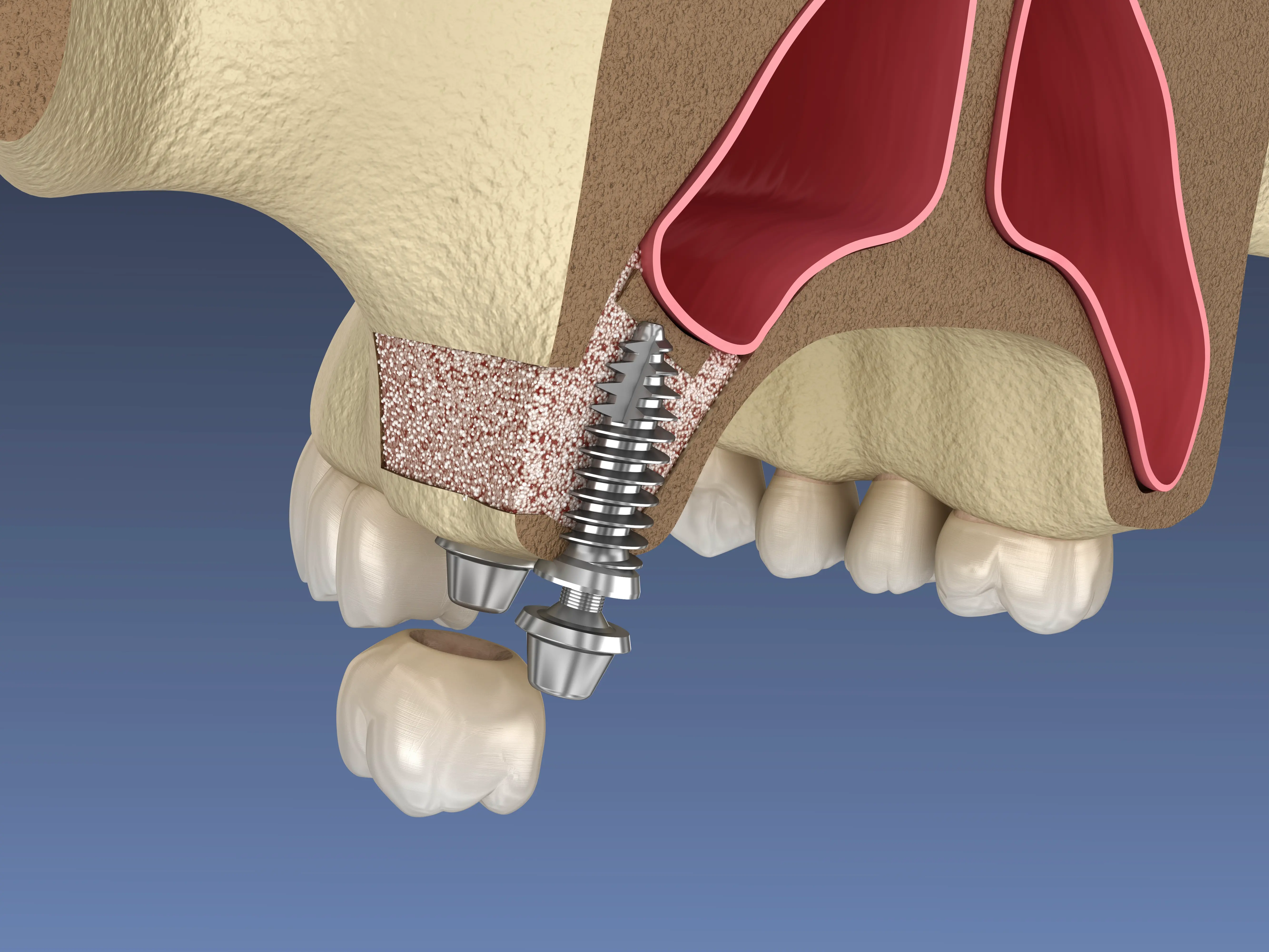
- The sinus membrane (Schneiderian membrane) is gently lifted upward
- Bone graft material is packed into the space created beneath the membrane
- New bone integrates over 4–9 months, creating the height needed for an implant
- Implant is placed once imaging confirms integration
Lateral window vs. crestal sinus lift
Two evidence-based approaches — the right one depends on how much bone you have and how much needs to be added. Dr. Husna Khan determines this from your CBCT scan at the first visit.
| Factor | Crestal (internal) sinus lift | Lateral window sinus lift |
|---|---|---|
| ADA code | D7310 | D7311 |
| Bone available | < 4–5 mm available | < 4 mm available |
| Bone added | 1–4 mm added | 5+ mm added |
| Surgical access | Through the implant site — no separate incision | Small access window in the lateral jaw wall |
| Time to implant | 4–6 months to implant | 6–9 months to implant |
| Best for | Minor augmentation needed; sufficient base bone to stabilize implant during healing | Significant augmentation needed; insufficient base bone for simultaneous implant |
Bone graft material fills the space beneath the elevated sinus membrane — over 4–9 months, new bone forms for the implant to anchor into.
What to expect after a sinus lift
The most important post-op rule: do not blow your nose for at least 2–3 weeks. Increased sinus pressure is the most common cause of membrane disruption.
Days 1–3
Acute phase
Swelling, congestion, and mild facial pressure. Ice packs, prescribed pain relief, and rest. Soft foods only.
Days 4–7
Early healing
Swelling subsides. Congestion continues. No blowing nose, no straws, no smoking. Return to light daily activity.
Weeks 2–4
Settling
Congestion resolves for most patients. Sutures removed at 1–2 weeks. Continue soft foods near the site.
Months 4–9
Integration
New bone matures. CBCT confirms readiness. Implant placement scheduled once integration is confirmed by Dr. Husna Khan.
After a sinus lift — do
- ✓Sneeze with mouth open (releases pressure safely)
- ✓Take prescribed antibiotics and rinse as directed
- ✓Eat soft foods — eggs, yogurt, pasta, soft vegetables
- ✓Sleep with head slightly elevated for the first few nights
- ✓Call Serenity Dental if you notice unusual swelling or discharge
After a sinus lift — avoid
- ✗Blowing your nose — for 2 to 3 weeks minimum
- ✗Drinking through a straw — negative pressure disrupts healing
- ✗Smoking or vaping — significantly impairs graft integration
- ✗Strenuous exercise for at least 1 week
- ✗Flying or altitude changes in the first 2 weeks
Sinus lift cost and insurance
Cost varies by approach and graft volume. We verify your dental and medical benefits before treatment — some cases qualify for medical coverage.
| Procedure | ADA code | Typical cost range | Insurance notes |
|---|---|---|---|
| Crestal sinus lift | D7310 | $2,500-$5,000 / side | Some PPO coverage; varies by plan |
| Lateral window sinus lift | D7311 | $2,500-$5,000 / side | PPO major restorative; medical ins sometimes applies |
| Bone graft material (added at same visit) | D7953 | $300-$800 per unit | Often bundled with the sinus lift claim |
Cost figures on this page are typical Chicago-area ranges, not quotes. Fees depend on exam findings, materials, and insurance benefits; we provide a written, itemized estimate before treatment.
Cost ranges reflect national averages. Serenity Dental provides a clear written estimate before any treatment begins. Call (630) 359-0105 with your insurance card for same-day benefit verification.
Sinus lifts at Serenity Dental
Dr. Husna Khan performs sinus lift surgery at Serenity Dental in Bloomingdale. Every case starts with a CBCT scan — the imaging that makes it possible to measure bone height precisely, visualize the sinus floor, and choose the right approach before any surgery begins.
Patients come to us from Bloomingdale, Glendale Heights, Carol Stream, Addison, and Schaumburg. If you've been told elsewhere that you don't have enough bone for an implant, a sinus lift evaluation is the right next step.
Serenity Dental of Bloomingdale · 1 Tiffany Pt, Suite 205, Bloomingdale, IL 60108
CBCT
3D imaging guides every plan
2
Approaches — crestal and lateral
D7310 D7311
ADA billing codes on file
4–9 mo
Typical healing before implant
Quick facts
| Treatment time | 60 to 90 minutes |
|---|---|
| Anesthesia | Local anesthesia; oral sedation typical; IV by referral |
| Recovery | 1 to 2 weeks of swelling; 4 to 9 months before implant placement |
| Techniques | Lateral window or crestal osteotome approach |
| Typical cost | $1,500-$5,000 (Chicago-area typical) |
| Why it's done | Adds bone height in upper back jaw for implant placement |
Clinical references
We rely on guidance from established clinical organizations. The references below inform how we explain options, expected outcomes, and aftercare on this page.
- American Academy of Periodontology considers sinus augmentation an established procedure when the maxillary sinus floor limits implant placement in the posterior maxilla.
- Cochrane Oral Health Group systematic reviews report high implant survival rates following sinus lift procedures with both lateral window and crestal osteotome techniques.
- American Association of Oral and Maxillofacial Surgeons publishes patient guidance on sinus augmentation indications, sedation options, and post-operative healing.
- Journal of Oral and Maxillofacial Surgery comparative outcomes research on lateral and crestal sinus augmentation guides technique selection based on residual bone height.
For patient education only. Treatment recommendations depend on individual diagnosis. Reviewed by Dr. Husna Khan, DDS.
Sinus lift — questions answered
What is a sinus lift and why would I need one?
How painful is a sinus lift procedure?
What is the difference between a lateral window and a crestal sinus lift?
How long does a sinus lift take to heal?
Can a sinus lift and implant be done at the same time?
How much does a sinus lift cost in Bloomingdale, IL?
What are the long-term side effects of a sinus lift?
Do I need a bone graft along with a sinus lift?
What graft material is used in a sinus lift?
What should I avoid after a sinus lift?
What kind of anesthesia is used for a sinus lift?
Can a general dentist do a sinus lift, or do I need a specialist?
Should I get a sinus lift or a short implant instead?
Is it worth getting a second opinion before a sinus lift?
Educational content only. Recommendations are personalized after an exam and any needed imaging.
Learn more about sinus lift
In-depth guides on every aspect of the procedure - from technique selection to recovery to alternatives.
What is a sinus lift?
The procedure explained step by step, with anatomy and timing
Tooth Extraction
Tooth Extraction Cost in 2026: What You Actually Pay
Real tooth extraction costs by procedure type -- simple, surgical, broken, and impacted. What insurance covers, what drives the price, and financing options.
Tooth Extraction
Tooth Extraction Aftercare: Day-by-day Dos and Don'ts
Complete tooth extraction aftercare checklist -- gauze, rinsing, smoking, straws, sleeping position, brushing, and exercise. What to do and avoid by day.
Dental Bone Graft
Types of Dental Bone Grafts: Autograft to Synthetic
The four bone-graft materials in dentistry: what each is, where it's from, and how to choose, with guidance for religious, ethical, or vegan concerns.
Dental Bone Graft
What Is a Dental Bone Graft? A Complete Patient Guide
A dental bone graft rebuilds jawbone where a tooth was lost. What it is, when it's needed, why bone disappears, and how it restores volume for an implant.
Broken Tooth
Broken Tooth Extraction: What to Expect
How broken tooth extraction differs from simple extraction -- surgical approach, cost, recovery, and whether a regular dentist can remove a broken tooth.
Infected Tooth
Infected Tooth Extraction: When It's Needed and What to Expect
When an infected tooth needs extraction vs saving, antibiotics before extraction, post-op infection signs, and what recovery looks like.
Tooth Extraction
Tooth Extraction Recovery Timeline: Healing Stages Day by Day
Day-by-day tooth extraction healing -- what's normal, when pain peaks, when bleeding stops, when you can eat normally, and warning signs to watch for.
Tooth Extraction
Root Canal vs Extraction: How to Decide
Tooth extraction vs root canal -- cost, pain, success rates, longevity, and when each makes sense. Clear framework for deciding which procedure is right.
Book Online
Schedule your dental appointment online
Choose a time that works for you using our secure online booking tool.
This is a good option for new patient visits, routine exams, and many general dental appointments. If you have severe pain, swelling, or a broken tooth, call us so we can help you more quickly.
Having trouble with the booking tool, or not sure which appointment type fits your situation? Call us and we’ll help you choose the right visit.
Visit us
Sinus Lift at our Bloomingdale, IL office
Serenity Dental of Bloomingdale is at 1 Tiffany Pt, Suite 205, Bloomingdale, IL 60108. Patients come to us for sinus lift from Bloomingdale and from Glendale Heights, Roselle, Carol Stream, Itasca, Medinah, Addison, and Bartlett. Our team speaks 7 languages, including Spanish, Polish, Hindi, Urdu, and Arabic.
Hours
- Mon9:00 AM – 5:00 PM
- Tue10:00 AM – 6:30 PM
- Wed9:00 AM – 5:00 PM
- Thu9:00 AM – 5:00 PM
- Fri9:00 AM – 5:00 PM
- Sat9:00 AM – 3:00 PM
- SunClosed
Saturday hours and Tuesday evenings available.
Book sinus lift
Online booking works for consultations and routine visits. For pain, swelling, or a broken tooth, call so we can fit you in sooner.