Preventive Dentistry
Dental sealants in Bloomingdale, IL
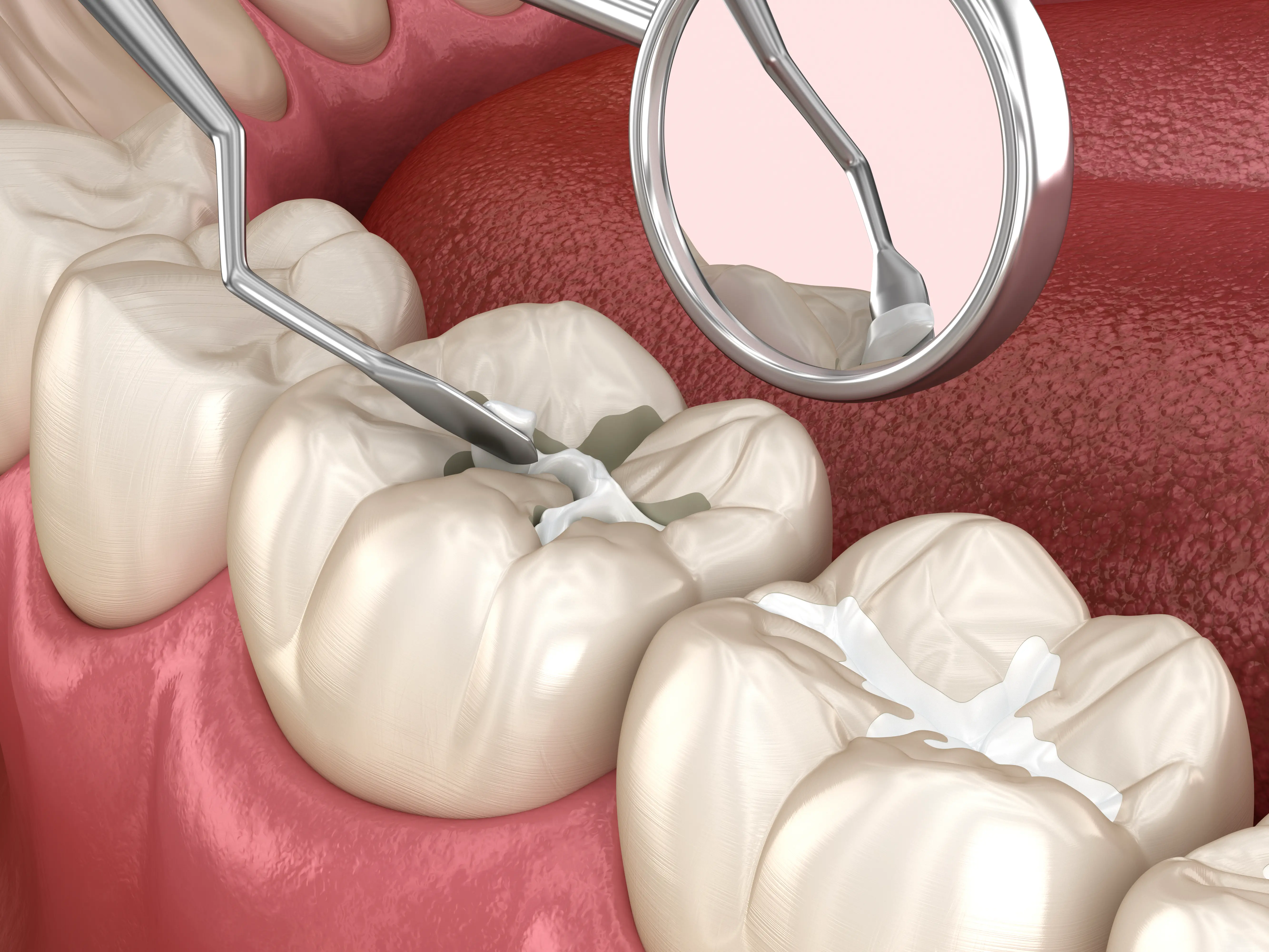
Most cavities in children start in the deep grooves of back molars — spots a toothbrush bristle can't reach. Dental sealants — also called dental coatings — fill those grooves with a thin protective coating, blocking bacteria before decay can start. Painless, no drilling, completed in one appointment.
Sealants are recommended for children as soon as six-year and twelve-year molars erupt. Adults with deep groove anatomy and no existing decay are also good candidates. At Serenity Dental, Dr. Husna Khan places sealants and checks existing sealants at every routine visit without patients needing to ask.
80%
Cavity reduction
CDC-cited study: sealants reduced decay in permanent molars by nearly 80% over nine years
5–10 yrs
Average lifespan
With normal care; checked at every routine visit and repaired chairside when needed
1 visit
No prep, no recovery
No injections, no drilling — sealants are placed and cured in a single short appointment
How dental sealants work
The chewing surfaces of molars aren't flat — they're carved with deep pits and fissures that trap food and bacteria. A toothbrush bristle is physically too wide to clean the bottom of those grooves. Bacteria accumulate, produce acid, and cavities form in spots that were never effectively cleaned regardless of how well someone brushes.
Sealants fill the groove mechanically — bacteria can't establish, no acid produced, no cavity starts.
A sealant — clinically called a pit-and-fissure sealant or preventive resin restoration — is a thin resin-based material that flows into those pits and fissures, bonds to the enamel, and hardens under a curing light. The groove becomes smooth and cleanable. The protection is mechanical, not chemical — it physically removes the environment bacteria need to establish. There's no cavity because there's nowhere for the process to begin.
The application — step by step
Clean & dry
Tooth surface cleaned and dried thoroughly. Moisture prevents the sealant from bonding — this step most affects longevity.
Etch
A mild gel etches the enamel briefly to create a microscopically rough surface for the sealant to grip. Rinsed off completely.
Apply & cure
Liquid sealant flows into all pits and fissures. A curing light hardens it in seconds. Coverage is checked for gaps.
Check bite
We confirm the sealant doesn't affect how the teeth come together. Any minor adjustments happen chairside before you leave.
The evidence behind sealants
Dental sealants have one of the strongest evidence bases in preventive dentistry. The effectiveness data is consistent across multiple independent study designs.
80%
cavity reduction
CDC-cited study — 9 years of follow-up data on permanent molars vs. unsealed controls
72–87%
two-year reduction
2014 Cochrane Library systematic review of 15 clinical trials in susceptible teeth
ADA + AAPD
both recommend
American Dental Association and American Academy of Pediatric Dentistry both recommend sealants at molar eruption
The CDC classifies dental sealants as an evidence-based intervention for cavity prevention in school-age children. The 80% figure isn't from a single industry study — it reflects a body of research across different populations and timeframes all pointing the same direction. Whether patients call them sealants, cavity sealants, or dental coatings, the mechanism and evidence are the same. Sealants also carry an oral health equity angle: the CDC School Sealant Programs specifically target children in lower-income households who are twice as likely to develop untreated cavities.
Dental sealants for children
Timing matters more than anything else. A sealant on a newly erupted, healthy molar prevents decay from starting. The same sealant placed over existing decay creates a different problem — which is why the exam that confirms the tooth is ready matters.
| Age | What's happening | Sealant recommendation |
|---|---|---|
| ~Age 6 | First permanent molars erupt | Seal as soon as fully in |
| ~Age 12 | Second permanent molars erupt | Seal promptly — same rationale |
| Teens (unsealed) | First/second molars in, never sealed | Still beneficial if decay-free |
| Any age | Active cavity present | Treat first — sealant not appropriate over decay |
Sealants vs. fluoride — both, not either/or
Fluoride strengthens all enamel surfaces systemically. Sealants physically block specific groove anatomy. They address different mechanisms and different surfaces — a child with both has protection that neither provides alone. Dr. Husna Khan discusses both at routine pediatric visits.
What accelerates wear in kids
Chewing ice, hard candy, or crunchy foods directly on sealed teeth wears sealants faster than normal chewing forces. A sealant approaching 10 years or showing visible chipping is worth checking. Dr. Husna Khan flags these at every routine visit without parents needing to ask.
Dental sealants for adults
Sealants are not exclusively a children's procedure. The ADA recognises sealants as an effective decay-prevention measure for adults with deep grooves or pits that are difficult to clean — whether because they were never sealed in childhood or because their groove anatomy is particularly deep.
Good adult candidates
- ✓Molars that have never been sealed and remain cavity-free
- ✓Deep groove anatomy confirmed by clinical exam
- ✓History of cavities in other teeth despite good hygiene
- ✓No existing fillings in the teeth to be sealed
- ✓Healthy gum tissue with no active periodontal disease
Not appropriate when
- →Active decay is present — treat first
- →The tooth already has a filling in the area to be sealed
- →Enamel is significantly thinned from wear or acid erosion
- →Previous sealants are still intact and in good condition
At the exam, Dr. Husna Khan assesses groove depth and enamel condition before recommending sealants for adult teeth. A note on sensitivity: patients with sensitive teeth from exposed dentine sometimes find that sealing deep grooves reduces sensitivity by blocking access to vulnerable enamel — worth discussing if sensitivity is a concern. The conversation is straightforward — if sealants won't help in your specific case, that's what you'll hear.
Are dental sealants safe? What about BPA?
This is the most common concern parents raise, and it deserves a direct answer. Earlier generations of sealant materials contained a component called Bis-DMA that could theoretically release trace BPA during the curing process. The amounts detected in research were far below any clinically significant threshold — comparable to BPA exposure from handling a grocery store receipt.
Modern resin-based sealants — including those used at Serenity Dental — are formulated to minimise this further. The ADA, CDC, and AAPD have all reviewed the evidence and continue to recommend sealants. The cavity-prevention benefit is well-established; the theoretical material concern is not.
Cost and insurance coverage
| Situation | Typical cost |
|---|---|
| PPO insurance — children (permanent molars) | Often $0 — covered at 80–100% |
| Illinois Medicaid (All Kids / EPSDT) | Covered for eligible children |
| PPO insurance — adults | Varies — often not covered or partially covered |
| No insurance — per tooth | $40-$80 per tooth |
| Molar sealant cost (typical 4-tooth appointment) | varies without insurance |
Cost figures on this page are typical Chicago-area ranges, not quotes. Fees depend on exam findings, materials, and insurance benefits; we provide a written, itemized estimate before treatment.
We verify coverage before scheduling so you know what to expect at checkout. Questions about your specific plan or payment options? Call (630) 359-0105.
Dental sealants near me — Bloomingdale and nearby
We see patients for sealants from Bloomingdale, Glendale Heights, Carol Stream, Roselle, Addison, and surrounding DuPage County communities. Sealants are placed at routine appointment visits when the right teeth are present and ready — no separate appointment needed for most patients.
Learn more about dental sealants
In-depth answers to the questions patients ask most about sealants -- candidacy, materials, procedure, longevity, and alternatives.
Sealant basics & materials
For children & teens
For adults
After placement & specifics
Cost, longevity & comparisons
Dental X-Rays
Dental X-Ray Types and Safety: What to Expect at Your Visit
Dental X-ray types explained, bitewing, periapical, panoramic, CBCT, with radiation safety, frequency, and what each X-ray reveals about your teeth.
Pediatric Sedation Dentistry
Pediatric Sedation Dentistry: What Parents Should Know
A parent's guide to dental sedation for children — nitrous oxide, oral sedation, what to expect, and how Dr. Rafia Jabeen decides what's right for your child.
at home dental products
Best At-Home Dental Products: A Bloomingdale Dentist's Honest Guide
A Bloomingdale dentist's honest guide to at-home dental products -- toothbrushes, toothpaste, floss, water flossers, mouthwash, and more.
Kids Dentist
How Often Should Kids Go to the Dentist? A Clear Answer by Age
AAPD recommends every 6 months — but some kids need every 3. What sets the schedule, the age-7 milestone, and what a routine visit covers.
Cavity Signs Kids
Signs a Child Has a Cavity
Seven signs a child has a cavity — tooth pain, sensitivity, discoloration, gum swelling, and more — and which ones need same-day dental care.
Related preventive and pediatric services
Pediatric Dentistry
First visits, routine checkups, fluoride treatments, and preventive care for children from their first tooth through their teens.
Cleanings & Exams
Sealants are assessed at every routine exam. A cleaning appointment is often the best time to place or repair sealants.
Dental Fillings
If decay is found before sealants are placed, it needs to be treated first. Tooth-coloured composite fillings at Serenity Dental.
Dental Sealants FAQs
Questions patients ask most before deciding on sealants for themselves or their children.
What are dental sealants?
Dental sealants are thin plastic coatings applied to the chewing surfaces of back molars and premolars. They bond to the enamel and create a smooth barrier that prevents bacteria from settling in grooves a toothbrush can't reach. The CDC lists sealants as one of the most effective tools for preventing cavities in children.
How long do dental sealants last?
Five to ten years with normal care. Dr. Husna Khan checks sealant integrity at every routine visit — small chips are often repaired chairside before they become a problem. Sealants approaching the 10-year mark typically need replacement. If the tooth is still cavity-free, resealing is worthwhile.
Are dental sealants safe?
Yes. Dental sealants have a long safety record and are recommended by the ADA, CDC, and American Academy of Pediatric Dentistry. Earlier sealant materials contained trace BPA, but modern resin-based sealants used in dental practices release negligible amounts — far below any clinically significant level. The decay prevention benefit substantially outweighs the theoretical material concern.
Can adults get dental sealants?
Yes. The ADA recognises sealants as an effective decay-prevention measure for adults with deep grooves or pits in their teeth that are difficult to clean. Adults who have never had sealants and whose molars remain cavity-free are often good candidates. The procedure is identical to children's sealants — painless, no drilling, completed in one visit.
How much do dental sealants cost?
Sealants typically cost $40-$80 per tooth without insurance. Most PPO plans cover sealants for children at 80–100% for permanent molars, often up to age 14 or 16. Illinois Medicaid (All Kids / EPSDT) covers sealants for eligible children. Adult sealant coverage varies by plan. We verify benefits before scheduling so the cost is clear in advance.
What is the best age to get dental sealants?
Age 6, when the first permanent molars erupt. The second set comes in around age 12 and should be sealed promptly too. Sealing before any decay forms is the goal. Teens who never had sealants but have cavity-free molars are still good candidates, as are some adults with deep groove anatomy.
Do sealants replace brushing and flossing?
No. Sealants protect the chewing surfaces of molars — where most childhood cavities start. They don't cover the sides or between teeth, where brushing and flossing still do the work. Sealants and good home care are complementary. Fluoride treatments protect all surfaces systemically; sealants physically block the grooves. All three work together.
Does getting sealants hurt?
No. The procedure is completely painless — no injections, no drilling, no removal of tooth structure. The tooth is cleaned, dried, etched briefly with a mild gel to help the sealant bond, then the liquid sealant flows into the grooves and is cured in seconds with a light. Most patients are surprised at how quick and unremarkable it feels.
Educational content only. Sealant recommendations depend on each patient's cavity risk, eruption stage, and exam findings.
Quick facts
| Treatment time | 2 to 3 minutes per tooth |
|---|---|
| Anesthesia | None |
| Lifespan | 5 to 10 years; reapplication possible |
| Typical cost | $40-$80 per tooth |
| Cavity reduction | Approximately 80% reduction in molar cavities (CDC) |
| Best age | Permanent molars shortly after eruption (around ages 6 and 12) |
Clinical references
We rely on guidance from established clinical organizations. The references below inform how we explain options, expected outcomes, and aftercare on this page.
- Centers for Disease Control and Prevention reports that dental sealants prevent approximately 80% of cavities in the back teeth of school-age children.
- American Academy of Pediatric Dentistry recommends sealants as a primary preventive intervention on permanent molars shortly after eruption.
- American Dental Association Council on Scientific Affairs evidence-based clinical recommendations support sealant placement on at-risk surfaces in children, adolescents, and adults.
For patient education only. Treatment recommendations depend on individual diagnosis. Reviewed by Dr. Husna Khan, DDS.
Visit us
Dental Sealants at our Bloomingdale, IL office
Serenity Dental of Bloomingdale is at 1 Tiffany Pt, Suite 205, Bloomingdale, IL 60108. Patients come to us for dental sealants from Bloomingdale and from Glendale Heights, Roselle, Carol Stream, Itasca, Medinah, Addison, and Bartlett. Our team speaks 7 languages, including Spanish, Polish, Hindi, Urdu, and Arabic.
Hours
- Mon9:00 AM – 5:00 PM
- Tue10:00 AM – 6:30 PM
- Wed9:00 AM – 5:00 PM
- Thu9:00 AM – 5:00 PM
- Fri9:00 AM – 5:00 PM
- Sat9:00 AM – 3:00 PM
- SunClosed
Saturday hours and Tuesday evenings available.
Book dental sealants
Online booking works for consultations and routine visits. For pain, swelling, or a broken tooth, call so we can fit you in sooner.