
Recovery & Aftercare
Tooth Extraction Healing Day by Day: What the Site Should Look Like
Day-by-day visual guide to normal tooth extraction healing with descriptions and reference points for days 1, 3, 7, 14, and 30. How to tell normal healing from dry socket or infection.
Tooth Extraction Healing Day by Day: What the Site Should Look Like

Written by Dr. Husna Khan, DDS
Serenity Dental of Bloomingdale · April 29, 2026
For post-op concerns or photo review during recovery in Bloomingdale, IL, call (630) 359-0105.
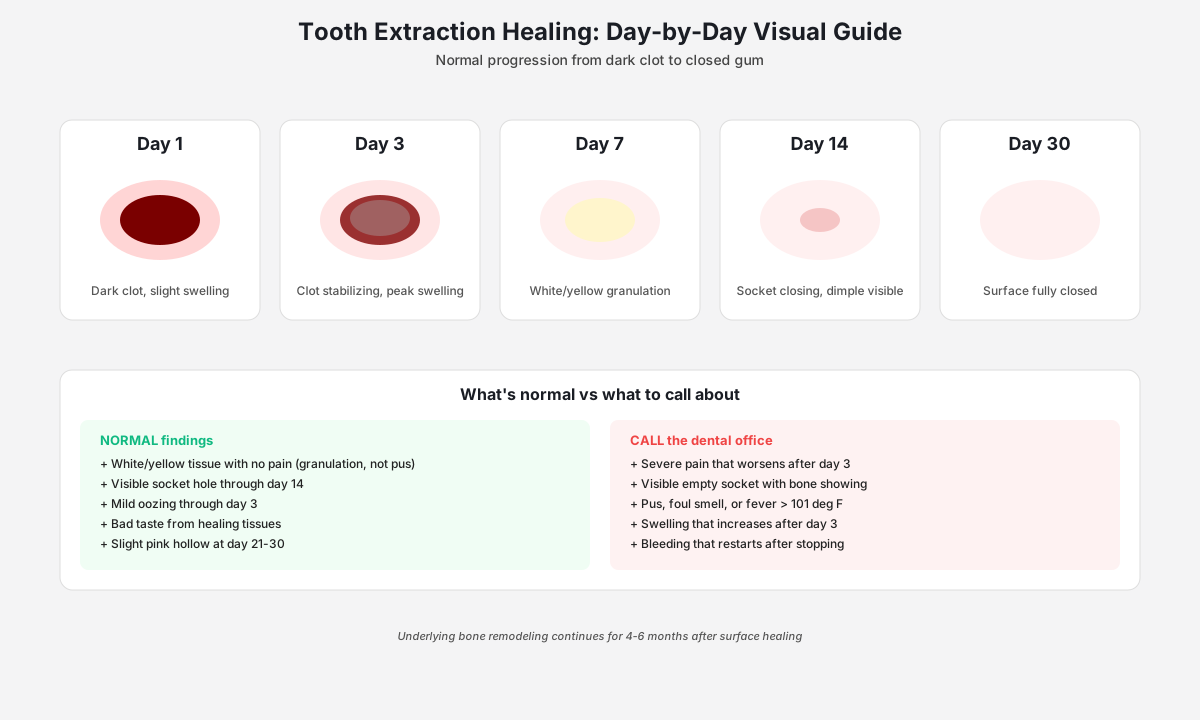
A normal tooth extraction site changes appearance significantly over the first month, and most of what you see day to day is healthy progress — not a problem. The dark blood clot of day 1 transitions through a fibrin-coated stage at day 3 to 5, then granulation tissue closes the visible hole between days 14 and 21, with the surface gum fully healed by day 30. Underneath, bone remodeling continues for another 4 to 6 months.
This guide walks through what each milestone looks like, what’s normal, and what warrants a phone call. Goal: it to give you a clear reference point so you can confidently distinguish “this is healing” from “this needs to be checked.”
Why this matters
A single most common reason patients call the office in the first two weeks after extraction is uncertainty about appearance: “I see something white in there, is that infection?” or “the hole is still there after a week, is that normal?” or “there’s a yellow patch that wasn’t there yesterday.”
Most of these calls are about completely normal healing milestones that look strange because the patient has never seen the inside of an extraction socket before. A clear visual guide — with descriptions of what each stage looks like and feels like — lets patients self-monitor with confidence and reach out only when there’s something genuinely worth checking.
Day 1: the dark clot
What it looks like: A dark red or maroon depression where the tooth used to be, partially or fully filled with a clot that often rises slightly to about the level of the surrounding gum. Your clot may have a slightly raised, jelly-like texture. The surrounding gum is mildly swollen and may be pink to slightly red.
What’s normal: Mild bleeding or oozing through the day. A small amount of pinkish saliva. Some swelling of the cheek on the extraction side. Numbness wearing off through the morning if the procedure was earlier in the day. Minor bleeding through the first night that stains the pillow lightly.
What’s not normal: Heavy active bleeding (bright red, filling the mouth) that does not slow with 30 minutes of firm gauze pressure. Severe pain that prescribed medication does not control. Fever.
What to do: Bite gauze for 30 to 45 minutes at a time as needed; ice pack 20 minutes on, 20 minutes off; soft cool foods; no rinsing or spitting; sleep with head elevated.
Day 2 to 3: peak swelling, clot stabilizing
What it looks like: The clot is darker and slightly more compact than on day 1. A very top surface may begin to look grayish or have a fibrin film starting to form. Swelling around the cheek is at its peak (day 2 or 3). Mild bruising may appear on the cheek or jaw.
What’s normal: Peak external swelling at this point. Mild discomfort that responds to over-the-counter pain medication. Stiffness of the jaw, especially with lower extractions. Slight oozing in the morning. Bad taste from the healing tissues.
What’s not normal: Pain that worsens significantly between day 2 and day 3 (warning sign for dry socket). Swelling that continues to increase rapidly. Foul drainage from the socket. Fever above 101 degrees Fahrenheit.
What to do: Continue cold compresses through day 2; switch to warm compresses on day 3 if helpful for soreness. Begin gentle warm saltwater rinses on day 2 (half teaspoon salt in 8 oz warm water, hold and tip head, do not swish forcefully). Soft diet continues.
Day 4 to 7: the white/yellow stage
What it looks like: The dark clot transitions to a whitish, yellowish, or pale gray coating in and around the socket. This is granulation tissue and fibrin — the new healing tissue. Many patients see this and worry it is infection or pus, but it is not. Your socket may still appear as a defined hole, but it is shallower than on day 1. Swelling is decreasing visibly each day.
What’s normal: White or yellow appearance with no pain, no foul smell, no fever. Discomfort easing significantly. Ability to chew on the opposite side comfortably. Warm saltwater rinses produce slight white debris that flushes away.
What’s not normal: White or yellow material accompanied by severe pain, foul taste, foul smell, or fever (these together suggest infection). Visible empty hole with bone showing rather than tissue (suggests dry socket). Pain that radiates to the ear or temple.
What to do: Continue gentle saltwater rinses 3 to 4 times daily. Soft to normal diet as tolerated. Resume light walking and easy activities. Avoid the extraction site when brushing teeth — brush around it gently.
Day 8 to 14: socket closing
What it looks like: The visible socket is significantly smaller than at day 7. A whitish granulation tissue is being replaced by pink gum tissue growing over the top. Swelling is essentially gone. Your site looks tender and pink rather than dark or yellow. Some patients still see a small dimple or depression at the site.
What’s normal: Mild tenderness when pressed. Pink color matching the surrounding gum. Sutures (if placed and resorbable) typically dissolve and disappear in this window. No pain at rest.
What’s not normal: Hard yellow or white material that rises from the socket and is painful to touch (possible bone sequestrum — usually self-resolves but worth a check). Swelling returning. Pain returning. Drainage with foul smell.
What to do: Resume normal diet (still avoid hard or sharp foods directly on the site). Resume moderate exercise per the activity-resumption guidelines. Continue gentle oral hygiene around the site.
Day 15 to 30: surface healing complete
What it looks like: The socket is no longer visible as a distinct hole. Gum surface is closed, smooth, and roughly the same color as the surrounding tissue. There may be a slight indentation or change in the gum contour where the tooth used to be, but the wound is closed.
What’s normal: No pain. No tenderness when pressed. Normal eating and chewing. Normal speech. Site looks similar to the surrounding gum.
What’s not normal: Persistent tenderness past day 21. Drainage. Mass or lump in the gum where the tooth was. New pain.
What to do: Resume completely normal diet, exercise, and oral hygiene. Visible healing is complete; the bone underneath continues to remodel for several more months but does not affect day-to-day life.
Underlying bone healing (months 2 to 6)
Bone that supported the tooth gradually fills in the socket from the bottom up, and the surface bone reshapes to its new contour without a tooth. This process takes 4 to 6 months and is not visible.
If a dental implant is planned to replace the tooth, the standard waiting period before implant placement is 4 to 6 months for unground sockets and 3 to 4 months for sockets that received socket preservation grafting. CBCT (3D imaging) confirms when the bone is ready.
If no implant is planned, the bone underneath continues to slowly resorb over the years, with the gum line gradually receding at that location. This is part of why replacement is recommended for any visible or chewing-essential tooth.
Quick reference: when to call
| Sign | Action |
|---|---|
| Severe pain worsening after day 3 | Call — possible dry socket |
| Visible empty socket, bone showing | Call — possible dry socket |
| Pus, foul smell, foul taste with pain | Call — possible infection |
| Fever above 101 degrees Fahrenheit | Call — possible infection |
| Swelling increasing after day 3 | Call — possible infection |
| Bleeding restarting after stopping | Call — needs evaluation |
| White/yellow with no pain | Normal — no action |
| Slow visible closing | Normal — no action |
| Hole still visible at day 7 | Normal — expected |
| Hole still visible at day 14 | Normal but call if concerned |
| Hole still visible at day 21 | Call — possibly delayed healing |
When to call rather than wait
Contact the dental office if any of the following develop during recovery:
- Severe pain that worsens between day 3 and day 5
- Pus or foul-smelling drainage from the socket
- Fever above 101 degrees Fahrenheit
- Swelling that increases rather than decreases after day 3
- Visible empty socket with bone showing in the first week
- Persistent hole or open wound past day 21
- Hard mass or lump that hurts when touched
- Bleeding that resumes after stopping
Patients of Serenity Dental of Bloomingdale can reach the practice at (630) 359-0105, located at 1 Tiffany Pointe, Suite 205,Bloomingdale, IL 60108. Photos can be sent through the patient portal for triage.
Practice notes from the chair
In our Bloomingdale office, patients are encouraged to take phone photos of the extraction site at days 1, 3, 7, and 14 — both for their own reference and to send if any concern arises. Dr. Husna Khan reviews photos sent through the patient portal within the same business day for triage, and most calls are resolved with reassurance that what the patient is seeing is normal.
The single most common false alarm is the day 4 to 7 white/yellow appearance — patients consistently call worried about infection when what they are seeing is normal granulation tissue. A check is straightforward: white or yellow material accompanied by severe pain, fever, or foul smell needs evaluation; the same material with no pain or smell is normal healing and resolves on its own.
About this article
Medical disclaimer. This article is for general educational purposes and does not constitute personalized medical or dental advice. Healing rates and visual appearances vary with the type of extraction, individual healing factors, and underlying health conditions. If you are concerned about how your extraction site is healing, contact your treating dental office and consider sending a photo through their patient portal. For severe pain, fever, or signs of spreading infection, contact the dental office promptly. For airway, breathing, or swallowing emergencies, call 911.
Sources referenced. American Dental Association (ADA) post-extraction patient instructions; American Association of Oral and Maxillofacial Surgeons (AAOMS) wound healing guidelines; Journal of the American Dental Association (JADA) reviews on socket healing biology; Cochrane systematic reviews on extraction outcomes.
Reviewed by Dr. Husna Khan, DDS — Serenity Dental of Bloomingdale, 1 Tiffany Pointe, Suite 205,Bloomingdale, IL 60108. Telephone (630) 359-0105.
Frequently asked questions about day-by-day healing
What should the extraction site look like on day 1?
What does normal healing look like at day 3?
When does the extraction hole close?
What is the white stuff I see in my extraction site?
How do I know if my extraction is healing wrong?
Is it normal to see a hole for weeks after extraction?
Can I take photos of my own extraction site to track healing?
When should I send a photo to my dentist?
Educational content only. Recommendations are personalized after an exam and any needed imaging.
Need help with this in real life?
Reading helps. Talking to someone who can look at your actual teeth and symptoms helps more. If you want a clear next step, we’re here.
Related articles
Broken Tooth Extraction: What to Expect
How broken tooth extraction differs from simple extraction -- surgical approach, cost, recovery, and whether a regular dentist can remove a broken tooth.
Read article →Infected Tooth Extraction: When It's Needed and What to Expect
When an infected tooth needs extraction vs saving, antibiotics before extraction, post-op infection signs, and what recovery looks like.
Read article →Tooth Extraction Healing Stages: Day by Day Recovery Guide
Day-by-day tooth extraction healing -- what's normal, when pain peaks, when bleeding stops, when you can eat normally, and warning signs to watch for.
Read article →