
Night Guards
Custom vs over-the-counter night guards: honest comparison
Custom dental night guards vs OTC boil-and-bite. Cost $300-$800 vs $20-$50. Compare fit, durability, protection, and long-term value.
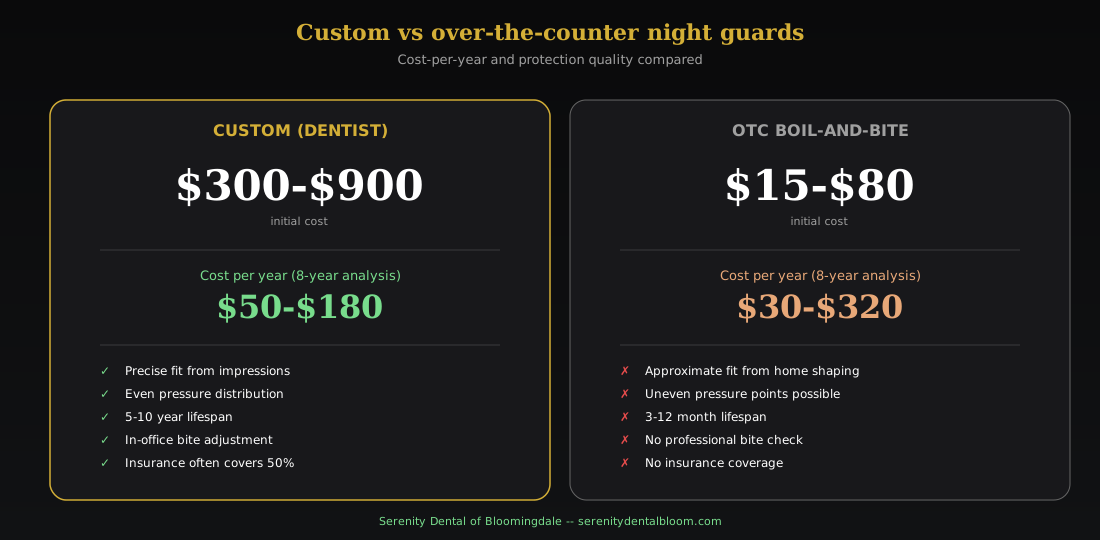
Patients choosing between a custom dental night guard ($300 to $800) and an over-the-counter alternative ($15 to $50) face a price gap that is often 10x or more — a comparison that initially seems straightforward but reveals significant trade-offs. Custom guards last 5 to 10 years versus 3 to 12 months for OTC, fit precisely versus approximately, distribute pressure evenly versus unevenly, and protect dental work effectively versus questionably. Yet OTC guards have legitimate use cases: short-term protection, trial periods, and very mild grinding without dental work to protect. American Dental Association (ADA) clinical guidance recommends custom guards for documented bruxism, while OTC guards remain useful for specific situations. The keyword “dentist night guard vs over the counter” generates regular search demand from patients trying to make this exact comparison. This guide provides the honest, evidence-based breakdown of when each option fits, real cost-per-year math, fit and protection differences, and the specific scenarios where OTC genuinely makes sense.

Written by Dr. Husna Khan, DDS
Serenity Dental of Bloomingdale · April 26, 2026
Schedule a comparison consultation at (630) 359-0105 — written estimates and honest discussion of all options.
For broader context, see night guards service page, what is a night guard, types of night guards, and night guard cost and insurance.
Side-by-side comparison
| Factor | Custom (dentist) | OTC boil-and-bite | OTC stock |
|---|---|---|---|
| Cost | $300-$800 | $20-$50 | $15-$30 |
| Fit | Precise, custom-molded | Approximate, home-fitted | Generic |
| Lifespan | 3-10 years | 3-12 months | 3-6 months |
| Cost per year | $30-$100 net of insurance | $40-$100 | $30-$60 |
| Material | Soft, hard acrylic, dual-laminate, NTI | Soft thermoplastic | Soft thermoplastic |
| Adjustment | In-office bite check | None | None |
| Protection level | High | Variable | Lower |
| Bite balance risk | Minimal | Possible | Likely |
| Comfort | High after adjustment | Variable | Low |
| Insurance covered | Yes (50% typical) | No | No |
In our Bloomingdale office, night guard consultations usually start with a patient comparing drugstore options against a custom fit. We see guard wear patterns at recall visits, and deep chew-through spots are the cue to discuss a harder material rather than a softer one.
For the four custom guard types in detail, see types of night guards.
What custom guards do better
Six measurable advantages of custom guards over OTC.
1. Precision fit
Custom guards are fabricated from impressions or digital scans of your specific teeth. The tooth-side surface conforms exactly to each tooth’s contour. This precision means:
- No tooth movement under pressure
- No gaps allowing food or saliva accumulation
- Even retention without rocking or shifting during sleep
- No painful pressure points on specific teeth
OTC guards are mass-produced or roughly home-fitted. Even after boil-and-bite shaping, fit is approximate.
2. Even pressure distribution
When upper and lower teeth contact during clenching, force should distribute evenly across the bite surface. Per ADA clinical research, custom hard acrylic guards distribute force across approximately 14 contact points evenly. OTC guards typically have 3-7 high-pressure contact points with significant unprotected zones between.
This matters because:
- Concentrated force damages specific teeth or restorations
- Uneven contact can shift teeth over months of use
- Localized pressure causes muscle imbalance and TMJ symptoms
3. Durability under bite force
Custom hard acrylic guards withstand 200-300 PSI grinding force for 5-10 years on average. OTC soft guards deform under similar forces, distorting in shape and developing weak spots.
4. Comfort drives compliance
A guard works only if worn nightly. Comfort determines compliance. Custom guards are typically tolerated for nightly wear from week 1; OTC guards see compliance drop significantly within 2-4 weeks as discomfort accumulates.
5. Protection of dental work
Patients with crowns ($1,000 to $3,500 each), veneers ($900 to $2,500 each), or implants ($3,500 to $6,000 each) have significant investment to protect. Custom guards offer reliable protection. OTC guards may allow concentrated force on specific restorations, accelerating cracks and failure.
6. Bite stability over time
Custom guards maintain natural tooth alignment. Some OTC guards, particularly those with uneven contact patterns, can gradually shift teeth — documented cases show measurable tooth movement within 6-12 months of consistent OTC use.
When OTC genuinely makes sense
Despite the limitations, OTC night guards have legitimate use cases.
Short-term financial bridge
A patient diagnosed with bruxism but unable to afford a custom guard immediately may benefit from an OTC guard for 3-6 months while saving for custom. Some protection is better than none during this interim period.
Trial period
Patients uncertain whether they will tolerate nightly wear can use a $20 to $50 boil-and-bite guard for 2-4 weeks. If they consistently wear it and find benefit, the investment in a custom guard becomes more justified. If they cannot tolerate the appliance at all, the lower trial cost limits financial loss.
Very mild grinding
A patient with documented mild bruxism and no significant tooth wear or dental work may achieve adequate protection from a quality boil-and-bite guard. The protection threshold for mild cases is lower than for heavy grinders.
Travel backup
Many patients keep a backup OTC guard for travel in case the primary custom guard is lost or damaged. A $20 to $30 backup is reasonable insurance against being unprotected for a week.
Sports protection (different category)
Sports mouthguards are technically a subcategory of OTC guards. For sports use, the bulkier OTC sports guard can be acceptable, though custom sports guards offer better fit and protection.
For sports-specific guards, see mouth guards for sports and braces.
When OTC is a bad choice
Specific situations make OTC particularly inadvisable.
Existing crowns or veneers
A patient with $10,000 or more invested in dental work should not protect that investment with a $25 OTC guard. The risk-reward math favors custom.
Diagnosed TMJ disorder
TMJ disorders benefit from precise bite repositioning that custom guards (particularly NTI-style or specialty splints) provide. OTC guards may worsen TMJ symptoms by introducing bite imbalances.
Heavy grinding
Heavy grinders generate forces exceeding OTC material durability. Soft OTC guards deform and develop weak spots within 1-3 months under heavy grinding loads.
Persistent grinding
Patients planning long-term nightly wear (years to decades) save money long-term with custom guards. OTC requires repeated replacement.
Bite imbalance or sensitivity issues
Custom guards address specific bite issues identified during exam. OTC guards cannot adjust to these issues.
Real cost-per-year math
Patients sometimes calculate cost differently when they understand the true economics.
Scenario A: Hard acrylic custom over 8 years
- Initial cost: $500
- Replacements over 8 years: 0
- Total cost: $500
- Cost per year: about $60
- Insurance reimbursement: -$250 (assuming 50% PPO coverage with deductible)
- Net out-of-pocket per year: about $30
Scenario B: Boil-and-bite OTC over 8 years (replaced every 6 months)
- Initial cost per guard: $30
- Replacements over 8 years: 16
- Total cost: $480
- Cost per year: $60
- Insurance reimbursement: none
- Net out-of-pocket per year: $60
Scenario C: Mail-order custom over 8 years
- Initial cost per guard: $150
- Replacements over 8 years: 4-8 (average 6)
- Total cost: $900
- Cost per year: about $110
- Insurance reimbursement: none (most mail-order sellers do not bill insurance)
- Net out-of-pocket per year: about $110
The custom dental office guard, despite higher initial cost, provides the lowest per-year cost when insurance coverage is factored. The protection quality difference is significant — custom protection is consistently better across the entire 8-year period.
Mail-order custom guards: the middle option
Mail-order custom guards from companies like JS Dental Lab, Pro Teeth Guard, Sentinel, and ProDent Mouthguards offer a middle path.
How mail-order works
- Order kit online ($100 to $200, guard included)
- Receive impression material at home
- Take impressions following instructions
- Mail impressions back
- Receive custom-fabricated guard 2-3 weeks later
Mail-order pros
- Lower cost than dental office custom
- Convenient — no office visits
- Materials similar to dental office (acrylic, dual-laminate)
- Decent fit when impressions are taken correctly
Mail-order cons
- No professional examination
- No bite adjustment in person
- Can’t address fit problems easily (mail-back-and-forth)
- No insurance coverage
- No bruxism diagnosis support
- No coordination with TMJ symptoms or dental work
- Quality varies significantly between companies
- Patients with strong gag reflex may struggle with at-home impressions
When mail-order makes sense
Mail-order custom is appropriate for:
- Mild-to-moderate grinding without dental complications
- Patients in areas without easy access to a dentist
- Cost-conscious patients between full OTC and full custom
- Comfort with at-home dental procedures
Mail-order is generally inappropriate for:
- Heavy grinders
- TMJ patients
- Patients with significant dental work
- Patients seeking insurance reimbursement
How to decide
A simple decision framework:
Choose custom from a dentist if:
- You have crowns, veneers, or implants worth protecting
- You have insurance covering 50 percent
- You experience significant grinding or jaw pain
- You have TMJ symptoms
- You plan to wear a guard nightly long-term
- Comfort is important for compliance
- You want professional fit and adjustment
Choose mail-order custom if:
- You have mild-to-moderate grinding
- You don’t have insurance
- You’re comfortable with at-home impression taking
- You don’t have significant dental work
- Cost is a primary factor
Choose OTC if:
- You need short-term protection only
- You’re testing whether you’ll tolerate a guard
- You have very mild grinding without dental work
- You need a travel backup
- Budget is constrained
What patients commonly regret
Patient feedback patterns reveal common regret scenarios.
Most-regretted choice: OTC for long-term use
Patients who buy OTC guards intending long-term use often report:
- Frequent replacement frustration
- Discomfort leading to inconsistent wear
- Continued tooth wear despite the guard
- Eventual switch to custom after wasted money
Average patient who switches to custom after OTC trial reports wishing they’d started with custom.
Less-regretted choice: Custom for documented bruxism
Patients with diagnosed bruxism who chose custom guards typically report high satisfaction and rare regret. Per ADA satisfaction surveys, custom guard satisfaction approaches 90 percent vs 50 percent for OTC.
Mail-order: mixed feedback
Mail-order satisfaction varies significantly. Patients with mild grinding and good impression-taking technique often find mail-order adequate. Patients with complex bites, TMJ, or significant dental work more frequently report problems.
Why Serenity Dental patients choose us for custom night guards
Serenity Dental of Bloomingdale provides:
- Honest comparison consultation — we discuss OTC and mail-order options openly
- No high-pressure sales — patients leave with information, not pressure
- All four custom types — soft, hard acrylic, dual-laminate, NTI
- Insurance verification before treatment to clarify out-of-pocket cost
- Written cost estimates with insurance breakdown
- Phased planning for patients who need time to budget for custom
- Mail-order discussion for patients exploring lower-cost custom options
- Honest assessment of when OTC suffices vs when custom is necessary
Schedule a night guard consultation at (630) 359-0105. Dr. Husna Khan reviews all options honestly and helps patients evaluate trade-offs based on their specific situation.
Related: night guards service page · what is a night guard.

A note on this article
This comparison is general information for patients weighing guard options. It does not replace an in-person exam. Whether a custom guard, a mail-order guard, or an OTC guard fits your situation depends on your bite, the severity of your grinding, and the dental work you are protecting.
Choosing between the three tiers gets easier when you decide what the guard is protecting, because a patient guarding a mouth full of intact natural enamel is making a different bet than a patient guarding four crowns and a pair of veneers that together represent several thousand dollars of restorative work. Protection follows investment. Fit quality also compounds over time in a way the price tags hide, since a precisely molded guard that distributes force evenly gets worn every night without complaint while an uncomfortable drugstore tray migrates to the nightstand drawer within a month and protects nothing from there. Comfort drives compliance.
When to call rather than wait
Most guard questions can wait for a regular visit. Three cannot.
Call the same day if a guard cracks and leaves a sharp edge, because a sharp acrylic edge can cut the tongue or cheek overnight while you sleep. Remove the guard until it is repaired.
Call promptly for new jaw pain, morning headaches, or tooth soreness that appears after you start wearing any guard. A guard that changes your bite is doing harm, not preventing it, and knowing when to call matters more than the brand you bought.
Call right away at (630) 359-0105 if a tooth under a guard becomes sensitive to heat. Heat sensitivity points to a pulp problem the guard cannot fix.
Cost figures in this article are Chicago-area reference ranges compiled from regional fee data, not quotes from Serenity Dental of Bloomingdale. Every dental insurance carrier negotiates its own fee schedule, and Medicaid and Medicare Advantage plans set separate schedules of their own, so the amount a plan allows can sit above or below these ranges. Your actual fee depends on exam findings, materials, and benefits, and we provide a written, itemized estimate before any treatment begins.
FAQs
What is the difference between a custom night guard and an over-the-counter night guard?
Are custom night guards better than over-the-counter?
How much do over-the-counter night guards cost?
Do over-the-counter night guards actually work?
Can over-the-counter night guards damage teeth?
What is a mail-order custom night guard?
How long does a boil-and-bite night guard last?
When does it make sense to use OTC night guards?
Educational content only. Recommendations are personalized after an exam and any needed imaging.
About this article
Reviewed by Dr. Husna Khan, DDS, of Serenity Dental of Bloomingdale. Comparison guidance here aligns with American Dental Association (ADA) clinical practice recommendations on occlusal appliance therapy, including evidence-based selection between custom and over-the-counter options based on bruxism severity, dental work present, and long-term wear commitment.
Educational content. Individual treatment recommendations depend on clinical evaluation. Cited sources: American Dental Association (ADA) clinical practice guidance on occlusal appliance therapy and CDT codes D9944-D9946, NIH National Institute of Dental and Craniofacial Research data on bruxism and tooth wear progression, FDA labeling guidance for over-the-counter and prescription dental appliances, Centers for Disease Control and Prevention (CDC) data on adult dental care utilization, AAOMS clinical guidelines on temporomandibular disorders.
Related: night guards service page.
Need help with this in real life?
Reading helps. Talking to someone who can look at your actual teeth and symptoms helps more. If you want a clear next step, we’re here.
Related articles
Night guard cost and insurance: 2026 pricing guide
Custom night guards run $300 to $800 in the Chicago area. What PPO plans pay under CDT D9944, soft vs hard vs NTI pricing, OTC and mail-order compared.
Read article →What is a night guard? Complete guide for patients
A night guard is a custom dental appliance protecting teeth from grinding and clenching. What it does, types, cost, fit, and care explained.
Read article →