Teeth Whitening
How to remove teeth stains: yellow, brown, and surface stain guide
How to remove teeth stains safely. Surface stains respond to brushing and cleaning. Yellow and brown stains in dentin need peroxide whitening.
Cost figures in this article are typical ranges for the Chicago area, compiled from regional fee data. They are not quotes from Serenity Dental of Bloomingdale; your fee depends on exam findings, materials, and insurance benefits, and we provide a written, itemized estimate before any treatment begins.
Removing teeth stains starts with identifying whether the stain is on the surface of the enamel (extrinsic) or inside the tooth in the dentin layer (intrinsic). Surface stains respond to brushing, professional cleaning, and whitening toothpaste. Internal stains require peroxide-based whitening — dentist-prescribed custom trays, in-office Zoom or Opalescence Boost, or over-the-counter strips. Yellow staining is the most common pattern and responds well to peroxide. Brown and gray staining have multiple possible causes (decay, tetracycline antibiotics, fluorosis) that need different treatments. This guide breaks down stain types, causes, and the right tool for each.

Written by Dr. Husna Khan, DDS
Serenity Dental of Bloomingdale · April 28, 2026
Call (630) 359-0105 to schedule a consultation and identify what is causing your stain pattern.
For an overview of all whitening methods, see what is teeth whitening. For pricing across methods, see teeth whitening cost. For result expectations, see teeth whitening results and longevity.
Surface stain vs internal stain (the foundational distinction)
The most important question for any patient with stained teeth is whether the staining is on the surface of the enamel (extrinsic) or inside the tooth structure (intrinsic). The treatments differ completely.
Extrinsic (surface) stains
Surface stains sit on the outside of the enamel and on the gum-line areas where biofilm accumulates. Common causes:
- Coffee, tea, red wine — chromogens bind to the enamel surface
- Tobacco — nicotine and tar produce yellow-brown surface deposits
- Curry, soy sauce, berries — pigmented food compounds
- Chlorhexidine mouthwash — prescription rinse can produce brown surface staining
- Iron supplements — can produce dark surface deposits
- Tetracycline mouthwash (rare in U.S. now) — yellow surface staining
Surface stains respond to mechanical and mild chemical removal: a professional cleaning, twice-daily brushing, electric toothbrush use, and ADA Seal of Acceptance whitening toothpastes.
Intrinsic (internal) stains
Internal stains are inside the dentin layer beneath the enamel. They cannot be reached by brushing because the brush cannot penetrate enamel. Common causes:
- Aging — enamel thins over time, revealing more yellow dentin
- Tetracycline antibiotics taken before age 8 (or in utero) — gray or yellow bands inside dentin
- Fluorosis from excess fluoride during enamel development — white spots, brown patches
- Trauma to a tooth — internal bleeding into dentin produces gray or pink staining
- Root canal treatment — the treated tooth often darkens over years
- Genetic enamel defects (amelogenesis imperfecta, dentinogenesis imperfecta) — discoloration from birth
- Long-term coffee or tea drinkers — chromogens slowly migrate through enamel into dentin
Internal stains respond to peroxide-based whitening that diffuses into the dentin and oxidizes the colored compounds.
Yellow stains: causes and treatment
Yellow staining is the most common pattern and the most peroxide-responsive. The yellow tones come from chromogens trapped inside enamel and dentin from years of coffee, tea, red wine, tobacco, or natural aging.
Treatment hierarchy
- Professional cleaning ($100-$200, often covered by insurance) removes surface yellow stain
- Whitening toothpaste daily produces 1 to 2 shade improvement over 4 to 8 weeks
- Custom take-home trays (10 to 16 percent carbamide peroxide) produce 4 to 8 shade improvement over 1 to 2 weeks
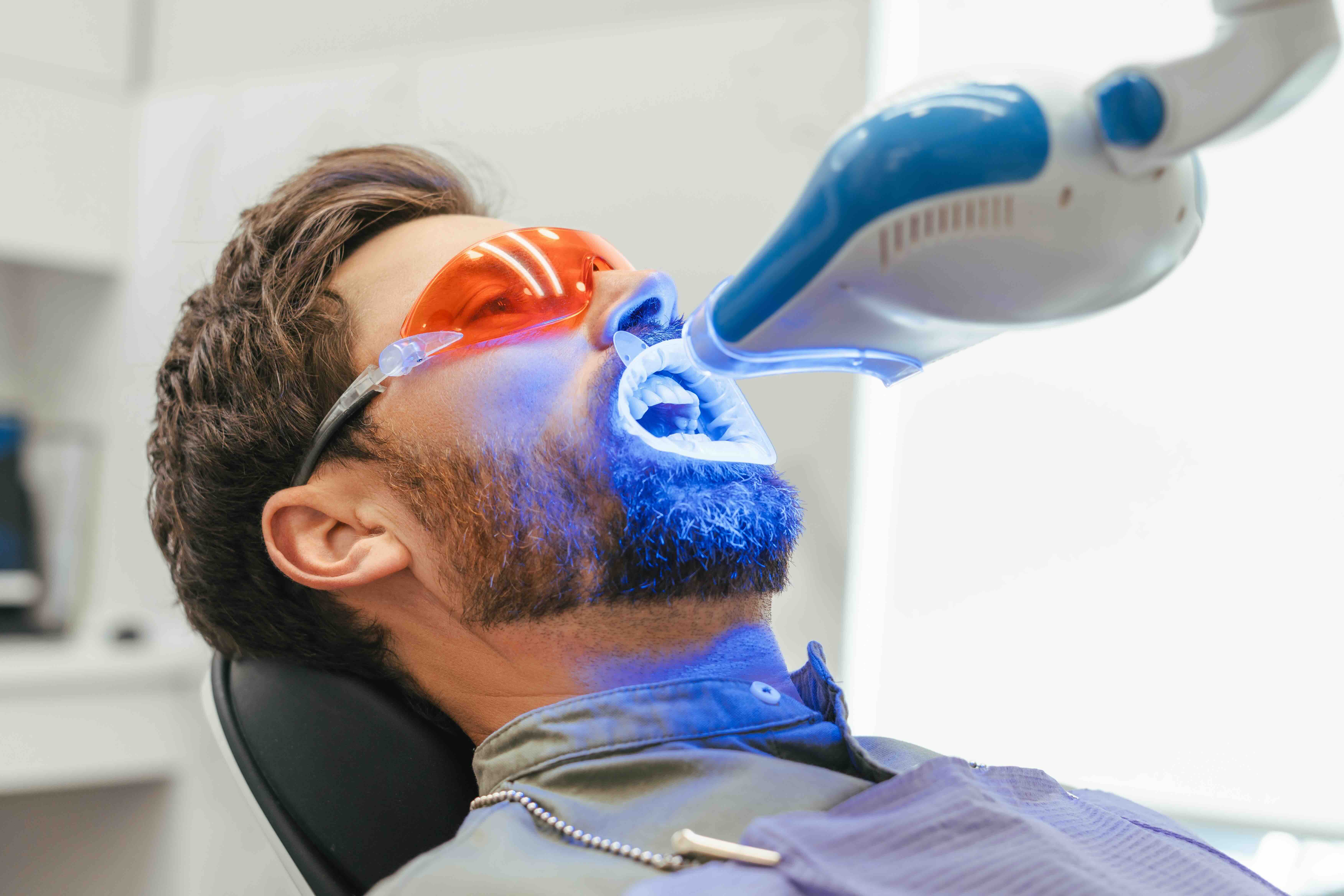
- In-office Zoom or Opalescence Boost produces 4 to 8 shades in a single 60 to 90 minute visit
- Combined in-office plus take-home plans produce 6 to 10 shades total
What to expect
Yellow staining responds well at every step. Most patients see meaningful improvement after a professional cleaning alone. Adding peroxide whitening typically takes the shade another 4 to 6 levels brighter. Yellow stains rarely require the more aggressive treatments reserved for gray or brown staining.
For result expectations, see teeth whitening results and longevity.
Brown stains: causes and treatment
Brown staining has several possible causes that determine treatment.
Surface brown stain (coffee, tea, tobacco)
Daily coffee or tea drinkers, especially heavy smokers, accumulate brown surface deposits along the gum line and between teeth. These respond to professional cleaning with an ultrasonic scaler and stain-removing polish. Brushing alone is rarely sufficient because the deposits sit in areas the brush cannot reach.
Brown spots from early decay
Brown spots that match a specific tooth surface (often a chewing surface or between two teeth) usually indicate early-stage decay. The brown color is from the bacterial process producing demineralization. Treatment is a filling, sealant, or in some cases resin infiltration with the Icon technique. Whitening will not remove decay-related brown spots and may worsen them by exposing dentin to peroxide.
Brown bands from tetracycline
Patients who took tetracycline antibiotics before age 8 (or whose mothers took them in pregnancy) often have permanent brown or gray bands across the front teeth. Standard whitening produces minimal change. KoR Deep Bleaching shows the best track record on tetracycline staining at varies across multiple visits. Severe cases may need veneers at $900–$2,500 per tooth for cosmetic improvement.
Brown fluorosis spots
Excess fluoride during enamel development (typically before age 8) produces patchy white-to-brown fluorosis. Treatment depends on severity: microabrasion (mechanical removal of the outer enamel layer), resin infiltration with Icon, or composite restoration. Standard whitening can sometimes blend the surrounding teeth to the fluorosis shade.
Brown stains from chlorhexidine mouthwash
Long-term use of prescription chlorhexidine mouthwash (Peridex) can produce brown surface staining. Stopping the rinse plus a professional cleaning resolves the discoloration within weeks.
Gray stains: causes and treatment
Gray staining is usually internal and often resistant to standard whitening.
Tetracycline gray bands
The same antibiotic exposure that causes brown bands also produces gray bands in some patients. KoR Deep Bleaching is the most effective whitening protocol; veneers are the alternative cosmetic solution.
Single dark gray tooth
A single tooth that has darkened to gray usually indicates internal bleeding from prior trauma or a non-vital pulp from a root canal. Treatment is internal bleaching — the dentist places peroxide inside the tooth through the back — at $250-$500 per tooth. Alternatives are a crown ($900–$2,500) or a veneer.
Sudden gray tooth (urgent)
A previously normal tooth that turns gray within hours or a day is a clinical emergency, not a staining issue. Sudden gray usually indicates internal bleeding from recent trauma or acute pulp necrosis from infection. Patients who notice a tooth darkening rapidly should call the dentist the same day. Whitening cannot address this and delaying evaluation risks losing the tooth. The American Association of Endodontists treats this as urgent triage.
Gray amalgam shadow
Old silver amalgam fillings can produce a gray shadow visible through enamel from the front. The treatment is replacement of the amalgam with a tooth-colored composite or porcelain inlay. Whitening will not address this because the gray is from the metal restoration, not from the tooth itself.
Stains from childhood, antibiotics, or fluoride (intrinsic developmental staining)
Some patients describe their stains as “from birth,” “from antibiotics as a kid,” or “from the water where I grew up.” These are intrinsic developmental stains — discoloration baked into the tooth structure during the years it was forming — and they respond differently to whitening than surface or aging-related stains. The clinical names matter when planning treatment.
Tetracycline staining
Tetracycline antibiotics taken during pregnancy or in childhood up to age 8 bind to forming enamel and dentin, producing distinctive horizontal bands ranging from yellow-brown to gray-blue. The pattern is usually symmetrical across the front teeth. Mild to moderate cases respond to KoR Deep Bleaching (a multi-visit professional protocol) over 6 to 12 weeks. Severe cases typically need veneers or crowns because the discoloration is too deep for whitening to reach.
Dental fluorosis
Excess fluoride exposure during enamel formation (under age 8) causes white flecks, lines, or in severe cases brown patches and pitting. Mild fluorosis often appears as cosmetic white spotting that whitening makes temporarily more visible before evening out. Moderate to severe fluorosis benefits from resin infiltration (Icon by DMG), microabrasion, or veneers rather than peroxide whitening.
Enamel hypoplasia
Illness, malnutrition, or trauma during tooth development can cause incomplete enamel formation, leaving thin patches, pits, or uneven surfaces that look discolored. Whitening will not fix the underlying defect. Composite bonding or veneers are the cosmetic solutions.
Stains “since birth”
Patients who say their teeth were stained from birth usually have one of the four developmental causes above. A clinical exam distinguishes which. The treatment plan and the realistic outcome are very different from a coffee-staining case, and patients deserve an honest conversation about what whitening alone can and cannot achieve. Setting that expectation in advance prevents the frustration of paying for in-office whitening and seeing a result that does not match the marketing photos.
Surface stain removal at home
Daily home strategies for surface stain prevention and removal:
Brushing technique
- Twice daily for 2 minutes minimum
- Soft-bristle brush — hard bristles damage gum tissue without removing stain better
- Electric toothbrush — Oral-B or Sonicare produce more consistent surface-stain removal than manual brushing
- 45-degree angle to the gum line where most stain accumulates
Whitening toothpaste
ADA Seal of Acceptance whitening toothpastes that work well:
- Crest 3D White — silica-based abrasive plus sodium tripolyphosphate
- Colgate Optic White — contains low-dose hydrogen peroxide
- Sensodyne Extra Whitening — includes potassium nitrate for sensitive users
- Arm and Hammer Advance White — baking soda based
- Colgate Total Whitening Gel — gentler abrasive profile
Daily whitening toothpaste use is safe long-term for most adults. Patients with severe sensitivity may prefer Sensodyne True White or alternating with a non-whitening sensitive toothpaste.
Drinking habits
- Use a straw for cold staining beverages (coffee, tea, wine)
- Rinse with water immediately after drinking dark beverages
- Drink water frequently throughout the day — saliva flow naturally cleans enamel
- Limit dark beverages to once per day
Professional cleanings
Professional cleanings every 6 months remove surface stain that brushing cannot reach. Most dental insurance covers cleanings at 100 percent for preventive care. Patients with heavy coffee or tobacco use sometimes benefit from cleanings every 3 to 4 months.
Internal stain removal options
Internal staining requires peroxide whitening. Treatment options ranked by effectiveness:
Custom dentist-prescribed take-home trays ($250-$500)
The strongest long-term value. Custom trays at 10 to 16 percent carbamide peroxide produce 4 to 8 shades of improvement over 1 to 2 weeks. Trays are reusable for years with refill gel ($25-$50 per syringe) for ongoing maintenance.
In-office Zoom WhiteSpeed or Opalescence Boost ($400-$700)
Single 60 to 90 minute visit produces 4 to 8 shades. Best for patients with deadlines or who prefer one-and-done convenience.
Combined in-office plus take-home ($500-$900)
The combined approach reaches 6 to 10 shades total and provides ongoing maintenance trays. Best per-shade value for patients seeking maximum brightness.
Over-the-counter strips ($30-$60)
Crest 3D Whitestrips Professional, Lumineux Whitening Strips, Opalescence Go. Produces 2 to 6 shades over 4 to 6 weeks. Less even coverage on crooked teeth.
KoR Deep Bleaching ($1,000-$1,800)
Multi-visit protocol for severe tetracycline staining or long-standing internal stains that resist standard whitening. The only protocol with documented results on the most resistant cases.
When should you see a dentist about staining?
Schedule a dental exam rather than buying a whitening product if:
- A single tooth is significantly darker than its neighbors (likely trauma or root canal needed)
- Brown spots match a chewing surface (likely decay)
- The discoloration appeared suddenly rather than gradually
- The discoloration is accompanied by pain or sensitivity
- Bands or stripes of color cross multiple teeth (tetracycline pattern)
- White or brown patches suggest fluorosis
- Whitening already tried without significant change
- Crowns or veneers on visible teeth need matching to a future shade
Whitening is the wrong tool for several of these scenarios. A clinical exam at Serenity Dental of Bloomingdale identifies the actual cause and the right treatment.
What doesn’t work for stain removal?
A few popular methods are either ineffective or harmful:
- Activated charcoal toothpaste — abrasivity often exceeds RDA 200 (the American Dental Association safety threshold is 250), wears enamel over months of daily use, and produces no measurable whitening benefit beyond the temporary surface effect of any abrasive paste. The ADA explicitly does not endorse charcoal toothpastes and has not granted any its Seal of Acceptance. Long-term use thins enamel and exposes the yellower dentin underneath — making teeth look more yellow over time, not less.
- Lemon juice or strawberries — the acid erodes enamel; the marginal whitening benefit is not worth the damage
- Hydrogen peroxide swishing — without a tray to hold the gel against teeth, contact time is too short for meaningful whitening
- Apple cider vinegar rinses — acid erosion without whitening benefit
- Turmeric paste — some online claims, no clinical evidence, leaves yellow residue
- Banana peels rubbed on teeth — no clinical evidence; sugar content may worsen surface biofilm
The American Dental Association and Cochrane Oral Health systematic reviews have evaluated several of these home remedies and found insufficient evidence supporting their efficacy.
Why do patients choose Serenity Dental for stain removal?
Serenity Dental of Bloomingdale provides:
- Professional cleanings with stain-removing polish for surface stain
- Stain-pattern diagnosis to identify the underlying cause
- Custom take-home trays at 10 to 22 percent carbamide peroxide
- In-office Zoom WhiteSpeed for fast results
- Combined plans for the strongest end shade
- Restoration coordination for old amalgam or color-mismatched crowns
- Realistic shade goals discussed during the consultation
Schedule a consultation by calling (630) 359-0105. Dr. Husna Khan will identify what is causing your stain pattern and recommend the right treatment.
Related: teeth whitening service page · professional vs at-home.
FAQs
How do you remove teeth stains?
What is the best teeth stain remover?
How do you remove yellow stains from teeth?
How do you remove brown stains from teeth?
Why are my teeth yellow even though I brush?
Can a dentist remove yellow stains?
How can I whiten my teeth naturally at home?
Does whitening toothpaste actually remove stains?
How long does it take to remove teeth stains?
Educational content only. Recommendations are personalized after an exam and any needed imaging.
About this article
Reviewed by Dr. Husna Khan, DDS, of Serenity Dental of Bloomingdale. Stain classification and treatment recommendations follow American Dental Association (ADA) clinical guidelines and Cochrane Oral Health systematic reviews of cosmetic stain removal interventions.
Educational content. Stain pattern interpretation requires clinical evaluation. Cited sources: American Dental Association (ADA) policy on cosmetic whitening, ADA Seal of Acceptance product list including whitening toothpastes, Cochrane Oral Health systematic reviews of carbamide and hydrogen peroxide whitening, U.S. Food and Drug Administration (FDA) regulation of cosmetic peroxide products, Centers for Disease Control and Prevention (CDC) oral health surveillance data on tobacco-related staining.
Related: teeth whitening service page.
Pricing note. Prices shown are approximate Chicago-area 2026 ranges compiled from public cost guides — not a quote or a Serenity Dental fee schedule. Your actual cost depends on your clinical needs, the materials chosen, and your insurance. We provide a written estimate before any treatment begins. Call (630) 359-0105 to confirm pricing for your situation.
Need help with this in real life?
Reading helps. Talking to someone who can look at your actual teeth and symptoms helps more. If you want a clear next step, we’re here.
Related articles
Professional vs at-home teeth whitening: which actually works?
In-office whitening vs custom take-home trays vs OTC strips, side by side: speed, cost, results, sensitivity, and which one suits your situation.
Read article →Teeth whitening for sensitive teeth: how to whiten without pain
Sensitive teeth? You can still whiten. The best options: lower-concentration custom trays, potassium-nitrate pre-treatment, and Sensodyne-style products.
Read article →