Teeth Whitening
Professional vs at-home teeth whitening: which actually works?
In-office whitening vs custom take-home trays vs OTC strips, side by side: speed, cost, results, sensitivity, and which one suits your situation.
Three legitimate ways exist to whiten teeth: in-office professional whitening (the dentist applies high-concentration peroxide gel under direct supervision), custom dentist-prescribed take-home trays (a milder gel used at home in trays molded to your teeth), and over-the-counter strips or kits (the lowest-concentration option from a drugstore). All three use the same peroxide chemistry, but they differ enormously in speed, customization, sensitivity, and price. Professional whitening produces visible change in one 60-to-90-minute visit. Custom trays reach similar shades over 1 to 2 weeks of nightly wear. Over-the-counter strips need 4 to 6 weeks. This guide compares each approach side by side and shows when each one fits — and where to spend money for real results versus where over-the-counter products work just as well at a fraction of the price.

Written by Dr. Husna Khan, DDS
Serenity Dental of Bloomingdale · April 28, 2026
Call (630) 359-0105 to compare professional and at-home options based on your shade goal, sensitivity, and timeline.
For a foundational overview, see what is teeth whitening. For the full whitening service overview, see the teeth whitening service page. For costs, see teeth whitening cost.
Quick comparison at a glance
| Factor | In-office professional | Custom take-home trays | Over-the-counter strips |
|---|---|---|---|
| Peroxide strength | 15 to 40 percent HP | 10 to 22 percent CP | 3 to 10 percent HP |
| Time to result | 1 visit (60 to 90 min) | 1 to 2 weeks at home | 4 to 6 weeks |
| End shade lift | 4 to 8 shades | 4 to 8 shades | 2 to 6 shades |
| Customization | Highest | High (custom trays) | Low (one size fits all) |
| Sensitivity control | Adjustable per visit | Most controllable | Least controllable |
| Cost | $400 to $800 per visit | $300 to $600 initial | $30 to $50 per box |
| Dentist exam included | Yes | Yes | No |
| Best for | Fast results, events | Gradual whitening, touch-ups | Mild staining, tight budget |
In-office professional whitening (chair-side)
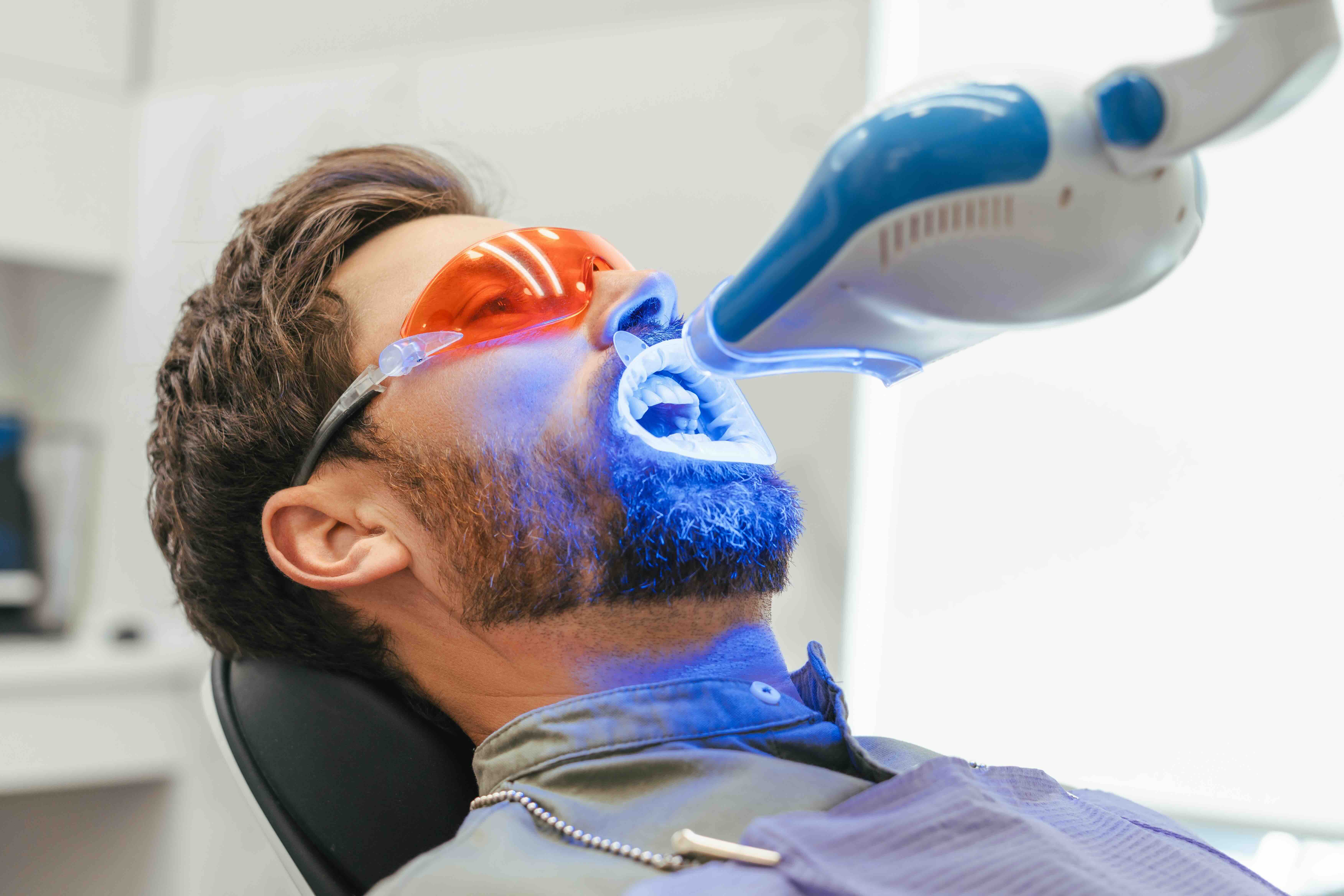
A typical in-office visit at Serenity Dental of Bloomingdale runs about 75 to 90 minutes and uses the Philips Zoom WhiteSpeed system: 25 percent hydrogen peroxide gel activated by a blue LED lamp during three 15-minute cycles. The hygienist or dentist:
- Documents the starting shade with a Vita guide and digital camera
- Polishes the teeth to remove surface stain (so peroxide reaches the actual tooth color)
- Inserts a cheek retractor and paints a flowable resin barrier onto the gum line, then cures it
- Applies a 15 to 40 percent hydrogen peroxide gel to the teeth
- Activates the gel with an LED lamp or chemical accelerator for 15-minute cycles
- Removes the gel between cycles, replaces it with fresh material, and repeats two to three times
- Removes the gum barrier, rinses, and documents the new shade
Other brand examples used in dental offices nationally:
- Philips Zoom WhiteSpeed — 25 percent hydrogen peroxide with LED activation (the system used at Serenity Dental)
- Opalescence Boost — 40 percent hydrogen peroxide, chemically activated, no light required
- KoR Whitening Deep Bleaching — multi-visit protocol for tetracycline staining
- BriteSmile — legacy LED-activated system
Most patients see two to four shades of improvement after a single in-office visit. Patients seeking the brightest end shade typically combine in-office with one to two weeks of follow-up tray use.
When in-office is the right choice
- A specific event is coming up in the next 1 to 2 weeks
- The patient has a low pain tolerance and wants the dentist to manage discomfort directly
- Existing crowns or veneers need to be matched precisely
- The starting shade is dark enough that strips will not bridge the gap
- The patient prefers a one-and-done appointment over weeks of home application
When in-office is not the right choice
- Severe cold sensitivity history (start with milder trays instead)
- Active cavities or untreated gum disease (treat first)
- Pregnancy or nursing (American Dental Association guidance recommends postponing elective bleaching)
- Children under age 14 with developing enamel
- Budget under about $400 (start with custom trays or strips instead)
Custom dentist-prescribed take-home trays
The custom-tray approach is the highest-value option for most patients. The workflow:
- Consultation visit (about 30 minutes) — exam, shade, impressions or digital scan
- Lab fabrication (3 to 7 days) — thin clear trays molded precisely to the patient’s teeth
- Fitting visit (15 minutes) — trays checked for fit, gel and instructions issued
- Home use (1 to 2 weeks) — 30 to 60 minutes per session, daytime or overnight
- Follow-up (optional) — shade check and touch-up plan
The trays themselves last for years and are reusable. Patients typically buy refill gel ($20 to $30 per syringe) once or twice a year for maintenance. This is the lowest long-term cost of any whitening option for someone planning to stay bright over time.
Brand examples for take-home trays:
- Opalescence PF (10, 15, 20, 35 percent carbamide peroxide options)
- KoR At-Home (paired with KoR in-office for severe staining)
- Philips Zoom NiteWhite or DayWhite (carbamide and hydrogen peroxide options)
- NiteWhite Excel ACP (added amorphous calcium phosphate to reduce sensitivity)
When custom trays are the right choice
- The patient wants the gentlest sensitivity profile
- The result needs to be maintained over years
- The starting shade is moderate and a 1-to-2 week timeline is acceptable
- Restorations on visible teeth need precise color matching
- The patient travels often and can whiten on the road
- The patient wants the lowest long-term cost per shade
Over-the-counter products
Pharmacy-aisle whitening covers a wide range of products at a wide range of price points. The honest summary: most of them work, but more slowly, less evenly, and with less safety screening than dentist-supervised options. Common categories:
Whitening strips
Crest 3D Whitestrips, Lumineux Whitening Strips, and similar products are pre-coated plastic strips applied to the front teeth. Hydrogen peroxide concentration ranges from 6 to 10 percent. Used as directed (30 to 60 minutes per day for 14 to 28 days), strips lift teeth by 2 to 6 shades. Most-rated brands deliver visible change.
The two main downsides: strips do not adapt to crooked teeth, so the front faces whiten while the angled or recessed areas do not, and applying them carelessly leaves gel on gum tissue, causing temporary chemical irritation.
Pre-loaded mouthpieces (one-size-fits-all trays)
Opalescence Go, Snow Whitening Wireless, Glo Brilliant, and similar products use a soft pre-filled tray. Performance is generally between strips and custom trays. Coverage is more even than strips but less precise than custom trays.
Whitening pens and serums
Hismile V34, Crest Whitening Emulsions, and brush-on serums apply a thin film of peroxide. The contact time is short and the concentration usually low (less than 5 percent). They produce mild results on light staining.
Whitening toothpastes
Colgate Optic White, Crest 3D White, Sensodyne Pronamel Gentle Whitening, and others use a combination of mild abrasives plus a tiny amount of peroxide or other active. They remove surface stain but cannot bleach the underlying dentin. Useful as maintenance after professional whitening; not a substitute.
When over-the-counter is the right choice
- Starting shade is already light and only minor brightening is wanted
- Budget is the dominant constraint
- The patient has had a recent dental exam confirming no cavities or gum recession
- Sensitivity baseline is normal
- Expectations are realistic about the slower pace and shade ceiling
How does sensitivity differ across methods?
About half of all whitening patients experience some cold sensitivity, regardless of method. The pattern across approaches:
In-office whitening can produce sharp short-term sensitivity within hours of the visit, typically resolving in 24 to 72 hours. Pre-treatment with potassium nitrate toothpaste (Sensodyne) for two weeks beforehand reduces this. Some in-office gels include desensitizing additives.
Custom take-home trays produce the gentlest sensitivity profile because the wear time per session is short and concentration is moderate. Reducing wear time per night is an easy adjustment. Desensitizing gel can be loaded into the trays after whitening to actively reverse sensitivity.
Over-the-counter strips cause uneven sensitivity from gel pooling at the gum line. There is no easy way to adjust strength because the strip is fixed.
For full sensitivity guidance, see teeth whitening for sensitive teeth.
How long do results last across methods?
Result lifespan is similar across all three methods because rebound is driven mostly by lifestyle, not by which method created the result. Average lifespans:
- In-office without follow-up: 6 to 12 months
- In-office plus take-home maintenance: 1 to 3 years
- Custom trays alone with periodic touch-up: 1 to 3 years
- Strips: 4 to 12 months
- Whitening toothpaste alone: maintains rather than creates a result
Lifestyle drivers: heavy coffee, tea, red wine, curry, and tobacco use shorten any result. Drinking through a straw, rinsing after coffee, and using a whitening toothpaste between treatments extend it.
For detail on longevity, see teeth whitening results and longevity.
Cost comparison over five years
Looking at total cost over a longer period changes the picture (typical Chicago-area ranges — your exact estimate is confirmed in writing before treatment):
| Method | Year 1 | Years 2 to 5 (touch-ups) | 5-year total |
|---|---|---|---|
| In-office only (annual) | $400 to $800 | $1,600 to $3,200 | $2,000 to $4,000 |
| Custom trays only | $300 to $600 | $80 to $240 (refill gel) | $380 to $840 |
| In-office plus trays | $700 to $1,200 | $80 to $240 (refill gel) | $780 to $1,440 |
| OTC strips (every 4 months) | $90 to $150 | $360 to $600 | $450 to $750 |
| Whitening toothpaste only | $30 to $75 | $120 to $300 | $150 to $375 (results modest) |
Custom trays plus initial in-office whitening produce the best long-term value for most patients seeking sustained brightness.
For a complete cost breakdown, see teeth whitening cost.
What does Dr. Husna Khan recommend in practice?
Dr. Husna Khan at Serenity Dental of Bloomingdale tailors recommendations to each patient’s clinical picture and lifestyle. The general patterns:
- Patient with an event in 2 weeks: in-office plus 1 week of take-home trays
- Patient with sensitive teeth and time to spare: custom trays alone, 16 percent carbamide peroxide
- Patient on a tight budget with mild yellowing: Crest 3D Whitestrips, with a dental exam first
- Patient with crowns or veneers on front teeth: in-office plus restoration replacement plan
- Patient with tetracycline staining: KoR Deep Bleaching protocol or veneer consultation
- Patient who already has custom trays: refill gel and a 5-day touch-up cycle
The American Dental Association supports both in-office and supervised at-home whitening as effective. Cochrane Oral Health systematic reviews of carbamide peroxide tray whitening have shown statistically significant shade improvement at concentrations from 10 percent up.
How do you choose between methods?
Use these questions to narrow down:
- Is there a deadline? If yes, in-office. If no, custom trays.
- What is the budget? Under $100 = strips. $300 to $600 = custom trays. $400 to $800 = in-office.
- Sensitivity history? Severe = custom trays at low concentration. Normal = any method.
- Restorations on front teeth? Yes = consult dentist before any whitening.
- Long-term plan? Sustained brightness = custom trays. One-time event = in-office.
- Comfort level with home routines? Hands-off preference = in-office. Self-managed = trays or strips.
If still uncertain, schedule a consultation. Dr. Husna Khan can review the actual shade, restoration map, and sensitivity profile before any product is bought or any treatment begins.
Why do patients choose Serenity Dental for whitening?
Serenity Dental of Bloomingdale provides:
- All three options under one roof — in-office, custom take-home, and Seal-of-Acceptance over-the-counter recommendations
- Sensitivity-aware planning to reduce post-treatment cold sensitivity
- Realistic shade goals with documented before and after photos
- Restoration coordination when crowns or veneers will be matched or replaced
- Clear written cost estimates before treatment begins
- Combined plans with the strongest value: in-office initial plus take-home maintenance
Schedule a consultation by calling (630) 359-0105. Dr. Husna Khan will review which method fits your timeline, sensitivity, and budget.
Related: teeth whitening service page.
FAQs
Is professional whitening better than at-home?
What is the best teeth whitening method at the dentist?
How much faster is professional whitening?
Are at-home whitening kits as good as professional?
What is the safest teeth whitening method?
Can I get the same results as a dentist with strips?
How much does each whitening option cost?
Will professional whitening cause more sensitivity than at-home?
Should I do in-office whitening or trays?
What is the best rated teeth whitening for everyday users?
Educational content only. Recommendations are personalized after an exam and any needed imaging.
About this article
Reviewed by Dr. Husna Khan, DDS, of Serenity Dental of Bloomingdale. The standard of care at Serenity Dental aligns with American Dental Association (ADA) guidance recognizing both supervised at-home and in-office peroxide whitening as effective at recommended concentrations.
Educational content. Individual treatment recommendations depend on clinical evaluation. Cited sources: American Dental Association (ADA) statements on professional and at-home whitening, ADA Seal of Acceptance product list, Cochrane Oral Health systematic reviews of carbamide and hydrogen peroxide tray whitening efficacy, U.S. Food and Drug Administration (FDA) classification of peroxide tooth-whitening products.
Related: teeth whitening service page · whitening for sensitive teeth.
Need help with this in real life?
Reading helps. Talking to someone who can look at your actual teeth and symptoms helps more. If you want a clear next step, we’re here.
Related articles
How to remove teeth stains: yellow, brown, and surface stain guide
How to remove teeth stains safely. Surface stains respond to brushing and cleaning. Yellow and brown stains in dentin need peroxide whitening.
Read article →Teeth whitening for sensitive teeth: how to whiten without pain
Sensitive teeth? You can still whiten. The best options: lower-concentration custom trays, potassium-nitrate pre-treatment, and Sensodyne-style products.
Read article →