
Cosmetic Dentistry
What Is Enameloplasty? A Plain-English Guide to Enamel Reshaping
Enameloplasty is the dental term for tooth reshaping. What it involves, what it costs, when it's the right choice, and how to find it in Bloomingdale, IL.
The short version
Enameloplasty is the clinical term for enamel reshaping — a fast, painless cosmetic procedure that removes a fraction of a millimeter of enamel to refine tooth shape. It goes by several names: odontoplasty (the older clinical term), tooth contouring, teeth sculpting, or just “tooth filing” in casual conversation. All describe the same procedure, billed under American Dental Association code D9971.
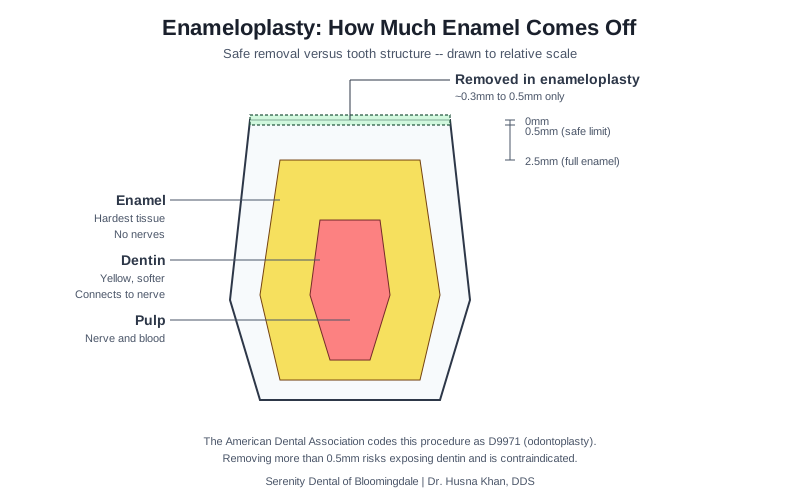
What does enameloplasty actually do?
The procedure addresses small cosmetic concerns that can be fixed by removing — not adding — tooth material. Pointed canines that catch the lip. A jagged incisal edge from a small chip. One front tooth that sits a millimeter longer than its neighbor. A bumpy surface that catches the tongue. None of these need a crown, a veneer, or even bonding. They need a dentist with a fine diamond bur, a polishing disc, and a careful hand.
The procedure is purely subtractive. Whatever enamel comes off, stays off. That constraint is also enameloplasty’s greatest strength: there is nothing to debond, nothing to chip, nothing that needs maintenance over time.
Why does it have so many names?
Enameloplasty, odontoplasty, enamel reshaping, enamel contouring, tooth contouring, teeth sculpting, tooth filing — seven terms, one procedure. Each came from a different setting.
Odontoplasty is the Greek-rooted clinical term used in dental school textbooks and on insurance claims. Odonto means tooth; plasty means reshaping. It is the official American Dental Association procedure name (CDT code D9971), and the phrase “odontoplasty dental” surfaces frequently in insurance documentation and dental coding references.
Enameloplasty narrowed the term to specify the layer being touched. It became the preferred clinical term in cosmetic dentistry because it makes clear the procedure stops at enamel and never reaches dentin. Many patients researching the topic search for “enameloplasty procedure” expecting a separate technique, but that phrase simply describes the same enamel reshaping work documented above.
Tooth contouring, teeth sculpting, and enamel contouring are consumer-facing terms used by cosmetic practices because they sound less clinical. Enamel reshaping sits in the middle, used by dentists when explaining the procedure to patients.
Tooth filing is the most casual term, and the one most associated with dangerous DIY trends — so dentists tend to avoid it in clinical settings even though it describes the same action.
Who is a candidate for enameloplasty?
Three conditions matter. First, the cosmetic concern must be solvable by removing material rather than adding. Long teeth, pointed canines, jagged edges, and small surface bumps qualify. Gaps, missing corners, and worn-down teeth do not.
Second, enamel must be thick enough at the targeted area. Adult enamel ranges from about 2.5mm at a molar cusp tip down to 1mm on the side surface of an incisor. A dentist measures thickness with a probe or transilluminates the tooth with a bright light to estimate it. Areas with less than 1mm of enamel above dentin are usually contraindicated for reshaping.
Third, the bite must be evaluated. Front teeth that look long because of how they sit in the bite (rather than how long they actually are) should not be reshaped without addressing the underlying alignment first. Filing them flat masks the misalignment but does not fix it — and may worsen wear patterns over time.
In our Bloomingdale practice, Dr. Husna Khan typically does a 20-minute consultation visit before any enameloplasty appointment. We take intraoral photos, evaluate the bite, and either confirm the patient is a candidate or recommend a different path (bonding, veneers, or orthodontics first).
What does the procedure feel like?
No anesthesia. No drilling. No noise beyond the soft whir of a polishing disc. Patients often describe the sensation as similar to a routine dental cleaning — a slight vibration on the tooth surface, occasional cool water spray, and that’s it. Enamel has no nerves, so removing it generates no pain signal.
The full visit usually runs 30 to 60 minutes for one to four teeth. Patients eat normally afterward. There is no recovery period and no aftercare beyond regular brushing.
What does the procedure look like, step by step?
A complete enameloplasty appointment in our office follows a consistent sequence.
Photos and measurement. Intraoral photos document the starting shape, captured from multiple angles including straight on, retracted lateral views from each side, and a close-up of each specific tooth being considered for reshaping, so the chart has a complete visual record before any irreversible change occurs. A measurement of enamel thickness in the targeted zone confirms there is room to work safely. Quick check.
Markup. Dr. Husna Khan marks the planned reduction zones on the tooth surface with a fine pencil, then shows the patient in a hand mirror. Adjustments to the plan happen here, before any enamel comes off.
Reduction. A fine-grit diamond bur (yellow band) in a high-speed handpiece, with continuous water cooling that prevents any temperature rise in the underlying pulp tissue and washes away enamel debris as it forms, removes enamel in micron-thin passes that build the new contour gradually rather than in one decisive cut. The dentist works under magnification (usually 2.5x or 4.5x loupes) so the bur tip stays exactly where intended. Pass by pass.
Polishing sequence. A series of progressively finer abrasive discs — medium, fine, superfine — restore the smooth glossy enamel surface. A final pass with diamond polishing paste leaves the contoured area indistinguishable from untouched enamel.
Recheck. The patient sees the result in a mirror, runs their tongue over the surface, and confirms it feels right. Photos document the new shape for the chart.
How much does enameloplasty cost?
Enameloplasty fees in the United States typically range from $50-$300 per tooth, with most cases for one to four teeth landing in the $50-$300 per tooth range. Cost $50-$300 with the number of teeth, complexity of the reshaping, and whether finishing strips are needed for interproximal (between-tooth) contouring.
Insurance coverage is limited. Most dental plans treat enameloplasty as cosmetic and do not reimburse. Exceptions exist when the procedure is medically necessary — for example, smoothing a sharp fractured edge that is cutting the tongue. In those cases, a code D9971 claim with photos and a clinical narrative can sometimes be reimbursed.
We provide a written estimate before any enameloplasty appointment in our Bloomingdale office, including the per-tooth fee and any consultation or photography charges. Patients always know the total cost before treatment begins.
What should you expect immediately after?
Enameloplasty has no recovery period. Most patients leave the office and resume normal eating, drinking, and oral hygiene the same day. A few transient experiences are common in the first 24 to 48 hours.
The reshaped tooth may feel slightly different to the tongue for a day or two as you adjust to the new contour. Cold sensitivity is rare but possible if the reduction approached the limits of safe enamel removal — it usually fades within a week. We typically see patients back at one week to confirm everything feels right.
When is enameloplasty not the answer?
Several common cosmetic concerns look reshapeable but actually need a different procedure.
Worn-down teeth from grinding. Filing already-worn teeth flatter accelerates the wear pattern and can lead to bite collapse over time. The right answer is usually a nightguard plus bonding or crowns to rebuild the lost length.
Gaps between teeth. Removing enamel cannot close gaps. Either bonding (to widen the adjacent teeth) or orthodontics (to move them together) is needed.
Severely chipped corners. A chip larger than about 1mm in any direction needs added material to look natural. Composite bonding rebuilds the missing corner; a veneer covers the entire front face.
Crowded or rotated teeth. Reshaping a crowded tooth flat does not move it. Invisalign or braces are required to reposition the tooth, often followed by minor enameloplasty to refine the final result.
Finding enameloplasty near you
Search engine queries like “enameloplasty near me” or “dentist reshaping teeth” return general and cosmetic dentists in your area. Most general dentists are trained in enameloplasty during dental school and offer it as part of routine cosmetic services. When evaluating a provider, three questions help.
Does the office take before-and-after photos as part of the standard visit? This is a sign of conservative practice — without baseline photos, there is no objective way to confirm the right amount was removed.
Does the dentist offer a consultation visit separate from the procedure visit? Same-day reshaping leaves no time for the patient to think it over and is not best practice for an irreversible cosmetic change.
Does the office discuss alternatives (bonding, veneers, orthodontics) when relevant? An office that recommends enameloplasty for every cosmetic concern is not evaluating each case individually.
In Bloomingdale, IL, Dr. Husna Khan at Serenity Dental of Bloomingdale follows all three of these practices. To learn more about the procedure or schedule a consultation, visit our tooth contouring page or call the office.
Sources cited
- American Dental Association, Code on Dental Procedures and Nomenclature (CDT) — D9971 odontoplasty
- American Academy of Cosmetic Dentistry (AACD), clinical guidelines on enamel reshaping
- Journal of the American Dental Association (JADA), articles on conservative cosmetic dentistry
- Cochrane Oral Health Group, reviews on enamel preservation
- American Dental Association, MouthHealthy patient education on cosmetic procedures
Medical disclaimer: This article is educational and does not substitute for an in-person dental exam. Individual results from enameloplasty vary based on enamel thickness, tooth position, and bite relationship. Enamel removal is permanent; please consult a dentist before making any decisions about reshaping your teeth. To discuss your specific situation with Dr. Husna Khan, please schedule a consultation at our Bloomingdale office.
Cost figures in this article are typical ranges for the Chicago area, compiled from regional fee data. They are not quotes from Serenity Dental of Bloomingdale; your fee depends on exam findings, materials, and insurance benefits, and we provide a written, itemized estimate before any treatment begins.
FAQs
What is enameloplasty?
What is odontoplasty?
How do I find enameloplasty near me in Bloomingdale, IL?
How much does enameloplasty cost?
Is enameloplasty permanent?
Does enameloplasty weaken the tooth?
Can enameloplasty fix all cosmetic issues?
How is enameloplasty different from teeth sculpting?
Educational content only. Recommendations are personalized after an exam and any needed imaging.
Need help with this in real life?
Reading helps. Talking to someone who can look at your actual teeth and symptoms helps more. If you want a clear next step, we’re here.
Related articles
Does Insurance Cover Dental Veneers? Coverage and Payment Options
Plain answers about veneer insurance coverage, what counts as cosmetic, and what payment plans actually work for patients in Bloomingdale, IL.
Read article →How Long Do Dental Veneers Last? Lifespan, Wear, and Replacement
Real numbers on how long porcelain and composite veneers last, what wears them down, and how to make them last longer, from a Bloomingdale, IL dentist.
Read article →Porcelain vs Composite Veneers: An Honest Comparison
Porcelain or composite veneers? A Bloomingdale, IL dentist breaks down cost, lifespan, appearance, and which option fits which kind of patient.
Read article →