Dentures
Implant-supported dentures: snap-in and overdenture guide
Implant-supported dentures snap onto 2-6 implants for stability. Compare snap-in, bar-retained, and fixed options, plus the procedure and recovery.
Implant-supported dentures combine the affordability of dentures with the stability of implants by anchoring the denture to 2 to 6 dental implants surgically placed in the jawbone. Patients eat foods they cannot manage with conventional dentures, eliminate adhesive, and report chewing efficiency at 70 to 85 percent of natural teeth versus 20 to 30 percent for conventional dentures per American College of Prosthodontists (ACP) clinical research. Costs range widely (typical Chicago-area ranges; your exact estimate is confirmed in writing before treatment): $6,000 to $12,000 for a basic 2-implant lower snap-in denture, $10,000 to $20,000 for a 4-implant upper or lower snap-in, and $20,000 to $35,000 per arch for a fixed (non-removable) full-arch denture. The 2-implant lower snap-in denture has been formally established by ACP as the standard of care for full lower dentures whenever clinically feasible. This guide covers all configurations, costs, the surgical process, and how to decide between snap-in and fixed designs.

Written by Dr. Husna Khan, DDS
Serenity Dental of Bloomingdale · April 29, 2026
Educational purposes only. Individual outcomes vary by case-specific factors. Schedule an implant denture consultation at (630) 359-0105 for written cost estimates and 3D imaging review.
For broader context, see the dentures service page, dental implants service page, and dentures vs implants decision guide.
In our Bloomingdale practice the patients who ask about implant-supported dentures are usually not denture beginners; they are experienced denture wearers who have run out of patience with adhesive.
Why do implant-supported dentures exist?
Conventional dentures rest on gum tissue and rely on suction (upper) or gravity (lower) for retention. Two problems result:
- Lower dentures are notoriously unstable, the lower jaw has less surface area for suction, the tongue actively dislodges the denture, and chewing forces are concentrated on a small footprint
- Bone loss accelerates, without tooth roots stimulating the jawbone, the alveolar ridge resorbs over time, making dentures fit progressively worse
Implant-supported dentures solve both problems. 2 to 6 small titanium implants placed in the jawbone provide stable anchor points that the denture locks onto. Underneath, the implants stimulate the bone, dramatically slowing or stopping resorption.
Measurable advantages
| Metric | Conventional denture | Implant-supported denture |
|---|---|---|
| Chewing efficiency | 20-30% of natural teeth | 70-85% of natural teeth |
| Patient satisfaction | 50-60% | 90+% |
| Bite force tolerance | 25-50 lbs | 200+ lbs |
| Daily adhesive needed | Yes | No |
| Bone preservation | Poor (3-5% volume loss/year) | Good (minimal loss with adequate implants) |
| Slipping during speech | Common | Rare |
| Cost (per arch) | $1,000 to $3,000 | $6,000 to $35,000 |
Three main configurations
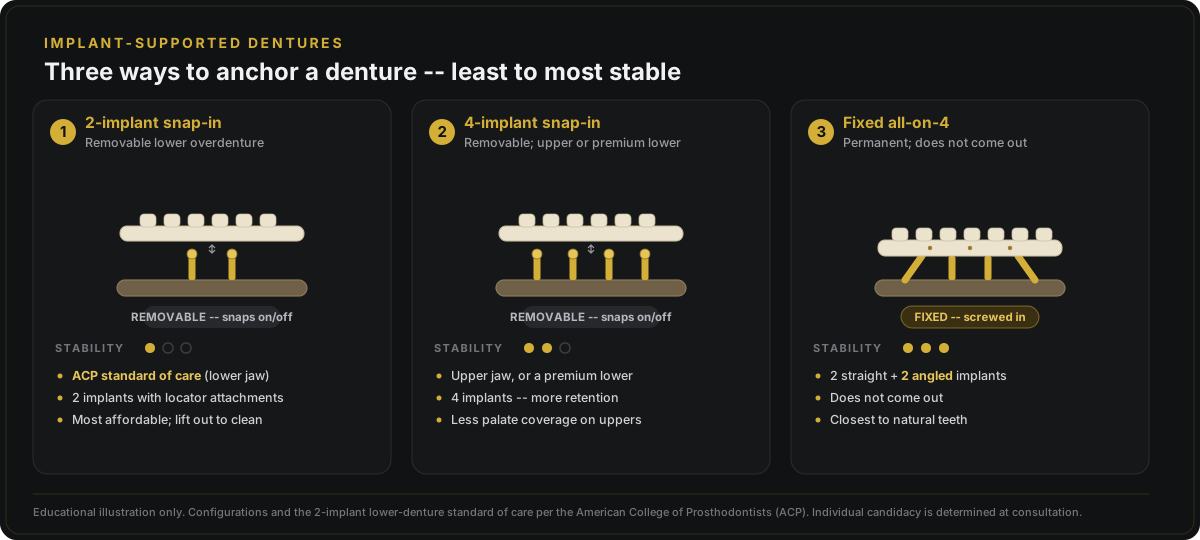
1. Snap-in removable overdenture on 2 implants
Most affordable implant denture. Two implants placed in the lower jaw provide retention through ball or locator attachments. It snaps on and off.
| Specification | Detail |
|---|---|
| Cost | $6,000 to $12,000 (lower jaw) |
| Implants required | 2 |
| Retention | Good, night and day improvement vs conventional |
| Daily handling | Patient removes daily for cleaning |
| Best for | Lower jaw (per ACP standard of care), budget-conscious patients |
| Limitations | Upper jaw typically needs 4 implants; 2 are not adequate up top |
This configuration captures the 49,500 monthly searches for “snap in dentures” and 1,600 searches for “implant retained dentures”, both directly addressed in this guide.
2. Snap-in removable overdenture on 4 implants
Upgraded retention. Four implants distributed across the arch provide superior stability vs 2-implant configuration. Patients still remove daily.
| Specification | Detail |
|---|---|
| Cost | $10,000 to $20,000 per arch |
| Implants required | 4 |
| Retention | Excellent |
| Daily handling | Patient removes daily for cleaning |
| Best for | Upper jaw (4 minimum), patients wanting maximum removable retention |
3. Fixed (non-removable) full-arch denture
Often called “all-on-4” style or “hybrid prosthesis.” The denture is screwed onto 4-6 implants and only the dentist removes it at maintenance visits.
| Specification | Detail |
|---|---|
| Cost | $20,000 to $35,000 per arch |
| Implants required | 4-6 |
| Retention | Maximum, feels like natural teeth |
| Daily handling | Brushed and flossed in mouth like natural teeth |
| Best for | Patients wanting closest-to-natural feel, willing to invest |
For fixed full-arch detail, see all-on-4 dental implants cost.
Bar-retained overdenture (specialty configuration)
A bar connects multiple implants and the denture attaches to the bar. More retentive than ball or locator attachments but more expensive.
| Specification | Detail |
|---|---|
| Cost | $13,000 to $23,000 per arch |
| Implants required | 4-6 |
| Retention | Very high |
| Daily handling | Patient removes daily |
| Best for | Patients wanting maximum removable retention without going to fixed |
Attachment types in detail
Between implants and denture, the mechanical interface takes several forms, each with specific advantages.
Locator attachments
Most common modern choice for snap-in dentures. A small metal post (the abutment) screws into each implant, and a nylon retention insert in the denture snaps over it. Inserts come in different retention strengths (typically yellow weakest, pink medium, blue strong, white strongest).
| What | Details |
|---|---|
| Cost | Standard included in most snap-in pricing |
| Replacement | Nylon inserts wear and need replacement every 6-24 months ($50 to $150 per insert) |
| Retention | Adjustable by switching insert color/strength |
| Cleaning | Easy to clean around |
Ball attachments
This is the traditional design preceding locators. A ball-shaped abutment screws into each implant; a metal cap in the denture snaps over the ball.
| What | Details |
|---|---|
| Cost | Lower-end of attachment pricing |
| Replacement | Caps wear less frequently than locator inserts |
| Retention | Less adjustable than locators |
| Profile | Slightly taller than locators |
Magnetic attachments
A small magnet in the denture aligns with a metal keeper on the implant. Less retentive than mechanical attachments but easier insertion for patients with reduced dexterity.
| What | Details |
|---|---|
| Cost | Specialty pricing |
| Best for | Patients with arthritis or limited hand strength |
| Trade-off | Lower retention than locator or bar |
Pros and cons summary
Pros
- Dramatically improved chewing efficiency vs conventional dentures
- No denture adhesive needed
- Bone preservation through implant stimulation
- Higher patient satisfaction scores
- Speech improvement
- Confidence in eating any food
Cons
- Higher upfront cost ($6,000 to $35,000 per arch vs $1,000 to $3,000 conventional)
- Requires surgery (with healing time and potential complications)
- Adequate bone needed (or bone grafting)
- Maintenance: attachment replacement every 6-24 months
- Limited insurance coverage
Configurations compared
| Configuration | Cost (per arch) | Removable? | Best for |
|---|---|---|---|
| 2-implant lower snap-in | $6,000 to $12,000 | Yes | Affordable lower stability |
| 4-implant snap-in | $10,000 to $20,000 | Yes | Upper or premium lower |
| Bar-retained overdenture | $13,000 to $23,000 | Yes | Premium retention, removable |
| Fixed all-on-4 | $20,000 to $35,000 | No (dentist only) | Closest to natural teeth |
| Fixed all-on-6 | $25,000 to $40,000 | No (dentist only) | Maximum durability |
The surgical process
Implant denture treatment progresses through staged appointments at Serenity Dental.
Phase 1: Consultation and planning (1-2 visits)
- Comprehensive exam and medical history review
- 3D cone-beam CT scan of jawbone (necessary for implant planning)
- Discussion of all configuration options
- Written cost estimate
- Bone graft assessment if needed
- For complex cases, Dr. Husna Khan may coordinate with an oral surgeon or periodontist
Phase 2: Implant placement (1 surgical visit, 60-120 min)
- Local anesthesia, with nitrous oxide or oral sedation per patient preference
- Implants placed through small precise incisions
- Sutures closed
- Recovery 2-7 days; soft food only first 1-2 weeks
- Healing implant covers placed (or temporary attachments if same-day loading)
- Cost: $1,800 to $3,000 per implant
Phase 3: Osseointegration healing (3-6 months)
Implants integrate with bone during this phase. Per ACP clinical evidence, lower jaw heals faster (3-4 months typical) than upper jaw (4-6 months) due to bone density differences.
Patients typically wear a temporary denture during this period. Your temporary may rest on tissue or, in select cases, be retrofitted onto healing implants.
Phase 4: Abutment placement and impressions (1-2 visits)
- Implant covers replaced with abutments (the connector pieces between implant and denture)
- Final impressions for the denture
- Bite registration
Phase 5: Denture delivery and adjustments (1-2 visits)
- Final denture delivered and snapped onto implants (or screwed in for fixed)
- Bite verification and adjustments
- Patient education on insertion, removal, cleaning
Phase 6: Maintenance (lifelong)
- Professional cleaning every 6 months
- Attachment replacement every 6-24 months (locator caps wear out)
- Denture relining or replacement every 5-10 years
- Implant durability typically 20-25+ years
Cost detail
What you invest depends on several factors. Ranges below reflect typical Chicago-area pricing; your exact estimate is confirmed in writing after 3D imaging and a clinical exam.
Component cost breakdown
| Component | Cost range |
|---|---|
| 3D CT scan and consultation | $250 to $600 |
| Single implant (placement only) | $1,800 to $3,000 |
| Abutment | $400 to $900 per implant |
| Surgical procedure fee | $500 to $2,000 |
| Bone graft (if needed) | $400 to $1,200 per site |
| Sinus lift (if upper, low sinus) | $1,500 to $4,000 |
| Denture portion (snap-in) | $1,500 to $4,000 |
| Denture portion (fixed all-on-4) | $5,000 to $15,000 |
| Sedation (if used) | $400 to $900 per visit |
Typical 2026 total costs
| Configuration | Total cost (per arch) |
|---|---|
| 2-implant lower snap-in (basic) | $6,000 to $12,000 |
| 4-implant snap-in | $10,000 to $20,000 |
| Bar-retained overdenture | $13,000 to $23,000 |
| Fixed all-on-4 | $20,000 to $35,000 |
| Fixed all-on-6 | $25,000 to $40,000 |
Insurance coverage
PPO insurance coverage varies dramatically:
| What | Details |
|---|---|
| Implants | Some plans cover 50 percent (typically with a $1,000 to $2,500 lifetime maximum); many exclude implants entirely |
| Denture portion | Usually covered at 50 percent like a regular denture |
| Surgical components | May be covered by medical insurance in select cases (rare) |
Pre-authorization is strongly recommended before starting any implant denture treatment. Serenity Dental coordinates insurance verification and provides written estimates including all expected components. For broader cost detail, see dentures cost and insurance.
Daily life with implant-supported dentures
The daily experience differs significantly from conventional dentures.
Snap-in denture daily routine
- Morning: Insert denture by pressing onto implants until snap is felt
- During day: Eat normally including foods conventional denture wearers cannot
- No adhesive needed | What | Details | | --- | --- | | Cleaning | Remove after meals when convenient, brush implants and denture, rinse | | Night | Remove for tissue rest, soak in water or denture cleaner | | Periodic | Replace locator/attachment caps every 6-24 months ($50 to $150 per insert) |
Fixed denture daily routine
- No insertion or removal, denture stays in place 24/7
- Eat normally, closest experience to natural teeth
- Cleaning: Brush like natural teeth; floss using floss threaders or water flosser
- Periodic: Professional removal and cleaning every 6-12 months at office; denture replacement every 10-15+ years
For comprehensive care detail, see denture care and cleaning.
Coordinating with the implant cluster
Dental implant procedures, healing, and pain management are covered in detail in the dental implants section of this site:
- Dental implants service page, service overview
- Dental implant cost, per-implant cost detail
- Do dental implants hurt, pain management protocol
- Types of dental implants, endosteal vs subperiosteal vs zygomatic
- Dental implants for seniors, age-specific considerations
- How long do dental implants last, longevity data
This guide focuses specifically on the denture portion of implant-supported dentures. For implant-specific clinical detail, follow the cross-links above.
Why do Serenity Dental patients choose implant dentures here?
Serenity Dental of Bloomingdale provides:
- All implant denture configurations, snap-in 2-implant, snap-in 4-implant, bar-retained, fixed all-on-4
- 3D CT scanning for precise implant planning
- Coordinated care with periodontists or oral surgeons for complex cases
- Sedation options for surgical visits
- Written cost estimates including all components, healing visits, and follow-up
- Existing denture conversion assessment for budget-conscious patients
- Lifelong maintenance including attachment replacement and denture care
Schedule an implant denture consultation at (630) 359-0105. Dr. Husna Khan reviews 3D imaging and discusses all configurations honestly before recommending a specific approach.
Related: All-on-4 service page.
When should you call rather than wait?
If you have implant-supported dentures in place and notice loose attachments, persistent gum bleeding around any implant, the denture feels different in the bite, food trapping that does not resolve with hygiene improvements, gum recession at any implant collar, or any new pain or swelling, call our office for a prompt evaluation rather than waiting. Schedule an appointment so we can address it before complications develop. Snap-in attachment retention naturally weakens over 1 to 2 years and warrants replacement at routine maintenance visits.
This article is general education and not individualized medical advice. Implant decisions come from an exam, imaging, and your health history, not an article.
When to call rather than wait
Snap-in and fixed implant dentures are low-drama once healed, and we see the same short list of exceptions in our Bloomingdale practice every year. Call right away at (630) 359-0105 for a denture that suddenly will not seat, an attachment that feels sharp or broken, gum swelling around any implant, or a fixed bridge that develops movement, because attachment problems compound with every day of off-axis chewing. Worn snap inserts are a routine swap. A rocking bridge is not.
Viewed across the years we follow these cases, one pattern repeats with almost boring reliability: patients spend months deciding between snap-in and fixed, then within weeks of delivery stop thinking about the hardware entirely, because the point of all this engineering was always to make the teeth disappear from daily attention.
FAQs
What are implant-supported dentures?
What are snap-in dentures?
How much do implant-supported dentures cost?
What is denture implantation?
How many implants do you need for upper or lower dentures?
Are implant-supported dentures worth the extra cost?
What is the difference between snap-in and fixed implant dentures?
Can existing dentures be converted to implant-supported?
Educational content only. Recommendations are personalized after an exam and any needed imaging.
About this article
Reviewed by Dr. Husna Khan, DDS, of Serenity Dental of Bloomingdale. Implant denture protocols here align with American College of Prosthodontists (ACP) consensus statements including 2-implant lower overdenture as standard of care for the lower jaw, structured osseointegration healing, and lifelong maintenance protocols to preserve outcomes.
Educational content. Individual outcomes depend on bone availability, medical status, and patient maintenance. Cited sources: American College of Prosthodontists (ACP) consensus statement on the mandibular two-implant overdenture as standard of care, American Dental Association (ADA) guidelines on implant prosthetics, FDA guidance on dental implant labeling and post-market surveillance, NIH National Institute of Dental and Craniofacial Research data on implant survival and bone preservation, Centers for Disease Control and Prevention (CDC) infection control guidelines for surgical procedures.
Related: All-on-4 service page.
Need help with this in real life?
Reading helps. Talking to someone who can look at your actual teeth and symptoms helps more. If you want a clear next step, we’re here.
Related articles
Palateless (horseshoe) upper dentures: when to choose them
Palateless upper dentures eliminate roof coverage to restore taste and reduce gag reflex. They require 4 or more implants for support.
Read article →Getting used to dentures: eating, speaking, daily life guide
Adjust to dentures in 2-8 weeks. Eating with dentures, speech changes, kissing, sleeping, sore spots, and the realistic week-by-week timeline.
Read article →