Invisalign
Invisalign vs braces for adults: an honest comparison
Invisalign vs braces for adults compared on speed, comfort, cost, results, and lifestyle. Adult invisible braces explained, with honest tradeoffs.
Cost figures in this article are typical ranges for the Chicago area, compiled from regional fee data. They are not quotes from Serenity Dental of Bloomingdale; your fee depends on exam findings, materials, and insurance benefits, and we provide a written, itemized estimate before any treatment begins.
Invisalign and traditional braces both straighten teeth, and either can produce excellent results for the right case. Invisalign suits most mild-to-moderate adult cases where appearance, lifestyle, and comfort matter most. Traditional braces remain the better choice for complex cases, severe skeletal misalignment, and patients who would struggle with the 22-hour daily wear-time requirement. This guide compares both systems on speed, cost, comfort, results, and the practical realities of daily life, so you can make an informed choice rather than a marketing-driven one.

Written by Dr. Husna Khan, DDS
Serenity Dental of Bloomingdale · April 27, 2026
Call (630) 359-0105 for an honest comparison consultation.
For the full Invisalign treatment overview, see the Invisalign service page. For the conditions Invisalign can fix, see what Invisalign can fix.
The short answer
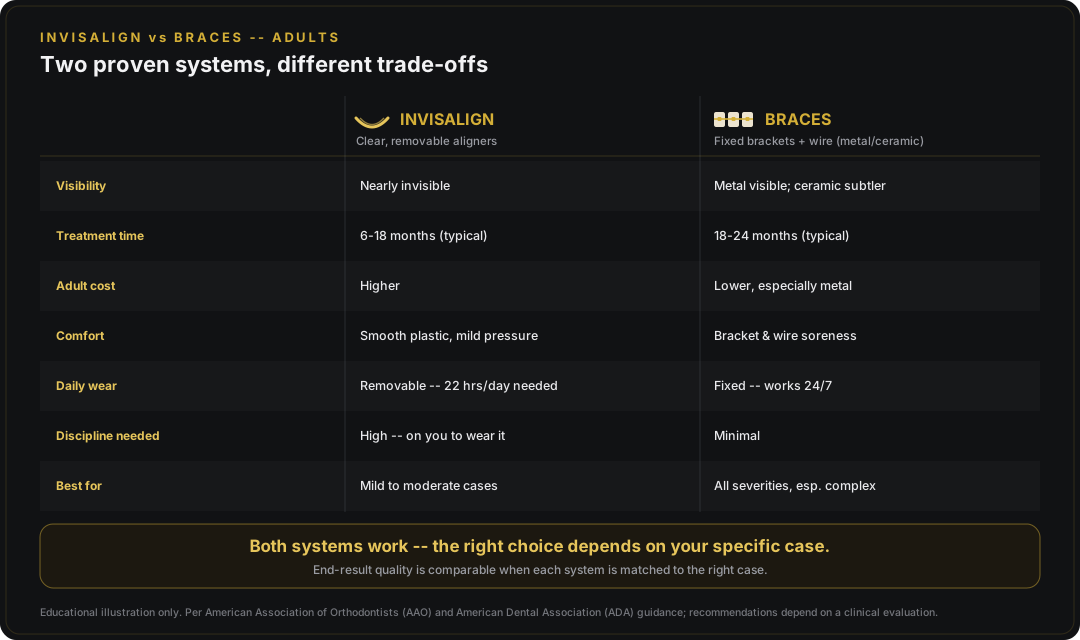
Invisalign is better for most mild-to-moderate adult cases prioritizing appearance and lifestyle. Braces are better for complex cases, severe skeletal corrections, and patients with low compliance with the 22-hour wear requirement. End-result quality is comparable when each system is used for an appropriate case. The cost gap is typically $500-$1,500 in favor of braces. Speed depends on case complexity, not on the system itself.
Side-by-side comparison
| Factor | Invisalign | Traditional braces |
|---|---|---|
| Visibility | Nearly invisible | Highly visible (metal); less visible (ceramic/lingual) |
| Adult cost | $3,500-$7,000 | $3,000-$6,000 (metal), $4,000-$7,000 (ceramic) |
| Treatment time | 6 to 18 months typical | 18 to 24 months typical |
| Comfort | Smooth plastic, mild pressure | Bracket and wire irritation, more soreness |
| Office visits | Every 6 to 8 weeks | Every 4 to 6 weeks |
| Removability | Yes — 22 hrs/day required | No — fixed |
| Food restrictions | None (remove for eating) | Many (no hard, sticky, chewy) |
| Oral hygiene | Normal routine | Special tools and effort required |
| Compliance required | Very high | Low (works continuously) |
| Best for | Mild to moderate cases, adults | All severities, especially complex |
| Discipline factor | Critical | Minimal |
Speed: when Invisalign is faster, when braces are faster
The “Invisalign is faster” claim is partly true and partly misleading.
Invisalign is faster for:
- Mild crowding or spacing (Invisalign Lite or Express completes in 6 to 12 months)
- Post-braces drift (Invisalign Express in 3 to 6 months)
- Patients who maintain perfect compliance with 22 hours/day wear
- Cases requiring small precise movements with iTero scan-to-tray accuracy
Braces are faster for:
- Severe rotations greater than 45 degrees
- Large vertical tooth movements (intrusion or extrusion)
- Patients with poor compliance (braces work whether you want them to or not)
- Complex bite corrections requiring elastics and wires simultaneously
- Cases requiring tooth-by-tooth precision with friction-free wires
In our practice, we tell patients honestly: if your case requires both systems for different reasons, we’ll say so. Sometimes the right answer is hybrid — braces for the heavy lifting followed by Invisalign for refinement, or vice versa.
Cost: the real numbers
Invisalign varies more than metal braces for comparable cases in the Bloomingdale and DuPage County market.
| System | Adult cost range | Lab/material cost driver |
|---|---|---|
| Metal braces | $3,000-$6,000 | Stock components, regular adjustments |
| Ceramic braces | $4,000-$7,000 | Tooth-colored brackets cost more |
| Self-ligating braces (Damon) | $4,500-$7,500 | Specialized brackets |
| Invisalign Lite | $3,000-$4,500 | Custom-manufactured aligners |
| Invisalign Full | $4,500-$7,000 | Custom-manufactured aligners + complexity |
| Lingual braces | $8,000-$10,000 | Custom-manufactured behind-tooth brackets |
The cost gap narrows for mild cases (where Invisalign Lite is competitive with full braces) and widens for complex cases (where Invisalign Full plus refinements add up).
For complete cost details and financing options, see Invisalign cost and payment plans.
Comfort: what each system actually feels like
Invisalign comfort profile
Invisalign trays are smooth thermoplastic. Soft tissues (cheeks, lips, tongue) tolerate them well — soft-tissue ulcers and irritation are uncommon. Patients describe 2 to 4 days of mild pressure soreness when switching to a new tray, peaking on day 2 and resolving by day 4.
The most common Invisalign discomfort issues we see in our office:
- Lisp during the first 3 to 7 days of wearing aligners
- Mild gum irritation around composite attachments in the first week
- Slight tongue discomfort for 1 to 2 weeks of adjustment
- Brief pressure soreness with each new tray
Braces comfort profile
Traditional braces apply continuous force and produce more soft-tissue irritation through brackets and wires. Patients commonly experience:
- Cheek and lip ulcers in the first 2 weeks (managed with dental wax)
- Significant soreness after each adjustment, lasting 3 to 5 days
- Difficulty eating hard or crunchy foods
- Wire pokes that require emergency office visits to trim
- More cumulative discomfort over 18 to 24 months of treatment
Per a 2020 systematic review in the Journal of Clinical Orthodontics, Invisalign patients consistently report lower pain scores than braces patients across multiple comfort metrics, though differences narrow during active force-application phases.
Lifestyle: what daily life is like with each
Invisalign daily life
- Eating: remove aligners for any food or drink besides plain water; no food restrictions
- Brushing: normal routine, must brush before reinserting after meals
- Special occasions: remove for events, photos, presentations — replace immediately after
- Travel: easy — aligners pack flat in case
- Sports: remove for contact sports, wear during non-contact
- Dating and social life: most people don’t notice you’re wearing them
- Professional life: nearly invisible during meetings and presentations
- Required discipline: very high — every meal becomes a remove/brush/replace cycle
Braces daily life
- Eating: many restrictions (no hard candy, sticky foods, popcorn, crunchy foods, gum)
- Brushing: special tools required, longer time per session
- Special occasions: brackets and wires are visible in photos
- Travel: pack wax, manage food restrictions
- Sports: mouthguard required for contact sports
- Dating and social life: more conspicuous, especially with metal
- Professional life: visible in close conversation
- Required discipline: low for wear; high for hygiene and food management
The lifestyle question for Invisalign comes down to one honest assessment: are you the kind of person who will actually wear them 22 hours a day, every day, for 12 to 18 months? Patients who are unsure should consider braces, where compliance is not optional.
Results quality: do they end up the same?
For cases within Invisalign’s clinical range, end results are comparable to braces. A 2022 systematic review in the American Journal of Orthodontics and Dentofacial Orthopedics found no statistically significant difference in final outcome quality between clear aligners and braces for routine adult cases.
Where the data favors braces:
- Severe rotations
- Complex extraction cases
- Severe overbites or underbites with skeletal components
- Cases with impacted or unerupted teeth
Where the data favors Invisalign:
- Mild to moderate crowding (faster, similar quality)
- Patient-reported comfort and satisfaction
- Lower oral hygiene complications
- Lower decalcification (white spot) risk on tooth surfaces
The American Association of Orthodontists takes a neutral position: both systems are valid, and the right choice depends on the case and patient preferences.
Who should choose Invisalign?
Invisalign is the better choice for adults with:
- Mild to moderate crowding, spacing, or bite issues
- Strong preference for nearly invisible appearance
- Professional roles where visible braces would be a problem
- Discipline to wear trays 22 hours a day reliably
- No complex rotational, vertical, or skeletal issues
- Budget that accommodates the $500-$1,500 premium
In our experience, the Invisalign patients who do best are those who are slightly older (28+), professionally established, and motivated by appearance reasons that have been put off for years.
Who should choose braces?
Traditional braces remain the better choice for adults with:
- Severe crowding requiring significant tooth movement
- Skeletal class II or class III malocclusion needing functional correction
- Complex rotations or impacted teeth
- Limited budget where the $500-$1,500 difference matters
- Inability or unlikelihood to maintain 22 hours of daily aligner wear
- Cases where the orthodontist has clinical concerns about Invisalign tracking
For teens, braces are often the better choice unless the case is mild and compliance can be assured. For more on Invisalign for younger patients, see Invisalign types explained.
Hybrid treatment: when both make sense
A meaningful number of cases benefit from combination treatment:
- Braces first, then Invisalign: braces handle complex movements; Invisalign refines and finishes (12 to 18 months total)
- Invisalign first, then refinement braces: aligners do most movement; brief braces finish specific stubborn details
- Concurrent: very rare, but occasionally a few brackets are placed for specific tooth movements while aligners handle the rest
These hybrid plans cost more than either system alone but produce excellent results in genuinely complex cases. Our practice uses them when neither pure Invisalign nor pure braces would deliver the best result.
How do you decide for your specific case?
The honest decision pathway:
- Get a comprehensive consultation with someone who offers both Invisalign and braces — providers who only offer one have an inherent bias
- Get a written treatment plan for each option with cost, timeline, and clinical rationale
- Ask: “If this were your spouse, which would you recommend and why?” — this often produces a more candid answer than the standard pitch
- Consider your honest discipline level for the 22-hour requirement
- Weigh appearance and lifestyle against cost and complexity tradeoffs
At Serenity Dental of Bloomingdale, we offer both Invisalign and traditional braces. Our recommendation is always case-driven and honest, even when the more expensive option isn’t the right fit.
For an in-person evaluation in Bloomingdale, Carol Stream, Glendale Heights, Hanover Park, Roselle, Addison, and surrounding DuPage County, call (630) 359-0105.
Related: Invisalign service page · what Invisalign can fix · is Invisalign worth it.
FAQs
Is Invisalign better than braces for adults?
Is Invisalign faster than braces?
Are adult invisible braces the same as Invisalign?
Which is more expensive: Invisalign or braces?
Does Invisalign hurt less than braces?
Can Invisalign fix everything braces can?
Why do some patients choose braces over Invisalign?
Are clear aligners other than Invisalign as good?
Educational content only. Recommendations are personalized after an exam and any needed imaging.
About this article
Reviewed by Dr. Husna Khan, DDS, of Serenity Dental of Bloomingdale. Comparison data reflects American Association of Orthodontists (AAO) guidance, American Dental Association (ADA) treatment standards, and peer-reviewed orthodontic literature on aligner versus bracket-based treatment outcomes.
Educational content. Individual treatment recommendations depend on clinical evaluation. Cited sources: American Association of Orthodontists (AAO), American Dental Association (ADA), American Journal of Orthodontics and Dentofacial Orthopedics (AJODO), Journal of Clinical Orthodontics (JCO).
Need help with this in real life?
Reading helps. Talking to someone who can look at your actual teeth and symptoms helps more. If you want a clear next step, we’re here.
Related articles
Is Invisalign worth it? Pros, cons, and patient experience
Is Invisalign worth it for adults? Honest pros, cons, real patient experiences, and the deciding factors. Reddit-honest review without the marketing spin.
Read article →What Invisalign can fix: underbite, overbite, crossbite, and more
What Invisalign can fix -- crowding, gaps, underbite, overbite, crossbite, snaggleteeth, bottom teeth only. Honest limits and complex case examples.
Read article →