Invisalign
What Invisalign can fix: underbite, overbite, crossbite, and more
What Invisalign can fix -- crowding, gaps, underbite, overbite, crossbite, snaggleteeth, bottom teeth only. Honest limits and complex case examples.
Cost figures in this article are typical ranges for the Chicago area, compiled from regional fee data. They are not quotes from Serenity Dental of Bloomingdale; your fee depends on exam findings, materials, and insurance benefits, and we provide a written, itemized estimate before any treatment begins.
Invisalign treats most mild to moderate orthodontic conditions, including crowding, gaps, underbite, overbite, crossbite, deep bite, and rotated teeth. The treatment has clear limits — severe skeletal misalignment, complex extraction cases, and very large rotational corrections often need traditional braces or surgical orthodontics. This guide covers what Invisalign reliably fixes, the conditions where it can be paired with auxiliary techniques, and the cases where braces remain the better tool. Each condition includes the typical Invisalign approach and where the limits are.

Written by Dr. Husna Khan, DDS
Serenity Dental of Bloomingdale · April 27, 2026
Call (630) 359-0105 to find out if Invisalign is right for your case.
For the full Invisalign treatment overview, see the Invisalign service page. For braces vs Invisalign decisions, see Invisalign vs braces for adults.
The short answer
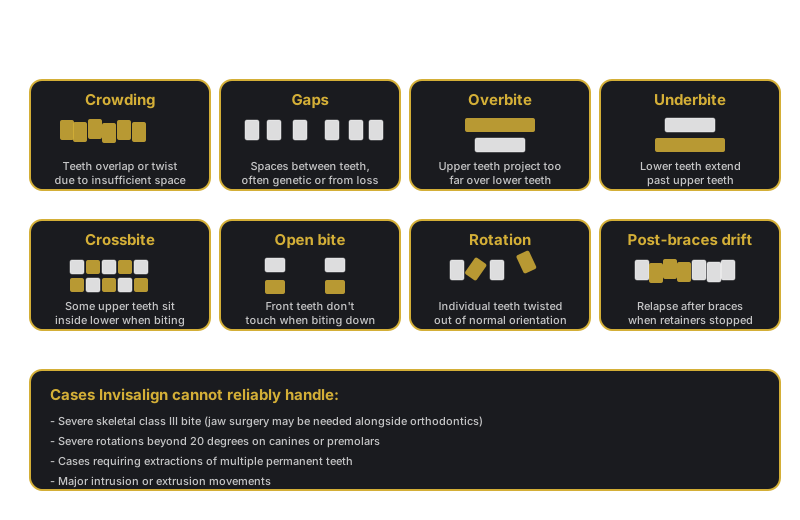
Invisalign reliably treats crowding, spacing/gaps, mild-to-moderate overbite, mild underbite (dental, not skeletal), crossbite, deep bite, mild rotations, post-braces drift, and partial-arch corrections. Invisalign struggles with severe skeletal jaw mismatch, large rotational corrections greater than 60 degrees, complex extraction-and-space-closure cases, impacted tooth retrieval, and cases requiring extensive vertical movement. Most adult cases are within Invisalign’s range.
The 8 most common conditions Invisalign treats
1. Crowding (overcrowding)
Crowding is the most common adult orthodontic concern. Teeth too large for the jaw arch produce overlap, twisting, and misalignment.
| Severity | Total space deficit | Invisalign approach | Typical result |
|---|---|---|---|
| Mild | 0 to 4 mm | Invisalign Lite, IPR | Excellent |
| Moderate | 4 to 6 mm | Invisalign Full, IPR or expansion | Very good |
| Severe | Over 6 mm | Often requires extractions; braces typically better | Variable with aligners |
Interproximal reduction (IPR) is the controlled removal of 0.1 to 0.3 mm of enamel between teeth to create space without harming the teeth. This is a routine technique used in most Invisalign cases.
For background on adult crowding, the American Association of Orthodontists notes 27 percent of orthodontic patients today are adults, and crowding is the leading reason adults seek treatment.
2. Gaps (diastemas / spacing)
Invisalign on gapped teeth is one of the most predictable Invisalign treatments. Gaps respond predictably because closing space is mechanically simpler than creating space.
- Small gaps (under 2 mm): close in 4 to 8 months with Invisalign Lite
- Medium gaps (2 to 4 mm): close in 8 to 14 months with Invisalign Full
- Large gaps (over 4 mm): may need full treatment plus auxiliary techniques
When gaps result from missing teeth, the missing tooth must be replaced before alignment is finalized — either with an implant before treatment, an implant after treatment, or a pontic (artificial tooth) built into the aligner during treatment. See Invisalign attachments and pontics for details.
3. Overbite (deep bite)
A normal overbite has the upper front teeth covering 1 to 3 mm of the lower front teeth vertically. Excessive overbite (4 mm or more) is called deep bite and causes wear, gum trauma, and aesthetic concerns.
Invisalign deep bite correction approaches:
- Posterior bite ramps: small extensions on aligners that disclude back teeth temporarily, allowing front teeth to move
- Intrusion of upper front teeth: precision movements via attachments
- Extrusion of back teeth: aligners drive back teeth slightly upward
- Combination approach for severe deep bite
Most adult deep bite cases are within Invisalign Full’s range. Severe skeletal deep bite with significant lower jaw recession may need surgical orthodontics.
4. Underbite
Invisalign underbite treatment is condition-dependent:
- Dental underbite (teeth misaligned but jaws normal): Invisalign treats well, typically with elastics anchored to attachments
- Mild skeletal underbite: Invisalign can help if patient growth has stopped (adults); class III elastics may be used
- Severe skeletal underbite: requires orthognathic surgery; aligners cannot reposition jaw bones
In our practice, we screen for the dental versus skeletal distinction at consultation using cephalometric imaging if needed. Per ADA guidance, severe class III malocclusions warrant referral to oral and maxillofacial surgery for combined orthodontic-surgical treatment.
5. Crossbite
Crossbite occurs when one or more teeth bite incorrectly relative to the opposing tooth — the upper tooth sits inside (or outside) the lower tooth instead of properly aligning.
- Anterior crossbite (front teeth): typically responds well to Invisalign with elastics
- Posterior crossbite (back teeth): can be treated with aligner expansion, sometimes paired with palatal expanders for severe cases
- Bilateral posterior crossbite: may need a fixed expander before Invisalign
A 2020 study in the American Journal of Orthodontics and Dentofacial Orthopedics reported posterior crossbite correction success rates over 80 percent with Invisalign in appropriately selected adult cases.
6. Open bite
Open bite — where the front teeth do not meet when the back teeth are closed — is one of Invisalign’s strongest indications. Aligners can intrude back teeth subtly while extruding front teeth, closing the bite predictably. Invisalign success rates for anterior open bite often exceed those of traditional braces because of the precision of vertical control.
7. Rotated teeth
| Rotation severity | Invisalign approach | Predictability |
|---|---|---|
| Mild (under 30 degrees) | Standard attachments | High |
| Moderate (30 to 45 degrees) | Multiple attachments, possible elastics | Medium |
| Severe (45 to 60 degrees) | Refinement likely needed | Lower |
| Very severe (over 60 degrees) | Braces typically better | Often inadequate |
Rotation correction is one of the most demanding Invisalign movements. Ample composite attachments and patient compliance with full 22-hour wear are critical.
8. Post-braces drift (relapse)
Adults who had braces years ago and stopped wearing retainers often see lower front teeth shift back into mild crowding. This is a textbook Invisalign Express or i7 case — 7 to 10 trays, 4 to 6 months, $2,000-$3,800. The same patients who avoid full Invisalign treatment because of cost often qualify for Express, which is meaningfully more affordable.
Specialized Invisalign treatments
Invisalign on bottom teeth only (single arch)
Single-arch Invisalign treatment is appropriate when the upper teeth are aligned and only the lower arch needs correction (or vice versa). This is most common in:
- Post-braces drift on lower front teeth only
- Mild lower crowding with stable upper arch
- Small lower gap closure
Bite stability must be evaluated before single-arch treatment to ensure moving lower teeth will not create new occlusion problems with the upper. Treatment cost runs $3,000–$8,000 with Invisalign Express or Lite.
Invisalign for adults over 60
Invisalign for adults over 60 is increasingly common as longer life expectancy and better dental retention create demand for adult orthodontics. Special considerations:
- Bone density: adequate bone support is required; periodontal evaluation precedes treatment
- Gum health: active gum disease must be treated first
- Existing dental work: crowns, bridges, and implants do not move with aligners and require treatment planning
- Tooth movement speed: typically slightly slower than younger adults but predictable
- Treatment outcome: comparable to younger adults when bone and gum health are good
In our practice, adults in their 60s and 70s have completed Invisalign successfully when the periodontal foundation is stable.
Invisalign for snaggleteeth
Snaggleteeth (canine teeth positioned high in the arch above the line of other teeth) respond well to Invisalign when there is space in the arch to bring them down. Cases requiring tooth extraction to create space are sometimes better managed with braces, where wire mechanics control space closure more precisely.
What can’t Invisalign fix?
The honest list of Invisalign limitations:
- Severe skeletal class II or class III malocclusion — requires orthognathic surgery
- Severe rotations over 60 degrees — braces are more reliable
- Complex extraction cases requiring large space closure — braces handle this better
- Impacted tooth retrieval — requires fixed appliances and surgery
- Major vertical movements (large intrusion or extrusion) — aligners have limits
- Patients unwilling or unable to wear 22 hours/day — braces work continuously and don’t require compliance
- Severe bone loss or active gum disease — must be addressed first regardless of treatment system
For these limitations, traditional braces, lingual braces, or combined surgical orthodontics are appropriate. See Invisalign vs braces for adults for the comparison.
How is candidacy evaluated?
A complete Invisalign candidacy evaluation at Serenity Dental of Bloomingdale includes:
- Comprehensive oral exam — general dental health, gum health, existing dental work
- Digital 3D scan with iTero — baseline tooth positions
- Bite analysis — how upper and lower teeth relate
- Cephalometric and panoramic radiographs for complex cases — jaw skeletal relationship
- Photographic records — intraoral and extraoral
- ClinCheck simulation — 3D preview of expected outcome with Invisalign
- Honest discussion of whether Invisalign or another treatment is the better fit
The simulation step matters. If the ClinCheck shows movements that look unrealistic or incomplete, that is a signal the case may exceed Invisalign’s range and braces should be considered.
For consultation in Bloomingdale, Carol Stream, Glendale Heights, Hanover Park, Roselle, Addison, and surrounding DuPage County, call (630) 359-0105.
Related: Invisalign service page · Invisalign vs braces for adults · is Invisalign worth it.
FAQs
Can Invisalign fix an underbite?
Can Invisalign fix an overbite?
Can Invisalign fix gapped teeth?
Can Invisalign fix overcrowding?
Can you get Invisalign on bottom teeth only?
Can Invisalign fix a crossbite?
Can Invisalign fix snaggleteeth or rotated teeth?
Can Invisalign fix a malocclusion?
Educational content only. Recommendations are personalized after an exam and any needed imaging.
About this article
Reviewed by Dr. Husna Khan, DDS, of Serenity Dental of Bloomingdale. Treatment range and indications align with American Association of Orthodontists (AAO) clinical guidance, American Dental Association (ADA) standards of care, and peer-reviewed orthodontic literature on aligner efficacy across malocclusion types.
Educational content. Individual treatment recommendations depend on clinical evaluation. Cited sources: American Association of Orthodontists (AAO), American Dental Association (ADA), American Journal of Orthodontics and Dentofacial Orthopedics (AJODO), Salzmann index for malocclusion severity grading.
Pricing note. Prices shown are approximate Chicago-area 2026 ranges compiled from public cost guides — not a quote or a Serenity Dental fee schedule. Your actual cost depends on your clinical needs, the materials chosen, and your insurance. We provide a written estimate before any treatment begins. Call (630) 359-0105 to confirm pricing for your situation.
Need help with this in real life?
Reading helps. Talking to someone who can look at your actual teeth and symptoms helps more. If you want a clear next step, we’re here.
Related articles
Invisalign vs braces for adults: an honest comparison
Invisalign vs braces for adults compared on speed, comfort, cost, results, and lifestyle. Adult invisible braces explained, with honest tradeoffs.
Read article →Is Invisalign worth it? Pros, cons, and patient experience
Is Invisalign worth it for adults? Honest pros, cons, real patient experiences, and the deciding factors. Reddit-honest review without the marketing spin.
Read article →