Invisalign
Is Invisalign worth it? Pros, cons, and patient experience
Is Invisalign worth it for adults? Honest pros, cons, real patient experiences, and the deciding factors. Reddit-honest review without the marketing spin.
Cost figures in this article are typical ranges for the Chicago area, compiled from regional fee data. They are not quotes from Serenity Dental of Bloomingdale; your fee depends on exam findings, materials, and insurance benefits, and we provide a written, itemized estimate before any treatment begins.
Invisalign is worth it for the right adult patient with the right case. For most patients in our practice with mild to moderate alignment issues, the trade — 12 to 18 months of disciplined daily wear in exchange for a permanent improvement in smile and bite — pays off. For others, traditional braces or no treatment at all is the better choice. This guide gives the honest math: real pros, real cons, the patient profile that should pursue Invisalign, and the patient profile that should not.

Written by Dr. Husna Khan, DDS
Serenity Dental of Bloomingdale · April 27, 2026
Call (630) 359-0105 for an honest case evaluation.
For comparisons with traditional braces, see Invisalign vs braces for adults. For complete cost details, see Invisalign cost and payment plans.
The short answer
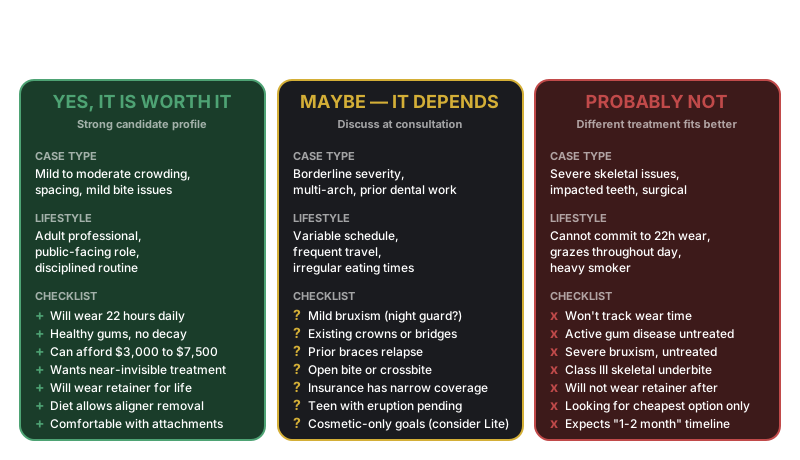
Invisalign is worth it if you have a mild to moderate case, value appearance and lifestyle compatibility, can commit to wearing aligners 22 hours a day for 12 to 18 months, and have the budget for the $500-$1,500 premium over braces. Invisalign is not worth it if you would struggle with daily compliance, have a complex case where braces would produce better results, or are stretching financially in a way that traditional braces would not require.
The honest pros
Appearance during treatment
Invisalign trays are nearly invisible. In normal conversation across a desk or in a video call, they are essentially undetectable. This is the single most-cited reason adults choose Invisalign over braces in our practice. For professionals in client-facing roles, sales, presenting, and similar positions, this matters meaningfully.
Lifestyle compatibility
Aligners come out for meals. There are no food restrictions, no broken brackets from corn on the cob, no popcorn kernel disasters. Patients can eat anything they could eat before treatment.
Comfort
Smooth thermoplastic does not produce the cheek and lip ulcers common with bracket-and-wire braces. Soft-tissue irritation is rare. Tooth-movement soreness exists with both systems but is typically rated lower for Invisalign in patient surveys.
Oral hygiene
Brushing and flossing are unchanged with Invisalign — you remove the aligners. With braces, plaque accumulates around brackets and wires, requiring special tools and dramatically more time. Per ADA data, patients in fixed orthodontic appliances have higher rates of decalcification (white spot lesions) and cavities than aligner patients.
Predictable digital simulation
The ClinCheck simulation lets patients see the expected outcome before treatment starts. Knowing what your final smile will look like before signing up reduces uncertainty meaningfully.
Removability for events
Wedding, big presentation, photo session, important date — aligners come out for 1 to 2 hours without affecting overall treatment progress. Patients value this flexibility.
Cumulative office time
Invisalign typically requires fewer office visits than braces. Standard monitoring intervals are every 6 to 8 weeks for Invisalign versus every 4 to 6 weeks for braces. Over 12 to 18 months of treatment, that is 4 to 6 fewer appointments.
The honest cons
Daily compliance is non-negotiable
The 22-hour wear requirement is real. Patients who actually wear aligners 18 to 20 hours daily routinely have tracking problems, treatment delays, and refinement requirements. The biggest gap between expectation and reality in Invisalign treatment is underestimating how disciplined the wear schedule needs to be. We document this clearly in our practice and turn down patients who candidly tell us they will not be able to maintain compliance.
Removing aligners for every meal is a real adjustment
Coffee in the morning, snack at the desk, lunch with coworkers, water cooler conversation, dinner with family — each food or drink event becomes a remove/brush/replace cycle. For people who graze throughout the day, this represents a meaningful behavior change. Some patients adapt easily; others find it consistently irritating.
Composite attachments are visible
Most Invisalign cases require 4 to 12 small tooth-colored composite bumps bonded to specific teeth to grip the aligners. They are far less visible than braces brackets but are visible up close, especially on front teeth. Some patients dislike them.
Speech adjustment in the first week
Most patients develop a slight lisp during the first 3 to 7 days of treatment. This typically resolves within 1 to 2 weeks but can be embarrassing in professional speaking situations during the adjustment period.
Initial taste and pressure feeling
The first day of treatment, and the first day of each new tray, there is a plastic taste and significant pressure sensation. This passes within 24 to 48 hours but is uncomfortable.
Cost is higher than metal braces
Invisalign typically runs $3,000–$8,000 more than traditional metal braces for comparable cases. For patients on tight budgets, this premium is meaningful.
Refinements happen
Approximately 30 percent of Invisalign cases require refinement aligners at the end of active treatment to fine-tune results that did not track perfectly. This adds 2 to 6 months to total treatment time. Reputable practices include the first round of refinements in the original quote.
Lost or damaged aligners are expensive
A lost or damaged tray runs $100-$200 to replace and can delay treatment by 1 to 3 weeks while a replacement is fabricated. Patients who lose multiple aligners over treatment can add real cost. See Invisalign problems and troubleshooting for details.
The patient profile that benefits most
In our practice, the patients who emerge most satisfied with Invisalign share a recognizable pattern:
- Adult, typically 25 to 55 years old
- Mild to moderate alignment issues (case within Invisalign’s clinical range)
- Professional or social context where braces would be a real concern
- Disciplined personality, good follow-through on routines
- Adequate budget; treatment cost is a meaningful but manageable investment
- Treatment goals that match clinical reality
- Realistic expectations about timeline and outcome
These patients consistently report satisfaction in our reviews and tend to recommend Invisalign to others.
The patient profile that does not benefit
The patients who tend to be dissatisfied or who we counsel toward alternatives:
- Severe skeletal cases where Invisalign cannot deliver the result the patient wants
- Patients who candidly know they will struggle with the 22-hour wear requirement
- Patients with active periodontal disease that has not been treated
- Patients seeking results outside Invisalign’s range based on online research that misrepresents the treatment
- Patients stretching financially when traditional braces would deliver an equivalent result for less
We turn down approximately 10 to 15 percent of patients who request Invisalign at consultation, redirecting them toward traditional braces, periodontal treatment first, or no treatment at all.
How should you think about the cost-value tradeoff?
A $5,000 Invisalign case averaged over the rest of an adult life of 30 to 50 years works out to roughly $100-$170 per year for a permanent smile improvement. Compared to other common adult investments — a gym membership, a streaming service bundle, a coffee habit — the per-year cost is modest. The upfront amount is the psychological barrier; the long-term per-year cost is reasonable.
That said, Invisalign is genuinely worth it only when the case is appropriate for it. If braces would produce a better result for less money, Invisalign is not the right choice regardless of how attractive its features are.
What do patients say at the end of treatment?
The consistent feedback themes from our Invisalign patients at completion:
- “I wish I had done this sooner” — by far the most common sentiment
- “The hardest part was the first 2 weeks” — adjustment period, then it became routine
- “I forgot I was wearing them most of the time” — after the adjustment phase
- “My biggest mistake was missing wear time when I was traveling” — almost universal regret among patients with extended treatment
The negative feedback themes:
- “I wish I had been more disciplined with wear time”
- “The attachments bothered me more than I expected”
- “I had to do a refinement, which I hadn’t anticipated”
- “Cleaning the aligners properly took some practice”
Both sets of feedback are useful for patients still deciding. The realistic Invisalign experience is in between the marketing claims and the worst-case Reddit complaints.
How do we evaluate worth at Serenity Dental?
At your consultation, we walk through:
- The specific case and what Invisalign would and would not accomplish
- The realistic timeline and tray count
- The total cost itemized in writing
- An honest assessment of the alternatives, including doing nothing
- The compliance requirements and what they look like in practice
Patients leave consultation with enough information to decide for themselves rather than being sold. In our experience, that approach produces the highest satisfaction rates over the course of treatment.
For consultation in Bloomingdale, Carol Stream, Glendale Heights, Hanover Park, Roselle, Addison, and surrounding DuPage County, call (630) 359-0105.
Related: Invisalign service page · Invisalign vs braces for adults.
FAQs
Is Invisalign worth it?
Is Invisalign legit?
Is Invisalign good?
Is Invisalign orthodontics?
Can anyone get Invisalign?
Is Invisalign worth it for adults over 60?
What are the cons of Invisalign?
Are Invisalign reviews real?
Educational content only. Recommendations are personalized after an exam and any needed imaging.
About this article
Reviewed by Dr. Husna Khan, DDS, of Serenity Dental of Bloomingdale. Information aligns with American Dental Association (ADA) treatment standards, American Association of Orthodontists (AAO) adult orthodontic guidance, and Align Technology clinical outcome reporting.
Educational content. Individual treatment recommendations depend on clinical evaluation. Cited sources: American Association of Orthodontists (AAO), American Dental Association (ADA), American Journal of Orthodontics and Dentofacial Orthopedics (AJODO), Align Technology clinical outcome data.
Pricing note. Prices shown are approximate Chicago-area 2026 ranges compiled from public cost guides — not a quote or a Serenity Dental fee schedule. Your actual cost depends on your clinical needs, the materials chosen, and your insurance. We provide a written estimate before any treatment begins. Call (630) 359-0105 to confirm pricing for your situation.
Need help with this in real life?
Reading helps. Talking to someone who can look at your actual teeth and symptoms helps more. If you want a clear next step, we’re here.
Related articles
Invisalign vs braces for adults: an honest comparison
Invisalign vs braces for adults compared on speed, comfort, cost, results, and lifestyle. Adult invisible braces explained, with honest tradeoffs.
Read article →What Invisalign can fix: underbite, overbite, crossbite, and more
What Invisalign can fix -- crowding, gaps, underbite, overbite, crossbite, snaggleteeth, bottom teeth only. Honest limits and complex case examples.
Read article →