Oral Surgery
What Is a Sinus Lift? How It Makes Upper Implants Possible
A sinus lift adds bone to the upper jaw for safe implant placement. Why bone loss makes it necessary, lateral vs. crestal approaches, and what to expect.

Written by Dr. Husna Khan, DDS
Serenity Dental of Bloomingdale · April 16, 2026
Educational purposes only. Sinus lift candidacy assessed with CBCT imaging at consultation. Call (630) 359-0105 to schedule.
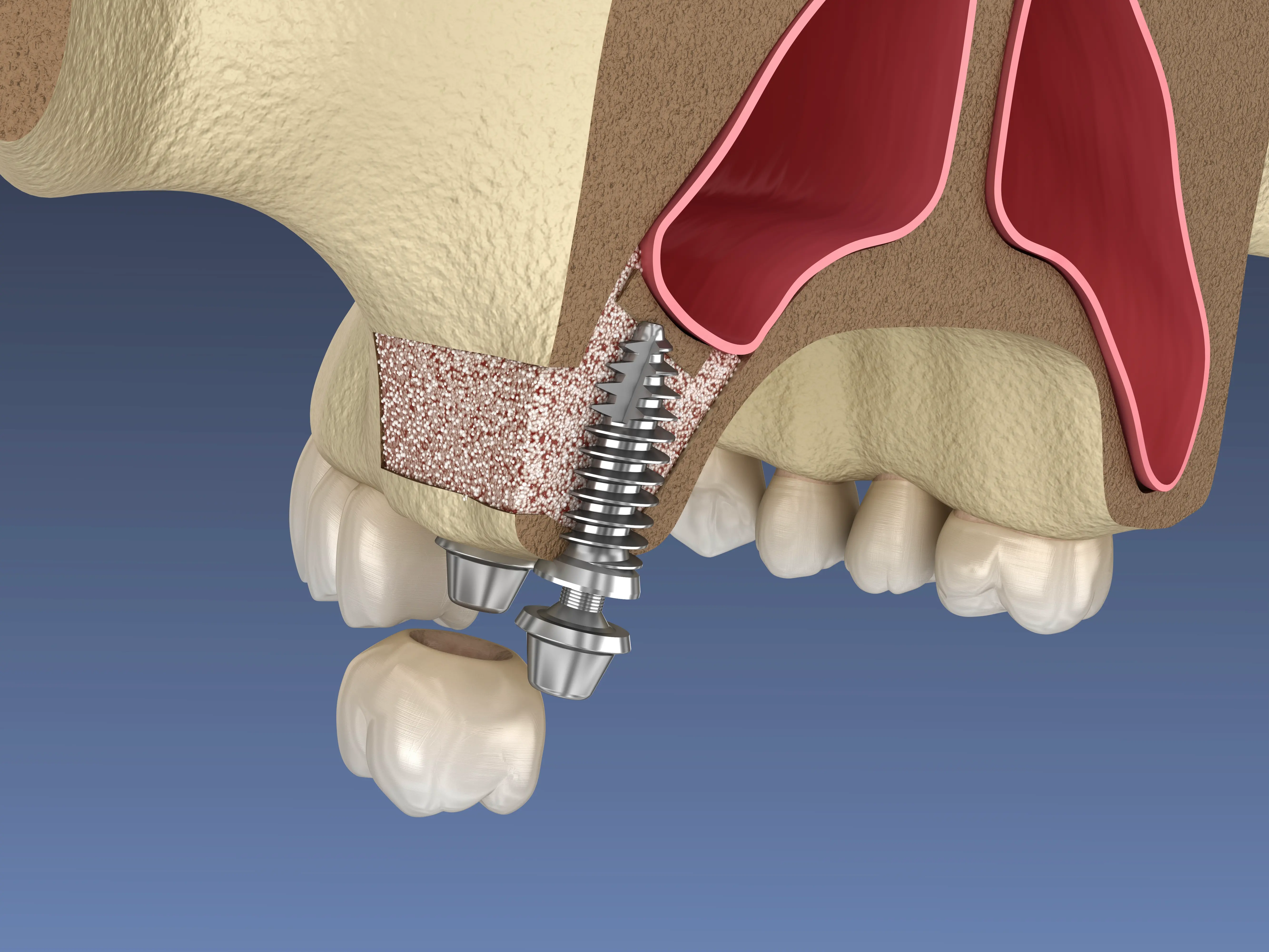
A sinus lift is a surgical procedure that adds bone to the upper jaw between your jawbone and the maxillary sinuses. Surgeons reach for it when the upper jaw lacks the vertical bone height to hold a dental implant safely, a shortage that develops after upper back molars are lost and the bone beneath them resorbs.
Nothing about your face or daily comfort changes afterward. What changes is underneath: the procedure builds the foundation that makes a dental implant possible in a spot where one would otherwise fail.
Why do upper jaw implants sometimes need extra steps?
Your maxillary sinuses are air-filled cavities that sit directly above the upper back teeth. Lose a molar in that area and two clocks start at once. The jawbone begins to resorb, and the sinus itself expands downward into the vacated space, a process called sinus pneumatization.
Left: insufficient bone, implant would enter the sinus. Right: after sinus lift, graft builds the height the implant requires.
Most surgeons draw the line at 8-10 mm of vertical bone in the posterior upper jaw. Measure less than that, and a standard-length implant cannot be anchored without risking a punch into the sinus.
Two surgical approaches, one decision made from your imaging
There is no single “sinus lift procedure.” Two distinct techniques exist, with different indications, recovery timelines, and costs.
| Factor | Crestal (internal) | Lateral window |
|---|---|---|
| ADA code | D7310 | D7311 |
| Bone height available | 4-8 mm | <4 mm |
| Access point | Through the implant site | Side window in jaw wall |
| Time to implant | 4-6 months | 6-9 months |
Which one you get is not a preference question; the CBCT scan decides. At Serenity Dental, Dr. Husna Khan reads your 3D imaging and tells you plainly which approach fits your anatomy and why, before anything is scheduled.
What happens during a sinus lift?
Both versions share the same core move. The Schneiderian membrane, the thin lining of the sinus floor, is gently separated from the bone and lifted. Graft material goes into the space below it. From then on the membrane works as a biological ceiling, holding everything in place while new bone forms.
That graft material, typically processed donor bone or a synthetic substitute, is only a scaffold. Over the next 4-9 months your own bone-forming cells migrate in and replace it with living bone. By the time the implant goes in, what started as a graft is your own tissue.
How you find out whether you need one
Nobody diagnoses a sinus lift from symptoms, because there are none. Bone height is silent. The answer comes from imaging, and the honest sequence looks like this: a CBCT scan measures the vertical bone under the sinus in fractions of a millimeter, the measurement gets compared against the length of implant your bite actually requires, and the gap between those two numbers, if there is one, is the entire case for or against a lift. In our Bloomingdale practice the conversation usually starts with a patient who wants one implant and has been told elsewhere that it is impossible; more often than not the scan shows it is entirely possible, just not in one step.
We see the same reaction at that appointment over and over: relief that the plan is concrete, followed by surprise that the graft phase is the boring part. It heals quietly while you live your life. The waiting is the treatment.
The most important thing about sinus lift recovery
One instruction outranks all the others, and patients underestimate it every time: do not blow your nose for 2-3 weeks after surgery. Pressure from a single hard blow can shift the membrane before it heals in position and undo the graft. Sneeze with your mouth open. Skip straws. Stay off airplanes for the first two weeks.
Everything else in recovery, the swelling and congestion and soft-food stretch, is temporary and manageable. The no-nose-blowing rule is the one that decides outcomes.
When to call rather than wait after a sinus lift
Normal recovery is undramatic: congestion, some cheek swelling, minor spotting from the nose for a day or two. A few things are not normal. Call right away at (630) 359-0105 for bleeding that will not slow, a sensation of air moving between your nose and mouth when you breathe, graft particles appearing in nasal discharge after the first days, fever, or pain that climbs after day three instead of fading. Each of those deserves same-week eyes on it, and every one is easier to fix early.
This article is general education and not individualized medical advice. Whether a sinus lift applies to you comes from an exam and a CBCT scan, not an article.
Patients in Bloomingdale, Glendale Heights, Carol Stream, Addison, and Schaumburg can call (630) 359-0105 to schedule a sinus lift consultation with Dr. Husna Khan. Related: sinus lift service page · dental implants.
Sinus lift, questions answered
What is a sinus lift?
Why would I need a sinus lift for an implant?
How is a sinus lift performed?
Does a sinus lift hurt?
How long does a sinus lift take?
What is the success rate of sinus lifts?
Which graft materials are clinically used in sinus lifts and why?
How long after a sinus lift can an implant be placed?
Is a sinus lift covered by insurance?
Educational content only. Recommendations are personalized after an exam and any needed imaging.
About this article
Educational purposes only. Procedure descriptions reflect AAOMS and ADA clinical guidance on sinus augmentation. Implant survival data from published research in the International Journal of Oral and Maxillofacial Implants. Individual candidacy and approach determined at CBCT-guided consultation.
Related: sinus lift at Serenity Dental.
Need help with this in real life?
Reading helps. Talking to someone who can look at your actual teeth and symptoms helps more. If you want a clear next step, we’re here.
Related articles
Tooth Extraction Cost in 2026: What You Actually Pay
Real tooth extraction costs by procedure type -- simple, surgical, broken, and impacted. What insurance covers, what drives the price, and financing options.
Read article →Tooth Extraction Aftercare: Day-by-day Dos and Don'ts
Complete tooth extraction aftercare checklist -- gauze, rinsing, smoking, straws, sleeping position, brushing, and exercise. What to do and avoid by day.
Read article →Types of Dental Bone Grafts: Autograft to Synthetic
The four bone-graft materials in dentistry: what each is, where it's from, and how to choose, with guidance for religious, ethical, or vegan concerns.
Read article →