Dental Bonding
What is dental bonding? Complete patient guide for 2026
Dental bonding uses tooth-colored composite resin to repair chips, gaps, and edges in one visit. What it is, how it works, cost, lifespan, and alternatives.
Cost figures in this article are typical ranges for the Chicago area, compiled from regional fee data. They are not quotes from Serenity Dental of Bloomingdale; your fee depends on exam findings, materials, and insurance benefits, and we provide a written, itemized estimate before any treatment begins.
Dental bonding is a conservative cosmetic and restorative procedure where the dentist applies tooth-colored composite resin directly to a tooth, shapes it to match natural tooth contour, and hardens it with a blue curing light. It is used to repair chips, close small gaps, smooth uneven edges, fill small cavities, and make minor cosmetic adjustments — all in a single appointment, usually 30 to 90 minutes per tooth, at a cost of varies depending on case complexity. Bonding is one of the most popular dental procedures because it is fast, affordable, reversible, and preserves natural tooth structure. This guide explains what dental bonding is, how it works, what it is used for, what it costs, how long it lasts, and how it compares with alternatives like veneers and crowns.

Written by Dr. Husna Khan, DDS
Serenity Dental of Bloomingdale · April 28, 2026
Bonding consultations are 30 minutes. Call (630) 359-0105 to schedule and discuss your specific case.
For the broader picture of bonding options, see the dental bonding service page. For specific concerns: dental bonding for chipped tooth, dental bonding for gap teeth, dental bonding cost.
The short answer
Dental bonding is composite resin (a tooth-colored polymer with ceramic filler) shaped directly on a tooth and cured with a blue light. Within 30 to 90 minutes per tooth, the process is complete; total cost runs $300–$600 and bonding lasts 4 to 10 years on average. It works for small to moderate cosmetic and restorative concerns: chipped teeth, small gaps, worn edges, small cavities, and minor reshaping.
Bonding is not the right answer for severely worn or fractured teeth (which need crowns), severely crooked teeth (which need Invisalign), full smile makeovers across 6 to 10 teeth (which usually do better with veneers), or replacing missing teeth (which need implants or bridges).
What is composite resin, actually?
Composite resin — the material used for bonding — is a hybrid of three components:
| Component | Percentage | Purpose |
|---|---|---|
| Resin matrix (Bis-GMA, UDMA) | 15-30% | Liquid base; polymerizes when cured |
| Filler particles (silica, glass) | 60-80% | Strength, wear resistance, esthetics |
| Photoinitiator (camphorquinone) | <1% | Triggers polymerization with light |
| Pigments | 1-5% | Tooth-matching color |
Modern cosmetic bonding uses nanohybrid composite — combining tiny nano-sized filler particles for high gloss with larger particles for strength. Per American Dental Association classifications, nanohybrid is the dominant material for both cosmetic and restorative bonding because it balances esthetic and functional properties well. For full material detail, read composite resin bonding explained.
How does dental bonding actually work?
The bonding process is a three-step chemical and mechanical procedure.
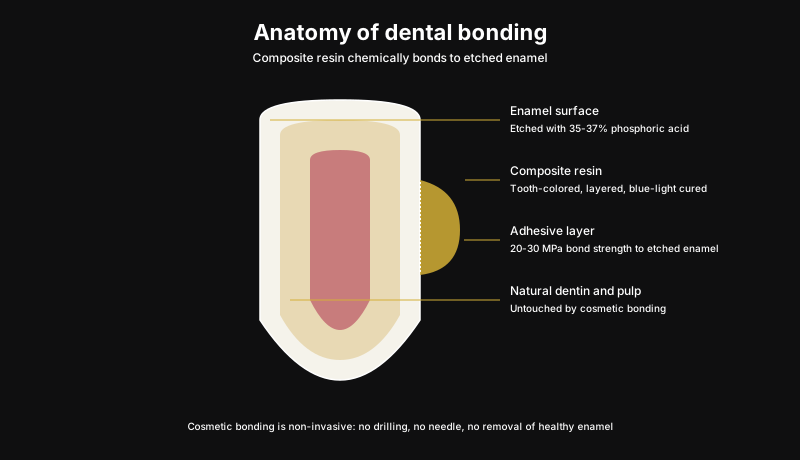
Step 1: Etching the enamel
Phosphoric acid gel at 35 to 37 percent strength is applied to the enamel surface for 15 to 20 seconds, creating microscopic surface roughness that increases bonding surface area dramatically. The acid is then rinsed thoroughly.
Step 2: Applying the bonding agent
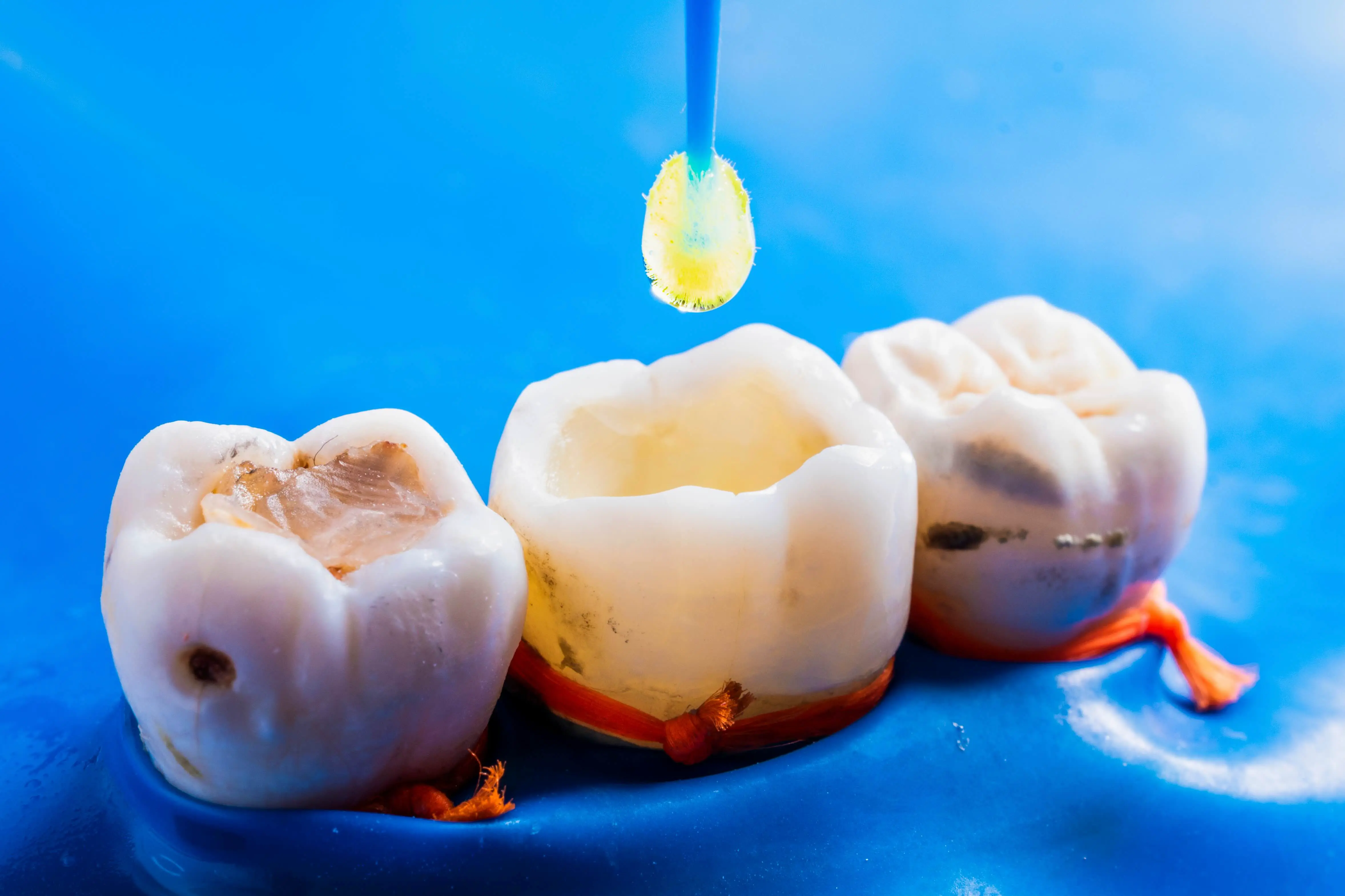
Liquid bonding adhesive is brushed onto the etched surface, gently air-dried, and cured with the blue LED light for 5 to 10 seconds. This forms a chemical bridge — the “hybrid layer” — between the tooth and the eventual composite.
Step 3: Layering the composite
Tooth-colored composite resin is placed in 1.5 to 2 millimeter layers, each cured for 10 to 20 seconds before the next layer is added. Multi-shade layering (a darker dentin shade, a body shade, and a translucent enamel shade) recreates the natural appearance of layered tooth structure.
Step 4: Shaping and polishing
Diamond burs and polishing discs shape the composite to match natural tooth anatomy. Final diamond paste polishing brings the surface to enamel-like gloss. The bite is checked with articulating paper and adjusted if needed.
Total procedure time runs from 30 minutes for a small chip repair to 90 minutes for a complex cosmetic case.
What is dental bonding used for?
1. Chipped teeth (most common use)
Small to medium chips on front teeth — from sports injuries, biting hard food, or facial trauma — are the most common bonding cases. In most cases, bonding restores the original shape in 30 to 45 minutes for $300–$600 per tooth. Chip-specific guidance lives at dental bonding for chipped tooth.
2. Small gaps (diastemas)
Small gaps of 1 to 3 millimeters between front teeth can be closed by adding composite to the inner edges of both adjacent teeth. The procedure takes 60 to 90 minutes and $300-$600 per tooth total. Larger gaps usually need Invisalign first. Gap closure detail is covered at dental bonding for gap teeth.
3. Worn or uneven edges
Years of grinding or wear can leave front-tooth edges flat, blunted, or asymmetric. Composite buildup restores natural edge length and shape. A custom night guard is recommended afterward to protect the new bonding.
4. Small cavities (composite fillings)
Composite material used for cosmetic bonding is also used for tooth-colored fillings. Composite fillings have replaced silver amalgam as the standard restoration for most cavities. See tooth-colored fillings.
5. Exposed tooth roots from gum recession
When gum recession exposes the root surface of a tooth, bonding can cover the exposed area to reduce sensitivity and improve appearance. This is sometimes called a Class V bonding restoration.
6. Minor cosmetic adjustments
Small surface stains that whitening cannot remove, slight discrepancies in tooth length, minor reshaping of pointed canines, and other small cosmetic adjustments are all valid bonding cases.
What is dental bonding not used for?
Bonding is not appropriate for several common dental concerns. Patients sometimes assume bonding is a universal cosmetic solution; it is not.
| Concern | Better solution |
|---|---|
| Severely chipped or fractured tooth (>1/3 missing) | Crown |
| Pulp (nerve) exposure | Root canal first, then crown |
| Significantly crooked teeth | Invisalign or braces |
| Severe staining throughout multiple teeth | Whitening first, then evaluate |
| Missing tooth | Implant or bridge |
| Failed root canal | Re-treatment, then crown |
| Multiple teeth needing cohesive cosmetic redesign | Porcelain veneers |
| Worn-down dentition with bite collapse | Comprehensive bite restoration |
| Very dark single tooth (post-trauma discoloration) | Porcelain veneer or crown |
Most 30-minute consultations clarify which concerns are bonding territory and which need other treatment. Dr. Husna Khan provides honest assessment rather than recommending bonding when an alternative is genuinely better.
Cost overview
| Case type | Cost range | Insurance coverage |
|---|---|---|
| Single chip repair | $300-$600 | 50-80% if restorative |
| Small gap closure | $400-$800 | Usually 0% (cosmetic) |
| Edge smoothing 4-6 teeth | $800-$1,800 | Mixed |
| Cosmetic veneer-style bonding (per tooth) | $400-$800 | 0% (cosmetic) |
| Composite filling (small cavity) | $175-$350 | 50-80% |
| Composite filling (large cavity) | $250-$550 | 50-80% |
See dental bonding cost for the complete cost breakdown including hidden fees, insurance scenarios, and financing.
Bonding vs alternatives
| Treatment | Cost per tooth | Lifespan | Best for |
|---|---|---|---|
| Direct bonding | $300-$600 | 4-10 years | Small repairs, single teeth, reversible |
| Porcelain veneers | $900-$2,500 | 10-15+ years | Multi-tooth cosmetic, durability |
| Lithium disilicate crowns | $1,000-$2,500 | 10-20 years | Major restoration with esthetics |
| Zirconia crowns | $1,000-$2,500 | 15-25 years | Maximum durability |
| Invisalign + bonding | $4,000-$7,500 total | Long-term | Crowded teeth + cosmetic finish |
Bonding wins on speed (one visit), reversibility (preserves enamel), and cost. Veneers and crowns win on durability, stain resistance, and uniformity for multi-tooth cases. Per American Academy of Cosmetic Dentistry guidance, the right answer depends on the specific clinical situation, not a universal preference.
What should you expect at the appointment?
A standard bonding visit at Serenity Dental of Bloomingdale follows this flow:
- Photos and exam (5 to 10 minutes): Intraoral photos document starting condition; dentist examines the tooth and any X-rays
- Treatment discussion (5 minutes): Options reviewed, written cost estimate provided
- Shade selection (3 to 5 minutes): Composite shades chosen against tooth in good lighting
- Anesthesia if needed (5 to 7 minutes): Most cosmetic bonding does not require anesthesia
- Surface preparation (3 to 5 minutes): Etching and bonding agent application
- Composite layering (10 to 25 minutes): Layered placement and curing
- Shaping and polishing (10 to 20 minutes): Final contour and gloss
- Bite check (3 minutes): Articulating paper and minor adjustments
- Photo documentation (3 minutes): After photos for records
- Care instructions (5 minutes): Aftercare review
Total chairside time: 30 to 90 minutes depending on number of teeth and case complexity. See dental bonding procedure step by step for a more detailed walkthrough.
Aftercare and maintenance
Bonding requires modest ongoing care:
- First 48 hours: Avoid very dark coffee, red wine, and curry to allow surface to fully seal
- Daily: Brush twice with non-abrasive toothpaste, floss before bed
- Every 6 months: Professional cleaning with brief polish
- Annually: Detailed inspection and diamond paste polish during cleaning
- As needed: Custom night guard if grinding, sports mouthguard for athletes, small chip repair
- Every 5 to 10 years: Replacement or major refresh
Detailed care guidance lives at dental bonding aftercare and maintenance.
Key advantages of dental bonding
- Same-day completion: No lab fabrication or second visit
- Reversibility: Composite can be removed with minimal damage to natural tooth
- Tooth preservation: Minimal or no enamel removal
- Affordability: Lower cost than veneers, crowns, or implants
- Insurance-friendly when restorative: Chip and cavity repairs covered at 50 to 80 percent
- Repairable: Small chips can be touched up rather than redoing the whole bonding
- No impressions needed for most cases: Reduces gag reflex concerns
- Modest discomfort: Most cases do not require anesthesia
Limitations and disadvantages
- Shorter lifespan than porcelain: 4 to 10 years versus 10 to 25 for veneers/crowns
- Stains over time: Picks up coffee, tea, red wine pigment faster than enamel
- Less stain-resistant than porcelain: Annual polishing recommended
- Can chip: Especially with grinding, hard-object biting, or contact sports
- Less translucent than porcelain: Multi-shade layering helps but does not fully match
- Cosmetic insurance not covered: Out-of-pocket for healthy-tooth reshaping
- Less uniform across many teeth: Better for 1 to 3 teeth than 6 to 10
See composite bonding disadvantages for the honest tradeoffs.
Common patient questions
“Is bonding permanent?” No, bonding is not permanent. It lasts 4 to 10 years on average and is designed to be replaceable. The underlying tooth is preserved, so replacement is straightforward.
“Will my bonding look obvious?” No, well-done multi-shade bonding is virtually invisible at conversational distance. Up-close inspection at 6 inches reveals very little difference from natural enamel.
“Can I eat normally after bonding?” Yes, immediately. Avoid biting very hard objects on the bonded tooth and avoid the most staining drinks for 48 hours. Otherwise, normal eating, drinking, and speaking resume immediately.
“Will bonding match my whitening?” Yes, when the bonding is done after whitening. Composite cannot be lightened with bleaching agents, so whitening must be completed first and the bonding shade matched to the whiter teeth. Allow 2 weeks after whitening for shade to stabilize before bonding.
“Does insurance cover bonding?” Sometimes. Restorative bonding (chip or cavity repair) is covered at 50 to 80 percent on most PPO plans. Cosmetic bonding (gap closure on healthy teeth, edge smoothing for esthetics) is rarely covered.
“Can I get bonding while pregnant?” Most non-emergency cosmetic bonding is deferred to after pregnancy and breastfeeding for prudent care reasons, per American Dental Association maternal oral health guidance. Emergency repair of chips or cavities can proceed safely with appropriate precautions.
Serenity Dental’s approach to bonding
At Serenity Dental of Bloomingdale, every bonding case follows the same standard:
- Comprehensive consultation with photos, options, and written estimates
- Premium nanohybrid composite for cosmetic cases
- Multi-shade layered placement for natural appearance
- Rubber dam or strict isolation during placement for predictable bond strength
- Polish-and-touchup visit at no charge in first year
- Annual diamond paste polish included with regular cleanings
- 5 to 7 year evaluation for replacement planning
- Insurance verification with restorative versus cosmetic coding clearly explained
- CareCredit financing available with 6, 12, or 18 month interest-free terms
Schedule a bonding consultation by calling (630) 359-0105. Dr. Husna Khan walks through what bonding can realistically achieve for your specific case, with honest comparison to veneers, Invisalign, or other alternatives when those would deliver a better long-term result. Related: dental bonding service page · dental bonding vs veneers.
FAQs
What exactly is dental bonding?
How does dental bonding actually work?
What is dental bonding used for?
How much does dental bonding cost?
How long does dental bonding last?
Does dental bonding hurt?
Is dental bonding the same as veneers?
Can dental bonding be removed?
Who is a good candidate for dental bonding?
Educational content only. Recommendations are personalized after an exam and any needed imaging.
About this article
Reviewed by Dr. Husna Khan, DDS, of Serenity Dental of Bloomingdale. Dr. Husna Khan offers comprehensive bonding consultations including photos, options, written estimates, and honest comparison to alternative treatments before any work is done.
Educational content. Individual treatment recommendations depend on tooth condition, gum health, bite, esthetic goals, and patient priorities. Schedule a consultation for evaluation specific to your situation. Cited sources: American Dental Association clinical guidance on direct composite restorations including CDT codes D2330-D2335 for anterior composite, American Academy of Cosmetic Dentistry case selection criteria for direct versus indirect cosmetic treatments, Centers for Disease Control oral health surveillance data on restoration outcomes, Cochrane systematic reviews of direct composite restoration longevity.
Related: dental bonding service page · bonding vs veneers.
Pricing note. Prices shown are approximate Chicago-area 2026 ranges compiled from public cost guides — not a quote or a Serenity Dental fee schedule. Your actual cost depends on your clinical needs, the materials chosen, and your insurance. We provide a written estimate before any treatment begins. Call (630) 359-0105 to confirm pricing for your situation.
Need help with this in real life?
Reading helps. Talking to someone who can look at your actual teeth and symptoms helps more. If you want a clear next step, we’re here.
Related articles
Dental bonding vs veneers: which is right for your smile?
Bonding runs a few hundred dollars per tooth and lasts 4-8 years; porcelain veneers cost more and last 10-15. When each makes sense and how to decide.
Read article →Dental bonding for a chipped tooth: cost, process, and what to expect
Bonding can fix a chipped front tooth in a single 30-45 minute visit. How the repair works, how long it lasts, and when you need a crown instead.
Read article →