Oral Surgery
Wisdom Teeth Removal Recovery: Day-by-Day Timeline and What to Expect
Wisdom teeth removal recovery -- a day-by-day timeline of swelling, pain, and healing milestones from surgery to full recovery, with red flags that mean call the office.
Recovery from wisdom teeth removal follows a predictable arc. Bleeding the first day, swelling peaking around day three, real improvement by the end of the first week, and full bone healing over the following weeks. Knowing what is normal at each stage prevents needless calls about expected symptoms and helps you spot the few things that genuinely need attention. Below is a day-by-day map based on standard third-molar healing patterns described in the AAOMS clinical paper on impacted third molars, the Cochrane reviews on dry socket and on antibiotics after extractions, and what we see at one-week follow-ups in our Bloomingdale office.
Hours 0 to 24: bleeding and clot formation
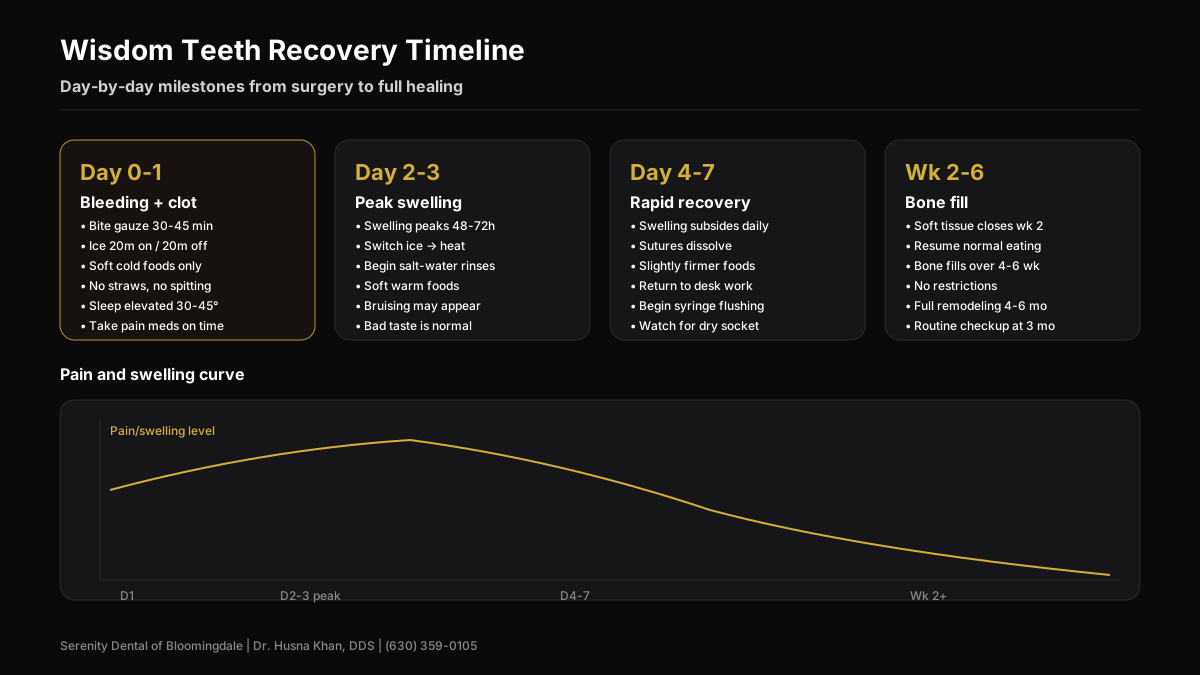
Recovery’s most active phase is the first 24 hours. A blood clot forms in each extraction socket within 30 to 60 minutes — this clot is the foundation for all later healing, and protecting it is the central goal of early aftercare.
Expect:
- Steady bleeding for 30 to 60 minutes, slowing to oozing for several more hours
- Numbness from local anesthetic for 3 to 6 hours after surgery
- The first wave of soreness as the anesthetic wears off (take pain medication before this)
- Swelling beginning to develop — it is often most noticeable the next morning
Do: bite firmly on the gauze for 30 to 45 minutes, ice on the cheek 20 minutes on / 20 off, stay upright (do not lie flat), drink room-temperature liquids without a straw, and start your pain medication before numbness fully wears off.
Avoid: spitting, rinsing, smoking, drinking through a straw, hot foods or drinks, and alcohol. All of these can dislodge the protective clot.
Days 2 to 3: peak swelling
Swelling peaks at 48 to 72 hours after surgery. This often surprises patients who felt good on day one and then woke up day two with a markedly puffy face. Peak swelling is normal, expected, and not a sign of infection. It resolves on its own over the next several days. In our practice, the day-three call about a puffy face is the most common call we get, and it is almost always this normal peak.
Expect:
- Maximum facial swelling on day 2 or 3
- Jaw stiffness (trismus) making it harder to open your mouth wide
- Bruising starting to appear on the cheek or even the neck
- Pain that responds well to alternating ibuprofen and acetaminophen
- Bad breath and a metallic taste — these are normal
Do: switch from ice to moist heat on day 2 or 3 to help drain swelling, continue soft foods, begin gentle warm salt-water rinses (one teaspoon of salt in a cup of warm water), and keep your head elevated when sleeping.
Call us if: swelling is rapidly worsening rather than peaking and stabilizing, fever climbs above 101 F, or pain is no longer responsive to medication.
Days 4 to 7: rapid improvement
Most patients describe day four as the corner-turning day. Swelling visibly subsides, jaw stiffness loosens, and pain becomes intermittent rather than constant.
Expect:
- Noticeable reduction in swelling each day
- Sutures loosening or beginning to dissolve (most are dissolvable; we use Vicryl)
- Ability to eat slightly firmer soft foods (pasta, soft bread, rice)
- Most patients return to desk work or school by day 4 or 5
Do: gentle salt-water rinses after eating, brush carefully around but not directly on the sites, begin walking and light activity (skip the gym still).
Call us if: pain suddenly worsens after improving, you develop a sharp throbbing pain that radiates to the ear (possible dry socket, which typically shows up between day 2 and day 5), or the surgical sites develop a foul taste or pus.
Days 7 to 14: tissue closure
Soft tissue closure is the milestone of week two. The gum knits over the socket, sutures dissolve completely (or are removed if non-dissolvable were used), and most patients return to normal activity.
Expect:
- Sockets nearly fully covered by gum tissue by day 14
- Sensitivity to cold or pressure when chewing on those sides
- A small depression where each tooth was — the bone underneath is still filling in
- Resumption of all normal foods, with care chewing on the surgical sides
Most patients are cleared to resume exercise, contact sports, and normal eating by the end of week two.
Weeks 3 to 8: bone fill
What you cannot see in the mirror is still happening underneath. Bone slowly fills the empty socket from the bottom up over the next four to six weeks. Imaging at six weeks typically shows the socket filling with new bone, and full remodeling continues for 4 to 6 months. There are no symptoms during this phase — you will not feel the bone forming. Your only clue is that the site gets progressively less sensitive.
When to call rather than wait
Call our office immediately for any of the following:
- Severe pain starting day 3 to 5 that worsens after initial improvement (dry socket)
- Fever above 101 F
- Pus, foul taste, or bad odor coming from a surgical site
- Swelling that worsens rather than peaking by day 3
- Numbness in the lip or chin that did not exist before surgery and is not resolving
- Bleeding that restarts and is not controlled by 30 minutes of firm gauze pressure
- Difficulty breathing or swallowing — call 911
Most of these are uncommon. Cochrane’s dry socket review puts it at 0.5 to 7 percent of routine extractions and a larger share of surgical third-molar removals, and the other red flags are rarer still. Calling early is always better than waiting.
A note from our office
At Serenity Dental of Bloomingdale, Dr. Husna Khan, DDS sees every wisdom-tooth patient for a follow-up visit at one week. We use that visit to confirm clot integrity, remove any non-dissolvable sutures, and answer the questions that have come up during the first week. If you have a recovery question between visits, call (630) 359-0105. Nobody has ever been scolded for asking.
Related reading from our tooth extractions guide
Wisdom teeth are a specialized type of tooth extraction. These guides cover related topics that apply to any extraction.
- Tooth extraction healing stages — Day-by-day biological healing stages from clot formation through full bone remodeling at six months
- Complete aftercare instructions — Day-by-day aftercare protocol that applies to every extraction
- Tooth extractions in Bloomingdale, IL — General extraction services for any non-wisdom tooth at Serenity Dental of Bloomingdale
Quick reference
| Stage | What to expect |
|---|---|
| Hours 0 to 24 | Bite gauze 30 to 45 min; ice 20 min on, 20 off; ibuprofen or prescribed pain meds |
| Days 1 to 3 | Peak swelling on day 2 to 3; soft cold foods; no straws, no smoking |
| Days 4 to 7 | Swelling resolves; transition to softer regular foods |
| Days 7 to 14 | Most patients return to normal activity; opening jaw fully takes 2 to 3 weeks |
| Weeks 4 to 6 | Full bone healing of the sockets |
| Watch for | Severe throbbing pain on day 3+ (dry socket), fever, or worsening swelling |
Wisdom teeth removal recovery - questions answered
How long does it take to fully recover from wisdom teeth removal?
When does swelling peak after wisdom teeth removal?
Can I go to work the day after wisdom teeth removal?
When can I eat normal food after wisdom teeth removal?
How long does the bleeding last after wisdom teeth removal?
When can I exercise after wisdom teeth removal?
When should I call my dentist after wisdom teeth removal?
Is bad breath normal after wisdom teeth removal?
Educational content only. Recommendations are personalized after an exam and any needed imaging.
Special situations during recovery worth knowing
Patients with diabetes heal more slowly. Poorly controlled blood sugar during the first week delays soft-tissue closure, so tighter control during recovery matters.
Smokers face higher dry socket rates and slower closure, even when they pause smoking for the first 72 hours; smoking is one of the risk factors the Cochrane dry socket review names. Quit-window support during the recovery week can be valuable.
Patients on immune-suppressing medications (prednisone, methotrexate, biologics) heal more slowly. Plan for a longer recovery and a follow-up at one week instead of two.
Athletes returning to high-intensity training too early increase bleeding and swelling. Three to four days of rest, then a graduated return over the next week, is the safer pattern.
Anxiety amplifies perceived recovery difficulty. Patients who go in expecting the worst often report more pain than the case warrants. Reasonable expectations and good information change the experience meaningfully.
Final recovery reminders
Trust the timeline. Day three feeling worse than day one surprises every patient, but it is the predictable inflammatory peak rather than a complication, and patients who panic and overcall during this normal phase use up energy and worry that the actual recovery does not require, while patients who simply rest, ice, and take medication on schedule almost always feel meaningfully better by day five. Be patient. Eat soft foods. Sleep elevated. Call only for true red flags.
Clinical context and evidence
Recovery after third-molar surgery is well described. The American Association of Oral and Maxillofacial Surgeons (AAOMS) clinical paper on impacted third molars notes that delayed healing and infection are the most common complications, that nerve injury is uncommon, and that complication rates rise with the patient’s age. Our timeline (clot in the first hour, peak inflammation at 48 to 72 hours, soft-tissue closure by about 14 days, bone fill over the following months) is the standard pattern we confirm at the one-week visit.
Dry socket is the complication patients fear most. Cochrane’s review on alveolar osteitis puts its frequency at 0.5 to 7 percent of routine extractions and considerably higher after surgical removal of lower third molars, and finds that a chlorhexidine rinse or gel around the time of surgery probably reduces the risk. Smoking, a difficult extraction, and oral contraceptive use are the risk factors that come up most.
Pain control has moved on from reflex opioid prescriptions. The American Dental Association’s 2024 guideline on acute dental pain recommends an NSAID such as ibuprofen, alone or with acetaminophen, as first-line treatment after extractions, with opioids reserved for limited circumstances. That is the regimen in this article.
Infection after wisdom tooth removal is uncommon in healthy patients. In the Cochrane review of antibiotics after extractions, about 19 healthy patients would need preventive antibiotics to stop one infection, with low-certainty evidence behind even that benefit. We do not prescribe them routinely. Every patient goes home with a printed instruction sheet and a one-week follow-up appointment instead.
Returning to physical activity should match healing milestones, not how the patient feels. Our activity timeline (no exercise for 3 to 4 days, light cardio from day 7, contact sports or heavy lifting from day 10 to 14) is the one we give at discharge, and patients who push it earlier are the ones who call about bleeding that restarted.
Medical disclaimer
This article is general information for patients and is not a substitute for the post-operative instructions you receive after your own surgery or for personalized medical or dental advice. Treatment recommendations depend on individual case complexity, X-ray and CBCT findings, medical history, and clinical assessment. If you are experiencing severe pain, swelling, fever, difficulty breathing, or uncontrolled bleeding after a wisdom tooth procedure, contact your dental provider or call our office at (630) 359-0105. For life-threatening symptoms, call 911 or go to the nearest emergency department.
Sources
- AAOMS clinical paper: The Management of Impacted Third Molar Teeth (2024). Delayed healing and infection are the most common complications; nerve injury is uncommon; complication rates rise with age
- Daly BJ et al. Local interventions for the management of alveolar osteitis (dry socket). Cochrane Database Syst Rev 2022;9:CD006968. Dry socket follows 0.5 to 7 percent of routine extractions and up to a third of surgical third-molar removals; chlorhexidine rinse or gel probably reduces the risk
- Lodi G et al. Antibiotics to prevent complications following tooth extractions. Cochrane Database Syst Rev 2021;2:CD003811. Low-certainty evidence that prophylactic antibiotics reduce infection and dry socket after wisdom tooth removal in healthy patients; about 19 people treated to prevent one infection
- American Dental Association, 2024 clinical practice guideline on the pharmacologic management of acute dental pain (ADA News summary of the JADA guideline). NSAIDs such as ibuprofen, alone or with acetaminophen, are first-line for acute dental pain; opioids only in limited circumstances
- AAOMS Parameters of Care: Clinical Practice Guidelines for Oral and Maxillofacial Surgery (ParCare), 7th edition. Practice guidelines covering dentoalveolar and implant surgery
Need help with this in real life?
Reading helps. Talking to someone who can look at your actual teeth and symptoms helps more. If you want a clear next step, we’re here.
Related articles
Emergency Wisdom Tooth Removal: When You Need Same-Day Care
When wisdom tooth pain, swelling, or infection needs same-day care, what the emergency visit involves, when antibiotics come first, and what to do until then.
Read article →Tooth Extraction Cost in 2026: What You Actually Pay
Real tooth extraction costs by procedure type -- simple, surgical, broken, and impacted. What insurance covers, what drives the price, and financing options.
Read article →Tooth Extraction Aftercare: Day-by-day Dos and Don'ts
Complete tooth extraction aftercare checklist -- gauze, rinsing, smoking, straws, sleeping position, brushing, and exercise. What to do and avoid by day.
Read article →