
Emergency Dentistry
Emergency Wisdom Tooth Removal: When You Need Same-Day Care
When wisdom tooth pain, swelling, or infection needs same-day care, what the emergency visit involves, when antibiotics come first, and what to do until then.
Most wisdom tooth pain can wait for a regular appointment. A small share of cases cannot. Severe throbbing pain, a jaw or cheek that swells overnight, fever, trouble swallowing, or pus draining from the gum line all point to an infection that has moved beyond the tooth itself. Those patients need to be seen the same day, and this guide explains how to tell the two apart, what the emergency visit involves, when antibiotics come before the extraction, and what the whole thing costs.
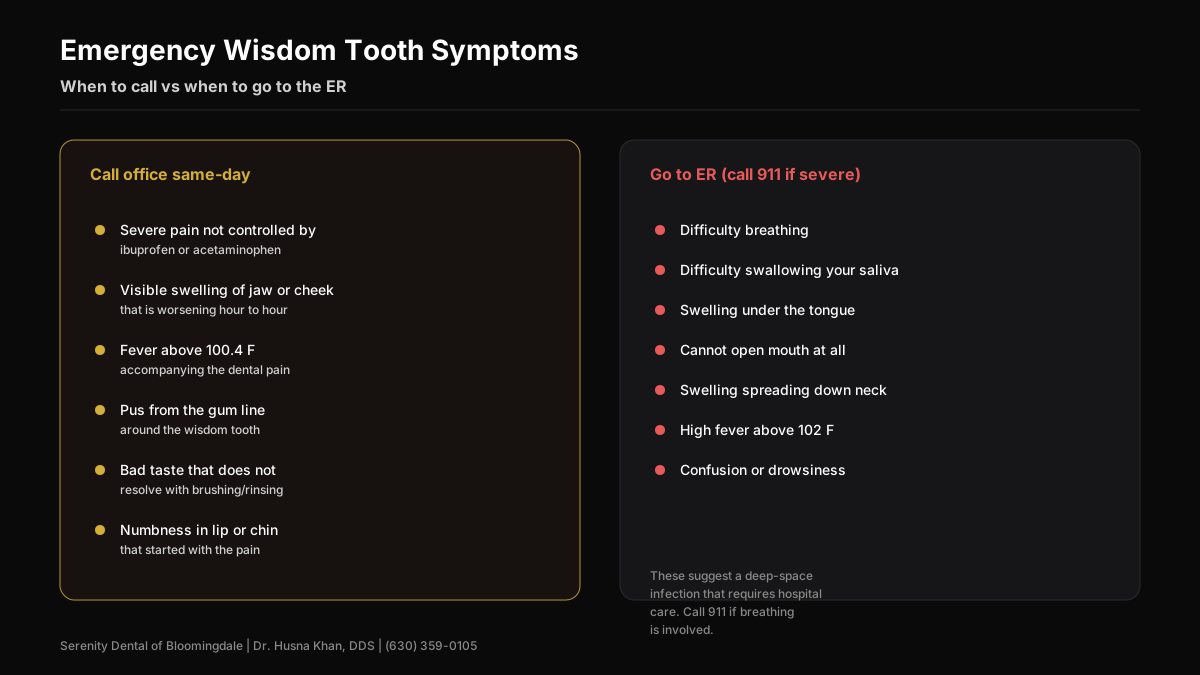
When to call rather than wait
Call (630) 359-0105 and ask for an emergency slot if you have any of the following:
- Severe pain that ibuprofen or acetaminophen no longer controls
- Swelling of the jaw, cheek, or the area under the chin that is growing hour by hour
- Fever of 100.4 F or higher alongside the dental pain
- Trouble opening your mouth more than about two finger-widths
- Pus, a foul taste, or a bad odor coming from the gum around a wisdom tooth
- Numbness or tingling in the lip or chin that started with the pain
These signs usually mean pericoronitis, an infection of the gum flap over a partially erupted tooth, or an abscess at the root. Rarely, the infection reaches the spaces under the tongue and jaw. A 2026 airway-management review of Ludwig’s angina puts a dental source behind roughly 70 to 90 percent of those cases, most often the lower second and third molars, and lists an elevated floor of the mouth, drooling, an inability to lie flat, and a muffled voice as the warning signs. Stridor comes late. Do not wait for it.
Difficulty breathing or swallowing means the emergency department, not the dental office. Call 911 if the airway is involved. For everything else on the list, a dentist is the right call, because the treatment that ends the infection is treatment of the tooth.
What happens at an emergency wisdom tooth visit
In our Bloomingdale office the emergency visit starts on the phone. Our front desk asks when the pain began, whether there is swelling or fever, whether you can swallow and open normally, and what you have taken for it, then holds the next open slot. At the visit we review your medical history and medications, take a panoramic X-ray or a CBCT scan to see the tooth and the bone around it, examine the gum for swelling and drainage, and check your temperature when a spreading infection is possible. Three outcomes are most common.
- Local infection only. We clean and irrigate under the gum flap, drain any pocket of pus, and send you home with rinses and pain control. If the tooth is accessible and the swelling is confined to the gum, it can often come out the same day.
- Pain without infection. An erupted wisdom tooth, or an impacted one that is not infected, can usually be removed at that visit if the anatomy and your schedule allow.
- Spreading infection. Fever, a face that is swelling, lymph nodes you can feel, or a jaw that barely opens means antibiotics plus drainage first. Once the acute phase settles, usually within a few days to two weeks, the tooth comes out.
At our Bloomingdale practice we remove erupted and most impacted wisdom teeth in-house under local anesthesia, with nitrous oxide or oral sedation for patients who want it. Deep bony impactions sitting on the nerve, patients who need IV sedation, and infections that have moved into the neck go to the oral surgeon we refer to, and for a true deep-space infection we send you straight to the hospital.
Why not just pull an infected tooth on the spot? Two practical reasons. Local anesthetic works poorly in acutely inflamed tissue, and a jaw that opens two finger-widths does not give a surgeon room to work safely at the back of the mouth. Even so, the American Dental Association’s guideline on dental pain and swelling puts definitive treatment first: for a wisdom tooth in the acute phase, that definitive step is the debridement and drainage on day one, with the extraction scheduled as soon as the mouth opens again.
Pericoronitis: the usual reason a wisdom tooth becomes an emergency
A lower wisdom tooth that has only partly broken through leaves a flap of gum over the crown. Food and bacteria collect underneath, the upper tooth bites down on the swollen flap, and the cycle feeds itself. Guidance from the Scottish Dental Clinical Effectiveness Programme on acute dental problems describes the pattern: localized pain around the partially erupted tooth, gum swelling that can spread to the face with lower molars, pain on swallowing, limited opening, a bad taste, and sometimes fever and fatigue.
That same guidance lays out the treatment order we follow. First, debridement and irrigation beneath the flap, under local anesthesia where possible. Second, warm salt-water or 0.2 percent chlorhexidine rinses and proper pain relief. Antibiotics are added only for signs of spreading infection, such as facial swelling or limited mouth opening, or for a patient whose immune system is compromised. Extraction is the answer when the episode is severe or when the same tooth keeps flaring, and the AAOMS clinical paper on impacted third molars lists acute or chronic infection, including cellulitis and abscess, as an indication for removal. Delayed healing and infection are, in the same paper, the most common complications of removal, and morbidity rises with the age of the patient, which is one argument for taking out a tooth that has already caused one infection rather than waiting for the second.
When antibiotics come before extraction
The American Dental Association’s 2019 guideline on antibiotics for dental pain and swelling, developed for pulpal and periapical infections in healthy adults, draws the line most dentists now apply to wisdom teeth as well. When the infection is localized and the tooth can be treated, antibiotics add nothing. When there is systemic involvement, which the guideline defines as swelling with fascial-space or lymph-node involvement, fever, or malaise, the dentist treats the tooth urgently and prescribes amoxicillin 500 mg three times a day or penicillin V 500 mg four times a day for 3 to 7 days. For patients allergic to penicillin without a history of anaphylaxis or hives, cephalexin is the alternative; for those with a true allergy, azithromycin or clindamycin, with the guideline noting higher resistance rates for the first and the risk of C. difficile colitis with the second. Patients are reassessed within three days, and the antibiotic stops 24 hours after the systemic signs resolve.
Evidence behind the restraint is thin but consistent. A 2018 Cochrane review (Cope and colleagues) found only two trials, 62 adults in total, comparing penicillin with placebo in people who also had the tooth treated. Adding the antibiotic made no measurable difference to pain or swelling at 24, 48, or 72 hours. Those reviewers rated the evidence very low certainty, which is itself the point: there is no good evidence that antibiotics help once the tooth is dealt with.
Stewardship is the other reason we do not prescribe for every sore wisdom tooth. In its 2026 stewardship strategies for outpatient dental settings, the CDC reports that general dentists wrote 25.2 million antibiotic prescriptions in 2022, more than 10 percent of all outpatient antibiotic use in the country, and they ask dentists to use the shortest effective course and to avoid clindamycin when another agent will do. We prescribe when the criteria are met, we explain why we do not when they are not, and we do not leave an infected tooth in place on a repeat prescription.
How to manage pain until your appointment
While you wait for the slot, three measures help most patients.
- Take an NSAID first. The American Dental Association’s 2024 acute dental pain guideline makes ibuprofen 400 mg or naproxen sodium 440 mg the first-line choice, alone or taken together with acetaminophen 500 mg, which gives better relief than either drug alone. Stay under 2,400 mg of ibuprofen and 4,000 mg of acetaminophen in 24 hours, counting any acetaminophen in combination products, and ask your pharmacist or physician first if you take blood thinners, have kidney disease or stomach ulcers, or are pregnant.
- Cold compress on the cheek, 20 minutes on and 20 minutes off, for swelling.
- Warm salt-water rinses every few hours, one teaspoon of salt in a cup of warm water, swished gently over the back of the mouth and spat out. A 0.2 percent chlorhexidine rinse works too.
Skip the rinses for the first 24 hours after the extraction itself. Before surgery they flush debris out from under the gum flap, which is exactly what a partially erupted tooth needs.
What emergency wisdom tooth removal costs
At Serenity Dental the emergency exam and X-ray are $49 for new patients. Extraction fees depend on how much bone covers the tooth, and the ranges below are typical for the Chicago area.
| Item | Chicago-area range |
|---|---|
| Emergency exam and X-ray | $49 new-patient special at Serenity; $50-$150 typical elsewhere |
| Erupted wisdom tooth, simple removal | $200-$700 per tooth |
| Soft-tissue impaction | $250-$850 per tooth |
| Partial bony impaction | $300-$950 per tooth |
| Full bony impaction | $350-$1,100 per tooth |
| Nitrous oxide | adds $50-$125 |
| Oral sedation | adds $200-$400 |
| IV sedation (at the referral oral surgeon) | adds $200-$600 |
Most PPO dental plans cover an emergency exam and X-rays even outside your normal recall schedule, and they cover surgical removal of an infected wisdom tooth at the basic or major rate, typically 50 to 80 percent after the deductible. With insurance, the out-of-pocket share for removal commonly lands between $50 and $200 per tooth. Antibiotics are filled at the pharmacy under your medical plan, not your dental plan. We verify benefits before any extensive treatment, emergency or not, and you get a written estimate before the extraction. Patients paying out of pocket can spread the cost through Cherry, CareCredit, or Sunbit.
For a broader look at the fees, including sedation and the difference between a simple and a surgical removal, see our wisdom teeth removal in Bloomingdale, IL page.
Special situations during a wisdom tooth emergency
Patients on blood thinners should say so when they call. Under the American Dental Association’s guidance, warfarin, aspirin, clopidogrel, and the newer anticoagulants such as apixaban are not stopped for a routine extraction, because the stroke or clot risk of stopping outweighs the bleeding, and the bleeding is controlled with pressure, hemostatic packing, sutures, and tranexamic acid. Any change to the medication is made with your physician, never on your own.
Pregnant patients with a wisdom tooth infection should not postpone care. The ADA’s pregnancy guidance, drawing on ACOG Committee Opinion 569, states that emergency treatments such as extractions can be performed safely during pregnancy and that penicillin, amoxicillin, cephalosporins, clindamycin, and metronidazole are considered safe. Delaying treatment, in the ADA’s words, may result in more complex problems. We coordinate with your obstetrician on medications.
Patients with diabetes often see blood sugar climb during an active oral infection. Bring your meter.
Patients who take bisphosphonates or denosumab for osteoporosis, or antiresorptive drugs for cancer, need the dentist to know before an extraction because of medication-related osteonecrosis of the jaw. The 2022 AAOMS position paper puts the risk below 0.05 percent for people on osteoporosis doses and below 5 percent for people treated for metastatic bone disease, and it lists extraction as a predisposing factor. At osteoporosis doses that risk is small. It still changes how we plan the surgery and the follow-up.
A note from our office
At Serenity Dental of Bloomingdale, Dr. Husna Khan, DDS holds time for acute dental pain, and we see emergency patients the same day whenever the schedule allows; calling early in the day gives you the best chance of a same-day slot. Hours run Monday through Friday with Tuesday evenings until 6:30 PM and Saturdays from 9 AM to 3 PM. After hours, the triage line takes your details and the front desk books the first opening the next morning. Our number is (630) 359-0105. Call rather than email if the pain is severe. If you are not sure whether what you have is an emergency, our guide to emergency dental care in Bloomingdale covers the other same-day problems we treat, from knocked-out teeth to lost crowns.
Related reading from our tooth extractions guide
Wisdom teeth are a specialized type of tooth extraction. These guides cover related topics that apply to any extraction.
- Infected tooth extraction covers removing a tooth with active infection, antibiotic timing, and abscess drainage.
- Wisdom teeth removal recovery walks through the first two weeks after the tooth comes out, day by day.
- Tooth extraction cost in 2026 itemizes simple, surgical, and broken-tooth fees with and without insurance.
- Our tooth extractions in Bloomingdale page covers extraction of any non-wisdom tooth at Serenity Dental of Bloomingdale.
Emergency wisdom tooth removal: questions answered
What counts as a wisdom tooth emergency?
Can a dentist remove a wisdom tooth the same day?
Do I need to go to the ER for a wisdom tooth infection?
How quickly can a wisdom tooth infection spread?
Will antibiotics fix a wisdom tooth infection without removal?
How much does emergency wisdom tooth removal cost?
Can I take ibuprofen and acetaminophen together for wisdom tooth pain?
Should I rinse with salt water before an emergency extraction?
Can I be seen on a Saturday for wisdom tooth pain?
Educational content only. Recommendations are personalized after an exam and any needed imaging.
Clinical context and evidence
Acute wisdom tooth care follows a short list of published guidance. The Scottish Dental Clinical Effectiveness Programme’s acute dental problems guidance covers pericoronitis itself: clean under the flap, rinse, treat the pain, prescribe antibiotics only for spreading or systemic infection, and remove the tooth when episodes are severe or recurrent. The American Dental Association’s 2019 antibiotic guideline supplies the definition of systemic involvement and the drug choices, and the 2018 Cochrane review by Cope and colleagues shows how little antibiotics add once the tooth is treated. Why that matters beyond your own mouth is the subject of the CDC’s 2026 stewardship document.
The AAOMS clinical paper on impacted third molars frames the decision to remove a tooth that has already been infected, and the 2022 AAOMS position paper on medication-related osteonecrosis, published in the Journal of Oral and Maxillofacial Surgery, sets the risk numbers we quote to patients on antiresorptive drugs. For pain control before and after the visit, the American Dental Association’s 2024 guideline in the Journal of the American Dental Association is the reference for the ibuprofen-plus-acetaminophen approach and for keeping opioids out of routine wisdom tooth care. Every source is listed below, and every number in this article comes from one of them or from the fee ranges on our own service pages.
Medical disclaimer
This article is general information for patients and is not a substitute for an examination, X-rays, and advice from a dentist who can see your mouth. Treatment depends on the position of the tooth, the extent of the infection, your medical history, and your medications. If you have severe pain, facial swelling, fever, or trouble opening your mouth, call our office at (630) 359-0105. If you have difficulty breathing or swallowing, call 911 or go to the nearest emergency department.
Cost figures in this article are Chicago-area reference ranges compiled from regional fee data and from the fee ranges on our own service pages, not quotes from Serenity Dental of Bloomingdale, apart from the $49 new-patient emergency exam, which is a current office promotion. Every dental insurance carrier negotiates its own fee schedule, so the amount a plan allows can sit above or below these ranges. Your actual fee depends on the position of the tooth, the sedation you choose, and your benefits, and we provide a written, itemized estimate before any treatment begins.
Sources
- Lockhart PB et al. Evidence-based clinical practice guideline on antibiotic use for the urgent management of pulpal- and periapical-related dental pain and intraoral swelling. J Am Dent Assoc 2019;150(11):906-921 (CDC summary for dentists). Definitive dental treatment first; antibiotics reserved for systemic involvement such as swelling with fascial-space or lymph-node involvement, fever, or malaise; amoxicillin 500 mg three times daily or penicillin V 500 mg four times daily for 3 to 7 days, reassessed within 3 days
- Cope AL, Francis N, Wood F, Chestnutt IG. Systemic antibiotics for symptomatic apical periodontitis and acute apical abscess in adults. Cochrane Database Syst Rev 2018;9:CD010136. Two trials, 62 adults who also had the tooth treated: adding penicillin made no measurable difference to pain or swelling at 24, 48, or 72 hours; very low-certainty evidence
- Centers for Disease Control and Prevention. Antibiotic Stewardship Strategies: Outpatient Dental Settings (July 2026). General dentists wrote 25.2 million antibiotic prescriptions in 2022, more than 10 percent of all outpatient antibiotic use; prescribe the shortest effective course and avoid clindamycin when a first-line or alternative agent can be used
- AAOMS clinical paper: The Management of Impacted Third Molar Teeth (2024). Acute or chronic infection, including cellulitis and abscess, is an indication for removal; delayed healing and infection are the most common complications; morbidity rises with the age of the patient
- Scottish Dental Clinical Effectiveness Programme. Management of Acute Dental Problems: Acute pericoronitis. Debridement and irrigation under the gum flap, salt-water or chlorhexidine rinses, and analgesia; antibiotics only for signs of spreading or systemic infection; extraction for severe or repeated episodes; difficulty breathing, stridor, dysphagia, or a muffled voice means emergency medical care
- Carrasco-Labra A et al. Evidence-based clinical practice guideline for the pharmacologic management of acute dental pain in adolescents, adults, and older adults. J Am Dent Assoc 2024;155(2):102-117. NSAIDs such as ibuprofen 400 mg or naproxen sodium 440 mg, alone or with acetaminophen 500 mg, are first-line for acute dental pain; daily maximums 2,400 mg ibuprofen and 4,000 mg acetaminophen; opioids only in limited circumstances
- Padhy S et al. Ludwig's Angina and the Race to Secure the Airway. In: Airway Management - Recent Advances. IntechOpen, 2026. Dental infection causes roughly 70 to 90 percent of cases, most often from the lower second and third molars; an elevated floor of the mouth, drooling, inability to lie flat, and a muffled voice are warning signs; stridor is a late sign
- Ruggiero SL et al. AAOMS Position Paper on Medication-Related Osteonecrosis of the Jaws, 2022 Update. J Oral Maxillofac Surg 2022. MRONJ risk is below 0.05 percent for patients taking antiresorptives for osteoporosis and below 5 percent for patients treated for metastatic bone disease; tooth extraction is a predisposing factor
- American Dental Association. Oral Anticoagulant and Antiplatelet Medications and Dental Procedures (Oral Health Topics, updated September 2022). For most patients the medication is not stopped before an extraction; bleeding is controlled with local measures such as pressure, hemostatic agents, sutures, and tranexamic acid; any change is made with the prescribing physician
- American Dental Association. Pregnancy (Oral Health Topics, updated July 2025), citing ACOG Committee Opinion 569. Emergency treatments such as extractions can be performed safely during pregnancy; penicillin, amoxicillin, cephalosporins, clindamycin, and metronidazole are considered safe; delaying treatment may result in more complex problems
Need help with this in real life?
Reading helps. Talking to someone who can look at your actual teeth and symptoms helps more. If you want a clear next step, we’re here.
Related articles
My Child Knocked Out a Tooth: What to Do Right Now
What to do when a child knocks out a tooth: baby versus permanent tooth, first-aid steps in order, how to store the tooth, and when the ER is the right call.
Read article →Wisdom Teeth Removal Recovery: Day-by-Day Timeline and What to Expect
Wisdom teeth removal recovery -- a day-by-day timeline of swelling, pain, and healing milestones from surgery to full recovery, with red flags that mean call the office.
Read article →Emergency Root Canal: Same-Day Care for Severe Pain
When tooth pain needs same-day treatment. Emergency root canal signs, what happens at the urgent visit, antibiotics, and emergency endodontic care options.
Read article →