Patient Resources
Are Root Canals Safe? The Evidence Behind the Online Myths
A clinical review of social-media claims that root canals cause cancer or chronic disease, with the real evidence and the AAE, ADA, and Cochrane positions.
A patient who arrives convinced that root canals cause cancer, autoimmune disease, or “energetic” harm is not unusual in 2026. Such claims circulate on TikTok, Instagram, certain podcasts, and a 2019 Netflix documentary that was eventually pulled from the platform. The question deserves a clear answer grounded in actual evidence — not dismissed and not amplified.
Short version: root canal therapy is one of the most studied dental procedures, performed approximately 15 million times per year in the United States according to AAE data, with consistently high success rates over follow-up windows of 5 to 30 years and no peer-reviewed evidence of systemic harm. Longer version follows.
For the procedure itself, see root canal procedure step by step. For the alternative comparison, see tooth extraction vs root canal.
Where do the myths come from?
Most contemporary anti-root-canal claims trace back to a single source: research published by Weston A. Price between 1910 and 1925.
Price was a dentist who hypothesized that root-canal-treated teeth harbored bacteria that caused chronic systemic disease — arthritis, heart disease, kidney problems. He extracted treated teeth from sick patients, implanted them under the skin of rabbits, and claimed the rabbits developed similar diseases. By even 1920s standards, the methodology was poor: no controls, no blinding, no consideration of confounding variables, and no understanding of the bacteria-host relationship as it is understood today.
A detailed rebuttal of Price’s work has been published by the American Association of Endodontists. Modern microbiology has the tools to study residual bacteria in treated teeth directly, and the findings do not support Price’s hypothesis. Yet the original claims persist, often re-packaged with newer-sounding language.
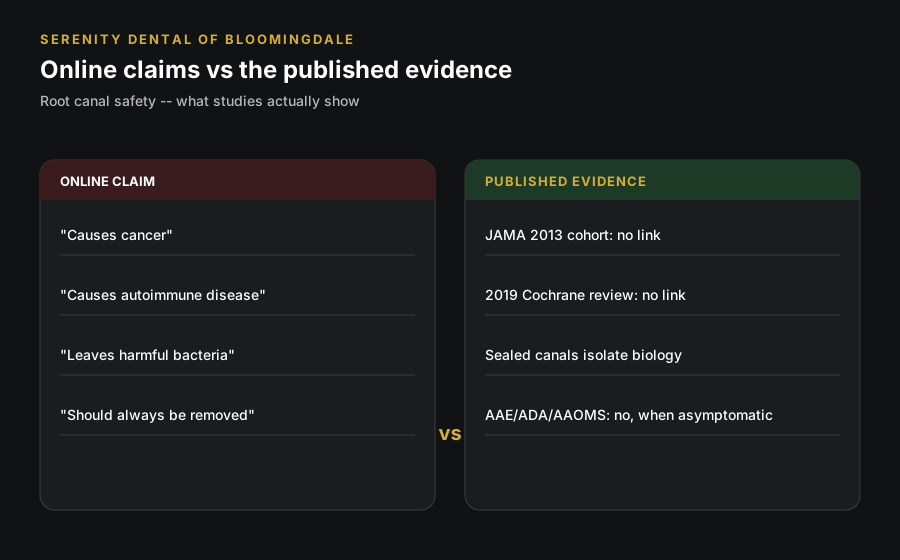
A 2013 study in JAMA Otolaryngology found no association between root canal therapy and cancer risk in over 100,000 patients followed across decades. A separate Annals of Translational Medicine review in 2018 found no association with cardiovascular disease beyond what is explained by general oral inflammation — which is itself a reason to keep teeth healthy, not to remove them.
What did the documentary Root Cause get wrong?
Several patients ask specifically about the 2019 Netflix documentary “Root Cause.” A focused review.
Selection bias. Individuals featured in the film attribute health improvements to extraction of root-canal-treated teeth. No control group, no comparison to patients who kept their teeth and also improved, no consideration of regression to the mean.
Misrepresentation of bacterial findings. Bacteria in dentinal tubules are presented as a novel discovery. They are not — microbiologists have known this for decades. The clinical question is whether sealed canals release significant bacteria into the bloodstream, and the answer in current evidence is no.
Conflicts of interest. Several of the providers featured market specific extraction-and-replacement protocols at substantial cost. This was not disclosed prominently.
Professional response. Formal statements identifying factual errors were issued by the American Association of Endodontists, American Dental Association, and American Association of Dental Research. Netflix removed the film in early 2019 after public health concerns were raised by multiple medical organizations.
What does the evidence actually show?
Stepping back from the social-media claims, the body of evidence on root canal therapy looks like this.
Survival rates. Pooled long-term studies show 86 to 93 percent 10-year survival of root-canal-treated teeth when properly restored with a crown. Failures are dominated by restorative breakdown, not the endodontic treatment itself.
Systemic outcomes. Large cohort studies and a 2019 Cochrane systematic review find no association between root canal therapy and systemic disease beyond the general (modest) link between oral inflammation and overall health — a link that argues for treating disease, not extracting treated teeth.
Quality of life. Multiple Journal of Endodontics quality-of-life studies show patient-reported outcomes equivalent to or better than implant alternatives in restorable teeth.
Safety of materials. Gutta-percha, the rubber-like material used to seal canals, has been used since the 1800s with no demonstrated allergic or toxic effects in clinical literature. Modern sealers are biocompatible per ISO 10993 testing.
What do the major dental and medical bodies say?
A snapshot of the institutional position.
American Dental Association (ADA). Root canal therapy is a safe, effective, evidence-based procedure. Removing healthy treated teeth is not recommended.
American Association of Endodontists (AAE). Position paper on focal infection theory: no scientific basis for the claim that root-canal-treated teeth cause systemic disease.
American Association of Oral and Maxillofacial Surgeons (AAOMS). Extraction of asymptomatic teeth is not indicated based on theoretical concerns alone.
World Health Organization (WHO). Includes endodontic treatment in its essential dental services framework.
Cochrane Collaboration. Systematic reviews of endodontic outcomes show high success rates and no evidence of systemic harm.
When every major evidence-based body lands in the same place, that consensus is meaningful. It does not mean every individual case is straightforward — it means the broad question of whether the procedure itself is safe is settled.
When is concern reasonable?
Healthy skepticism is not the same as rejection of evidence. A few cases warrant genuine clinical attention.
Persistent symptoms in a treated tooth. Pain, swelling, or a sinus tract on the gum near a root-canal-treated tooth points to failure of that specific tooth, not failure of root canal therapy as a category. See failed root canal signs for what to watch for.
Vertical root fracture. A treated tooth that fractures down the root cannot be saved further — extraction is appropriate.
Allergic reactions. Genuine allergies to gutta-percha or sealers are documented but rare. Patch testing with a dermatologist is reasonable for patients with multiple unexplained reactions to dental materials.
Compromised immune status. Patients on certain immunosuppressive therapies may need consultation between their physician and dentist before any dental treatment. AAE has specific guidance for these cases.
In our practice, every patient who arrives with safety concerns gets the same response: questions deserve real answers, evidence is reviewed openly, and the decision about the specific tooth is made together. We schedule longer consultation slots when patients want to discuss the literature in detail.
What do we recommend?
A few principles we apply at our office.
For a tooth that genuinely needs root canal therapy, we recommend root canal therapy. Doing nothing safely is not actually an option here — the alternative is extraction, often followed by an implant. Where the procedure is appropriate, treatment typically completes in 2 to 4 weeks across one or two visits, with a permanent crown placed shortly afterward.
For an asymptomatic root-canal-treated tooth that is functioning well, we recommend leaving it alone. Removing functioning teeth on theoretical grounds is not supported by evidence.
For patients with significant safety concerns, we recommend an extended consultation rather than a rushed visit — either with us or with a board-certified endodontist for a second opinion. Decisions made under time pressure or social-media-induced anxiety are rarely the best decisions.
To get an evaluation for your specific tooth, call our office at (630) 359-0105 or schedule an appointment online. Related: root canal service page · root canal procedure · tooth extraction vs root canal.
Clinical references and sourcing
Clinical guidance in this article reflects current standards from the American Association of Endodontists (AAE) consensus statements on endodontic diagnosis and treatment outcomes; American Dental Association (ADA) procedure coding and clinical guidance; American Association of Oral and Maxillofacial Surgeons (AAOMS) parameters of care for surgical adjuncts; Cochrane systematic reviews of endodontic outcomes; and outcome studies indexed in the Journal of Endodontics (JOE). Specific timelines, costs, and survival rates cited reflect peer-reviewed pooled data, not vendor or single-study claims.
Root canal safety - common questions
Are root canals safe?
Do root canals cause cancer?
Do root canals leave bacteria in the tooth?
Should I have my old root canals removed?
Are root canals linked to autoimmune disease?
Is the documentary Root Cause accurate?
What does holistic or biological dentistry say about root canals?
Is there a safer alternative to a root canal?
Educational content only. Recommendations are personalized after an exam and any needed imaging.
About this article
Reviewed by Dr. Husna Khan, DDS, of Serenity Dental of Bloomingdale. Dr. Husna Khan practices evidence-based dentistry and welcomes longer consultation slots for patients who want to review the published literature on root canal therapy before making a decision about a specific tooth.
This article is for general educational and informational purposes and is not a substitute for an individualized in-person dental evaluation. Individual cases vary based on clinical findings, imaging, and patient-specific factors. If you have a tooth in question, please call our office or schedule an evaluation.
Cited sources: AAE clinical guidelines and outcome statements, ADA procedure coding and clinical guidance, AAOMS parameters of care, Cochrane systematic reviews of endodontic outcomes, and Journal of Endodontics (JOE) outcome studies.
Need help with this in real life?
Reading helps. Talking to someone who can look at your actual teeth and symptoms helps more. If you want a clear next step, we’re here.
Related articles
Root Canal Cost in 2026: What You Actually Pay
Real root canal costs by tooth type -- front, premolar, molar. What insurance covers, the crown cost after, financing, and the $99 root canal trap explained.
Read article →Root Canal Recovery Time: Day-by-Day What to Expect
Root canal recovery timeline -- when pain resolves, what to eat, when to return to work, chewing restrictions, and the crown appointment timing.
Read article →Pain After a Root Canal: Normal vs Concerning
Post-root-canal pain timeline -- what is normal, how long soreness should last, when pain after 7 days signals a problem, and when to call your dentist.
Read article →