
Oral Surgery
Root Canal vs Extraction: How to Decide
Tooth extraction vs root canal -- cost, pain, success rates, longevity, and when each makes sense. Clear framework for deciding which procedure is right.
Hearing “you need a root canal or an extraction” puts most patients at a decision point they didn’t expect. The honest answer is that saving a natural tooth is usually preferable when it’s possible — but “possible” depends on the tooth’s specific condition. This guide compares the two options on the factors that matter most: cost, pain, longevity, success rates, and the specific clinical situations where each makes sense.
A tooth extraction removes the tooth and root entirely. A root canal removes the infected or damaged pulp inside the tooth but preserves the tooth structure itself, which is then restored with a filling and usually a crown. Both are common, predictable procedures. The question is which is right for your specific situation.
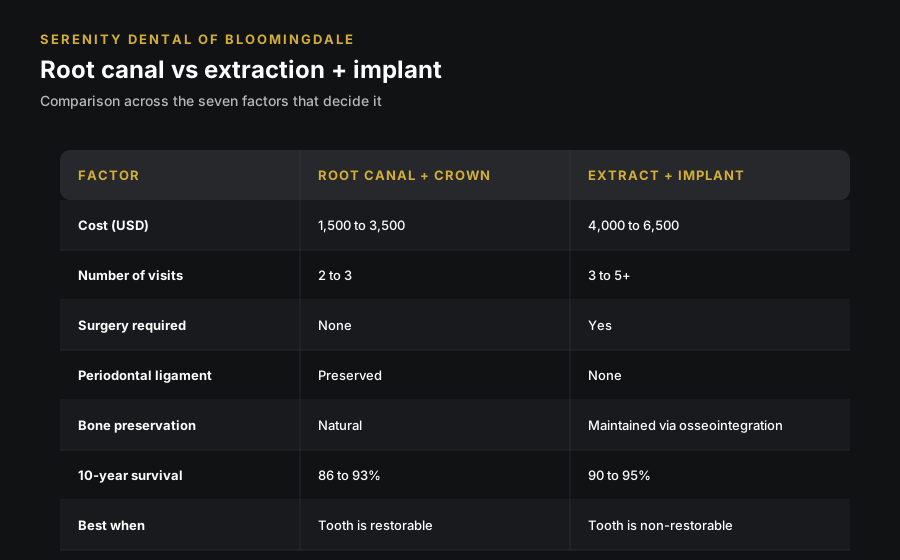
Quick-reference comparison
| Factor | Root canal + crown | Extraction + replacement |
|---|---|---|
| Initial cost | $1,700 to $3,400 | $150 to $650 (extraction only) |
| Total cost with replacement | $1,700 to $3,400 | $4,000 to $7,000 (with implant) |
| Procedure duration | 1 to 2 visits, 60 to 90 min each | 1 visit, 30 to 60 min |
| Recovery time | Mild soreness 1 to 3 days | Moderate soreness 3 to 7 days |
| 10-year success rate | 86 to 93 percent | 90 to 95 percent (implants) |
| Preserves bone | Yes | No (unless implant placed) |
| Natural tooth sensation | Yes | Close but not identical with implant |
| Insurance coverage | Typically 50 to 80% of root canal | Extraction covered well, implant usually not |
When does a root canal make sense?
Root canal therapy preserves the natural tooth, which is the single most important advantage. Natural teeth integrate with the bite, feel natural when eating, maintain the jawbone around them, and don’t require maintenance beyond normal dental care. Six clinical situations strongly favor root canal over extraction.
1. Adequate tooth structure remains. At least half the tooth’s clinical crown (the visible portion above the gum) should be intact. Teeth with enough structure for a crown to grip are excellent candidates. Teeth broken below the gumline or with minimal structure remaining usually can’t be restored predictably even after a successful root canal.
2. Healthy periodontal support. The gum and bone around the tooth must be healthy enough to hold the tooth in place long-term. Teeth with advanced periodontal disease (50 percent or more bone loss around the roots) are unlikely to function well even after successful endodontic treatment.
3. No vertical root fracture. A crack extending vertically through the root is not repairable. These teeth are typically extracted because fluid and bacteria track down the crack and reinfect the area even after a root canal.
4. First-time root canal. First-time root canal treatments have the highest success rates, typically 90 percent or higher. Second root canals (retreatment) have lower success rates (70 to 80 percent), making the decision more nuanced for teeth that have failed a previous root canal.
5. Important position in the mouth. Front teeth and teeth critical for bite function warrant more effort to save. Losing a front tooth affects appearance, speech, and self-confidence. A healthy molar supports chewing and jaw stability.
6. Age and future planning. Younger patients typically benefit more from root canal therapy because the tooth has more functional years ahead. Older patients in excellent health similarly benefit from preserving natural dentition.
The American Association of Endodontists estimates more than 15 million root canals are performed annually in the United States, with well-documented long-term success when cases are selected appropriately.
When does extraction make sense?
Extraction is the right answer in several specific situations, not as a failure of saving the tooth but as a clinical reality that some teeth cannot be reliably restored.
1. Severe decay below the gumline. If decay has progressed to the point where there isn’t enough healthy tooth structure above the bone level, restoring the tooth predictably becomes unlikely. Crown lengthening surgery can sometimes change this, but it adds cost and isn’t always anatomically possible.
2. Vertical root fracture. A crack through the root is not repairable. The tooth should be extracted and replaced.
3. Failed previous root canal. Teeth with a previously failed root canal have 70 to 80 percent success rates on retreatment compared to 90 percent on first-time treatment. Third attempts (re-retreatment or apicoectomy) have even lower success. Some patients opt for extraction rather than investing in repeat procedures.
4. Advanced periodontal disease. When gum disease has destroyed 60 to 70 percent or more of the supporting bone, the tooth is likely to fail mechanically even after successful root canal therapy.
5. Strategic orthodontic extraction. Some orthodontic treatment plans require removing teeth to create space. These are healthy teeth being removed for alignment purposes.
6. Patient factors. Patients with certain medical conditions, significant dental anxiety, or financial constraints sometimes choose extraction even when root canal is technically possible. This is a legitimate decision when made with full information.
Cost comparison over time
Immediate cost favors extraction. Long-term cost depends heavily on what replaces the extracted tooth. The ranges below reflect typical Chicago-area pricing; your exact estimate is confirmed in writing after examination and imaging.
Year 1 costs
| Scenario | Typical range |
|---|---|
| Root canal + crown (molar) | $2,000 to $3,400 |
| Root canal + crown (front tooth) | $1,700 to $2,800 |
| Extraction only | $150 to $650 |
| Extraction + dental implant | $4,000 to $7,000 |
| Extraction + bridge | $2,500 to $5,000 |
| Extraction + partial denture | $500 to $2,000 |
10-year total cost
The picture changes substantially when factoring in long-term needs.
A successful root canal and crown typically requires no additional intervention for 10+ years. Total 10-year cost: $1,700 to $3,400.
A successful implant similarly lasts 10+ years. Total 10-year cost including the extraction: $4,000 to $7,000. Higher than a root canal but includes functional replacement.
Extraction without replacement starts cheapest but often requires intervention later: adjacent teeth shift (requiring orthodontic correction), opposite tooth extrudes (requiring crown work), and bone loss progresses. The tooth extractions service page covers replacement options in depth.
A failed root canal followed by extraction and implant is the most expensive path — starting with the root canal cost, then adding extraction, then the implant. Careful case selection minimizes this scenario.
Pain comparison
A common misconception: root canals are painful. Modern root canal therapy with proper anesthesia is typically no more uncomfortable than a filling during the procedure. Post-procedure soreness is generally milder than extraction recovery.
Root canal
During: Local anesthesia. Most patients feel pressure and mild vibration, but no sharp pain. Anxious patients often benefit from nitrous oxide or oral sedation.
After: Mild to moderate soreness for 1 to 3 days. Ibuprofen typically sufficient. Eating soft foods for the first day is reasonable.
Extraction
During: Local anesthesia. Simple extractions feel like pressure and movement. Surgical extractions involve incision and sometimes sectioning of the tooth, but still no sharp pain with proper anesthesia.
After: Moderate soreness for 3 to 7 days for simple extractions, 5 to 10 days for surgical. Ice packs for the first 48 hours. Diet restrictions for a week or more. Dry socket risk adds a small but meaningful concern.
For most patients, the recovery burden favors root canal. The pain after tooth extraction article covers extraction recovery specifically.
Success rates: what the research shows
Both procedures have well-documented outcomes.
Root canal success
Meta-analyses by the American Association of Endodontists report:
- First-time root canal success: 86 to 93 percent at 10 years
- Retreatment success: 70 to 85 percent at 10 years
- Apicoectomy (surgical retreatment): 60 to 80 percent at 10 years
Key predictors of success include the quality of the final restoration (crown within 30 days), absence of vertical root fractures, and the specific tooth being treated (front teeth generally higher success than molars).
Implant success (after extraction)
Large implant registries show:
- Single-tooth implant success at 10 years: 90 to 95 percent
- Multi-unit implants: 85 to 90 percent
- Full-arch implant-supported prosthetics: 93 to 98 percent at 10 years
Key predictors include bone quality at placement, smoking status (smokers have notably higher failure rates), and overall oral hygiene.
Both procedures work well when cases are selected appropriately. Neither is a magic solution; both require good clinical judgment and execution.
The decision framework
A useful way to think through the choice:
Questions to work through with your dentist
- Is the tooth restorable? Does enough structure remain above the bone level for a reliable crown?
- Is the root intact? Is there a vertical fracture that would make root canal therapy predictably fail?
- Is the periodontal support healthy enough to hold the tooth long-term?
- Has the tooth had previous root canal therapy? If so, is retreatment reasonable or is the success rate too low?
- Does your lifestyle (smoking, diabetes management, oral hygiene) affect the success rate of each option?
- What’s your total cost sensitivity, considering both immediate and 10-year outcomes?
- If extraction is chosen, is implant replacement financially and clinically feasible in the near term?
A good dental provider walks through all of these with you rather than rushing to a recommendation. CBCT imaging, when indicated, clarifies the anatomy and improves decision-making. Second opinions are reasonable for major decisions — especially when extraction is recommended for a tooth that could potentially be saved.
What if you’re not sure?
Several reasonable paths exist for patients facing this decision.
Get a consultation from an endodontist. Endodontists specialize in root canal therapy and can give a clear read on whether your specific tooth is a good candidate. They may identify cases where root canal is predictable that a general dentist might recommend for extraction.
Get a second opinion on extraction recommendations. If your current provider is recommending extraction, a second opinion confirms the clinical reasoning. Most ethical providers appreciate second opinions on significant decisions.
Review the CBCT imaging yourself. Modern imaging lets you see the anatomy clearly. A good provider walks through the images with you, pointing out what’s driving the recommendation.
Think about your timeline. Emergency situations sometimes force immediate decisions. Non-emergency situations benefit from taking a week to think through options and gather information.
For a consultation on whether your tooth is a good candidate for root canal therapy or extraction, or to review a recent recommendation from another provider, call Serenity Dental at (630) 359-0105. Related: tooth extractions service page · dental implants · tooth extraction cost · dental implant cost.
In our practice, we map every canal with electronic apex location before obturation, and we schedule the final crown promptly because timing the restoration well is one of the strongest predictors of long-term tooth survival.
One more rule. Swelling in the gum or face, a bad taste that keeps coming back, or pain that wakes you at night is the point where you call us rather than wait, because an abscess narrows the choice to whichever treatment can still save the tooth once the infection has been drained, and that window closes faster than most people expect. Waiting costs options. Call (630) 359-0105 the same day. Two hours of numbness beats a week of antibiotics that only postpone the decision you were already facing, and that is the whole argument for picking up the phone early.
Clinical references and sourcing
Clinical guidance in this article reflects current standards from the American Association of Endodontists (AAE) consensus statements on diagnosis, retreatment, and outcomes; American Dental Association (ADA) procedure coding and clinical guidance; American Association of Oral and Maxillofacial Surgeons (AAOMS) parameters of care for adjacent surgical decisions; Cochrane systematic reviews of endodontic outcomes; and outcome studies indexed in the Journal of Endodontics (JOE). Cited timelines and survival rates are drawn from these primary sources.
Cost figures in this article are typical ranges for the Chicago area, compiled from regional fee data. They are not quotes from Serenity Dental of Bloomingdale; your fee depends on exam findings, materials, and insurance benefits, and we provide a written, itemized estimate before any treatment begins.
Tooth extraction vs root canal - questions answered
Is a root canal better than a tooth extraction?
Is a root canal or extraction more painful?
How much does a root canal cost vs an extraction?
How long does a root canal last compared to an extraction?
When should I choose extraction over root canal?
Can you save a tooth that needs a root canal?
Is it cheaper to extract or save a tooth?
What happens if I just extract the tooth and don't replace it?
Root canal vs extraction for a back molar: which is better?
Can a tooth be extracted after a root canal and crown?
Educational content only. Recommendations are personalized after an exam and any needed imaging.
About this article
Reviewed by Dr. Husna Khan, DDS, of Serenity Dental of Bloomingdale. Dr. Husna Khan performs endodontic treatment in-house at our office using rubber-dam isolation, rotary nickel-titanium instrumentation, electronic apex location, and CBCT imaging when canal anatomy warrants it.
This article is for general educational and informational purposes and is not a substitute for an in-person dental evaluation. Individual cases vary — a specific treatment plan is determined after clinical examination and imaging. If you have ongoing tooth pain, swelling, or a tooth you are unsure about, please call our office or schedule an evaluation so we can examine the tooth and review your imaging with you.
Cited sources: AAE clinical guidelines, ADA procedure coding and clinical guidance, AAOMS parameters of care, Cochrane systematic reviews of endodontic outcomes, and Journal of Endodontics (JOE) outcome studies.
Need help with this in real life?
Reading helps. Talking to someone who can look at your actual teeth and symptoms helps more. If you want a clear next step, we’re here.
Related articles
Root Canal Cost in 2026: What You Actually Pay
Real root canal costs by tooth type -- front, premolar, molar. What insurance covers, the crown cost after, financing, and the $99 root canal trap explained.
Read article →Root Canal Recovery Time: Day-by-Day What to Expect
Root canal recovery timeline -- when pain resolves, what to eat, when to return to work, chewing restrictions, and the crown appointment timing.
Read article →Tooth Extraction Cost in 2026: What You Actually Pay
Real tooth extraction costs by procedure type -- simple, surgical, broken, and impacted. What insurance covers, what drives the price, and financing options.
Read article →