
Restorative Dentistry
Root Canal Procedure: Step by Step What Actually Happens
The root canal procedure explained step-by-step -- tooth anatomy, anesthesia, cleaning and shaping, obturation, temporary filling, and the final crown.
A root canal (also called endodontic treatment or tooth canal treatment) is a routine procedure that removes infected or inflamed pulp from inside a tooth, cleans and seals the canals, and saves the natural tooth. Most cases are completed in a single appointment lasting 45 minutes to 2 hours depending on the tooth. This guide walks through exactly what happens at each step, with the clinical rationale behind the technique.
For the bigger picture including cost and when it’s needed, see the root canal service page. If you’re deciding between root canal and extraction, see tooth extraction vs root canal.
A 60-second anatomy primer
Every tooth has three main layers and an inner chamber:
Enamel is the hard outer shell — the hardest substance in the human body, even harder than bone.
Dentin is the yellowish layer beneath the enamel. It’s softer than enamel and contains tiny tubules that connect to the pulp. When decay reaches dentin, it spreads faster than through enamel.
Pulp is the soft tissue in the center of the tooth. It contains nerves, blood vessels, and connective tissue. The pulp extends from the crown of the tooth down through channels in the roots called root canals.
Cementum covers the outer surface of the roots below the gumline and anchors the tooth to the surrounding bone through the periodontal ligament.
The root canals are what the procedure is named for. When bacteria reach the pulp through deep decay, a crack, or trauma, the pulp becomes inflamed or infected. Root canal treatment removes the diseased pulp from these channels, cleans them, and seals them against reinfection.
How many canals does your tooth have?
Canal count varies by tooth position:
| Tooth | Typical canal count | Notes |
|---|---|---|
| Upper incisors | 1 | Simplest anatomy |
| Lower incisors | 1 | Occasionally 2 in older patients |
| Canines | 1 | Long, straight canal |
| Upper premolars | 1 to 2 | First premolar often has 2 |
| Lower premolars | 1 | Occasionally 2 |
| Upper molars | 3 to 4 | Often has a harder-to-find fourth canal (MB2) |
| Lower molars | 3 | Sometimes 4 in anatomical variations |
Missing a canal during treatment is one of the most common causes of root canal failure. For this reason, CBCT imaging is particularly valuable for molar root canals, where canal anatomy is most variable. A 3D scan can identify extra canals that might not be visible on standard 2D X-rays.
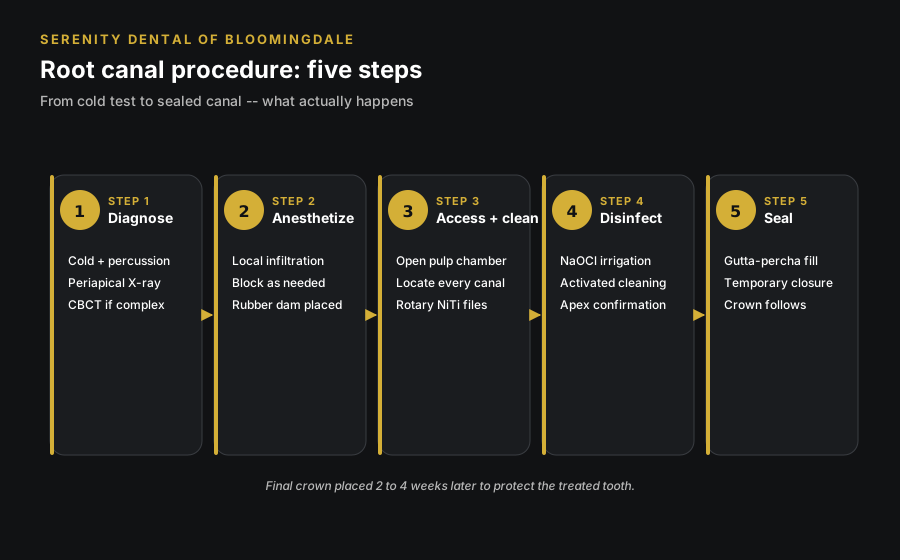
The procedure step by step
Most root canals follow this sequence regardless of which tooth is being treated.
Step 1: Diagnosis and imaging
Before any treatment begins, the diagnosis is confirmed. This typically involves:
- Clinical exam testing the tooth for sensitivity to cold, heat, percussion (tapping), and biting pressure
- Digital X-ray showing the tooth roots, surrounding bone, and any visible infection at the root tip
- CBCT imaging (3D scan) for complex cases — molars with unusual anatomy, retreatment cases, or teeth with failed prior treatment
The imaging also maps the canal system so the provider knows what to expect inside the tooth. For a first-time straightforward front tooth, 2D X-ray is usually sufficient. For a molar or retreatment case, CBCT adds important information.
Step 2: Anesthesia
Local anesthesia is administered and given time to reach full effect. This typically takes 5 to 10 minutes. The provider tests the tooth with cold or tapping before starting — if anything is still sensitive, more anesthesia is added.
For anxious patients, nitrous oxide (laughing gas) or oral sedation can be added on top of local anesthesia. Full numbness of the tooth is the goal regardless of whether sedation is used.
Step 3: Rubber dam placement
A thin sheet of latex or silicone is stretched over the tooth being treated, with a small hole for just that tooth. The rubber dam:
- Keeps saliva and bacteria out of the treatment area (essential for long-term success)
- Prevents swallowing small files or debris
- Improves visibility by keeping the tongue and cheek out of the way
- Keeps the tooth dry, which improves the effectiveness of disinfecting solutions
Using a rubber dam is standard of care for modern endodontic treatment. Clinics that skip this step have meaningfully lower success rates.
Step 4: Access opening
A small opening is made through the top of the tooth using a dental drill. The goal is to reach the pulp chamber with minimum removal of healthy tooth structure.
- Front teeth: opening is on the back surface (tongue side) to preserve the front appearance
- Molars and premolars: opening is on the top chewing surface
The pulp chamber is cleaned and the openings of the root canals are identified.
Step 5: Canal cleaning and shaping
This is the core of the root canal. Small flexible files — often rotary powered with nickel-titanium instruments — remove the infected pulp tissue and shape the canals to a specific size and taper. Between instruments, the canals are irrigated with disinfecting solutions:
- Sodium hypochlorite (dilute bleach) dissolves organic debris and kills bacteria
- EDTA removes the smear layer left by file work
- Chlorhexidine may be used as a final antibacterial rinse
Modern electronic apex locators help determine exact canal length, so the files don’t extend beyond the root tip into the surrounding tissue.
Clean, dry canals with the proper shape are the goal. This step takes the most time — often 30 to 60 minutes depending on the number and complexity of canals.
Step 6: Obturation (filling the canals)
Once the canals are clean and shaped, they’re sealed. The most common technique:
- A small amount of sealer cement is placed in each canal
- Gutta-percha points (a natural rubber-like material) are inserted into the canals
- The gutta-percha is compacted with heated pluggers, filling every space
Gutta-percha has been the standard root canal filling material for over 150 years because it’s biocompatible, dimensionally stable, and seals effectively. Modern warm vertical compaction techniques produce dense, void-free fills that significantly improve long-term outcomes.
An X-ray confirms the fill reaches the end of each canal without overfilling.
Step 7: Temporary restoration
The access opening is sealed with a temporary filling material. The tooth is now internally sealed and the infection source is removed. The temporary is designed to hold for 2 to 4 weeks while the permanent crown is being made.
For straightforward single-rooted teeth, some providers place the permanent restoration the same day. More commonly, the crown appointment is scheduled 2 to 4 weeks later to allow any remaining inflammation to subside.
Step 8: Final restoration (separate appointment)
The permanent crown or filling is placed:
Crown (most molars and premolars, some front teeth): The tooth is prepared to receive the crown, an impression or digital scan is taken, and either the permanent crown is placed same-day (with in-office CEREC milling) or a temporary crown is placed while the permanent is fabricated off-site.
Filling only (some front teeth): A direct composite filling restores the access opening. Usually reserved for teeth with minimal structural loss.
Placing the permanent restoration within 30 days significantly improves the tooth’s 10-year survival rate. The crowns service page covers material options and the crown appointment process in depth.
Why do rubber dam and magnification matter?
Two pieces of equipment have transformed root canal success rates over the past 20 years.
The rubber dam
Studies consistently show that rubber dam use improves root canal success by keeping the treatment area free of bacteria and saliva. Treatment without a rubber dam has meaningfully higher failure rates. Modern standard of care is to use a rubber dam for every root canal procedure.
Dental microscopes and magnification
Dental operating microscopes (used more commonly by endodontists but increasingly by general dentists) allow the provider to see canal openings, cracks, and fine anatomical details at 10 to 25 times magnification. This has improved the ability to:
- Find extra canals (particularly the MB2 canal in upper molars)
- Detect cracks that signal a non-restorable tooth
- Remove broken instruments when they occur
- Perform surgical retreatment with precision
At Serenity Dental, Dr. Husna Khan uses magnification and imaging appropriate to each case. Complex retreatment or surgical cases are referred to an endodontist when microscope-level precision is needed.
One-visit vs two-visit root canals
Most modern root canals are completed in one visit. Two-visit approaches are used in specific situations.
When one visit is typical
- Uncomplicated cases with moderate pulp inflammation
- Teeth without significant infection at the root tip
- First-time treatment
- Single-canal teeth (front teeth, canines)
When two visits make sense
- Severe infection where the canals need to be cleaned, medicated (calcium hydroxide dressing), and sealed at a later visit once the infection is under control
- Severely inflamed pulp (“hot tooth”) where anesthesia is difficult to achieve — a medicated dressing placed at visit one significantly improves comfort at visit two
- Complex anatomy discovered during treatment that needs additional time
- Retreatment cases where existing filling material must be removed before re-cleaning
The second visit is typically 1 to 2 weeks after the first. Modern research supports single-visit treatment for most cases, but judgment about which cases need the two-visit approach is important.
What can go wrong, and why does modern technique reduce the risk?
Root canal complications are uncommon with current techniques, but worth knowing about.
Missed canal. A canal not identified during treatment continues to harbor bacteria. More common in molars. Mitigation: CBCT imaging, magnification, careful inspection.
Broken file. Small files can break inside the canal. Modern nickel-titanium rotary files break less often than older stainless steel files. When a file does break, it can sometimes be removed; sometimes it’s incorporated into the filling with acceptable outcome.
Perforation. The file passes through the side of the root rather than following the canal. Modern electronic apex locators and CBCT imaging reduce this risk. Small perforations can be repaired with mineral trioxide aggregate (MTA) cement.
Overfilling. Gutta-percha extending beyond the root tip. Uncommon with modern technique but occasionally occurs. Most cases heal without additional intervention.
Vertical root fracture. A crack running down the root itself. Usually not discovered until treatment is attempted or until the tooth fails. Not repairable — the tooth typically needs extraction.
Per American Association of Endodontists data, first-time root canal success rates are 86 to 93 percent at 10 years, with most failures caused by the restoration rather than the root canal itself — underscoring the importance of a timely, well-placed crown.
After the procedure
Recovery is typically mild. Most patients return to work the next day and have full normal function once the permanent crown is placed 2 to 4 weeks later. See the root canal recovery time article for the full day-by-day recovery picture and the pain after root canal article for distinguishing normal from concerning pain patterns.
Schedule a root canal evaluation at Serenity Dental by calling (630) 359-0105. Dr. Husna Khan performs root canals in-house using modern endodontic technique, with CBCT imaging available for complex cases. Related: root canal service page · root canal cost.
Clinical references and sourcing
Clinical guidance in this article reflects current standards from the American Association of Endodontists (AAE) consensus statements on diagnosis, retreatment, and outcomes; American Dental Association (ADA) procedure coding and clinical guidance; American Association of Oral and Maxillofacial Surgeons (AAOMS) parameters of care for adjacent surgical decisions; Cochrane systematic reviews of endodontic outcomes; and outcome studies indexed in the Journal of Endodontics (JOE). Cited timelines and survival rates are drawn from these primary sources.
Root canal procedure - questions answered
What is a root canal?
What is the pulp in a tooth?
How many canals does a tooth have?
What does the dentist actually do during a root canal?
What is a rubber dam and why is it used?
Why is a crown needed after a root canal?
Is a root canal done in one visit or two?
What is gutta-percha?
Educational content only. Recommendations are personalized after an exam and any needed imaging.
About this article
Reviewed by Dr. Husna Khan, DDS, of Serenity Dental of Bloomingdale. Dr. Husna Khan performs endodontic treatment in-house at our office using rubber-dam isolation, rotary nickel-titanium instrumentation, electronic apex location, and CBCT imaging when canal anatomy warrants it.
This article is for general educational and informational purposes and is not a substitute for an in-person dental evaluation. Individual cases vary — a specific treatment plan is determined after clinical examination and imaging. If you have ongoing tooth pain, swelling, or a tooth you are unsure about, please call our office or schedule an evaluation so we can examine the tooth and review your imaging with you.
Cited sources: AAE clinical guidelines, ADA procedure coding and clinical guidance, AAOMS parameters of care, Cochrane systematic reviews of endodontic outcomes, and Journal of Endodontics (JOE) outcome studies.
Need help with this in real life?
Reading helps. Talking to someone who can look at your actual teeth and symptoms helps more. If you want a clear next step, we’re here.
Related articles
Root Canal Cost in 2026: What You Actually Pay
Real root canal costs by tooth type -- front, premolar, molar. What insurance covers, the crown cost after, financing, and the $99 root canal trap explained.
Read article →Root Canal Recovery Time: Day-by-Day What to Expect
Root canal recovery timeline -- when pain resolves, what to eat, when to return to work, chewing restrictions, and the crown appointment timing.
Read article →Are Root Canals Safe? The Evidence Behind the Online Myths
A clinical review of social-media claims that root canals cause cancer or chronic disease, with the real evidence and the AAE, ADA, and Cochrane positions.
Read article →