
Restorative Dentistry
Pain After a Root Canal: Normal vs Concerning
Post-root-canal pain timeline -- what is normal, how long soreness should last, when pain after 7 days signals a problem, and when to call your dentist.
Root canal pain should peak at 24 to 48 hours, then decrease every day. Pain that follows this curve is normal, even if uncomfortable. Pain that breaks this pattern — sudden intensification after improvement, pain that keeps getting worse past day 3, or pain persisting past a week — deserves a closer look.
This guide covers the normal pain timeline, common causes of pain that isn’t normal, evidence-based pain management, and the specific signals that should prompt a same-day call to your dentist.
For broader context on recovery, see the root canal recovery time article. For why root canals hurt less than their reputation suggests, see do root canals hurt.
The normal pain curve
Healthy healing follows a predictable pattern. Understanding it is the first step in recognizing when something needs attention.
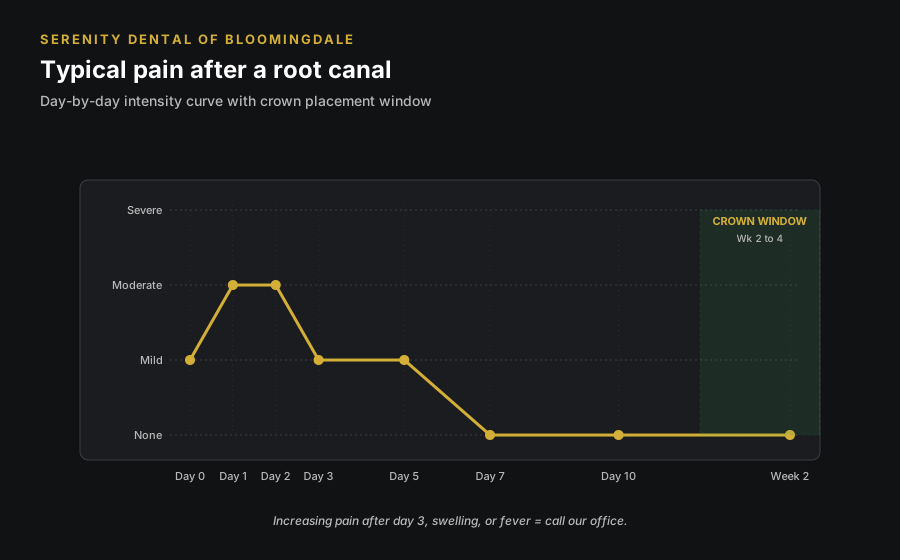
Day 0
Numbness then ache
Local anesthesia wears off 4 to 6 hours post-procedure. Mild aching begins. OTC pain relief sufficient for most patients.
Days 1–2
Peak soreness
Tenderness peaks around 48 hours. Ibuprofen plus acetaminophen combo works well. Soft foods on opposite side.
Days 3–5
Steady decline
Pain decreases daily. Most patients reduce medication. Biting tenderness lingers but is manageable.
Days 6–14
Mostly gone
Minimal pain beyond mild awareness. Biting tenderness fades by 2 weeks. Final crown appointment usually happens in this window.
Key principle: pain should decrease every day starting day 3. Not perfectly smooth, but the overall trend. A day that’s notably worse than the previous one after day 3 is the signal to pay closer attention.
What does normal post-root-canal pain feel like?
Normal post-procedure pain has specific characteristics:
- Location is focused on the treated tooth, sometimes with mild radiation to adjacent teeth
- Nature is aching and dull rather than sharp, shooting, or intensely throbbing in bursts
- Intensity responds to medication — ibuprofen or acetaminophen reduces it noticeably
- Worse with pressure — biting directly on the tooth triggers tenderness
- Improves day over day starting around day 3
- Rarely interferes with sleep after day 2
Tenderness when biting is the most common complaint in the first week, and there’s a clinical reason it shows up so consistently: the small files used inside the canal during treatment unavoidably extend a fraction of a millimeter past the apex of the root, which produces minor mechanical irritation in the periodontal ligament fibers that suspend the tooth in its socket, and that irritation persists for several days as the ligament inflammation settles. The effect is local and self-limiting, peaking around 48 hours and resolving on its own without intervention by day 5 to 7 in most cases.
Pain that isn’t normal: common causes
When pain doesn’t follow the normal curve, several specific issues are most likely.
High bite on the temporary filling
The most common cause of post-root-canal pain beyond day 2 to 3. The temporary filling sits slightly above the natural bite level, so your treated tooth hits first when you close your mouth. Every time you bite, you’re hitting that tooth harder than the others, causing pain and often bruising the ligament around the root.
Fix: A five-minute bite adjustment at a follow-up visit. The provider marks where you’re hitting and smooths down the temporary until your teeth contact evenly. Pain usually improves within a day or two.
How to know: Pain is sharp and immediate when biting on the tooth, and significantly better when not biting. Eating on the opposite side feels fine.
Missed canal
A tooth can have more canals than expected, and if one is missed during treatment, the bacteria inside continue causing problems. More common in molars (which have complex anatomy) and in patients who had infection prior to treatment. Often shows up as lingering or recurring pain a week or more after the procedure.
Fix: CBCT imaging identifies the missed canal. Retreatment accesses and cleans it.
How to know: Pain that doesn’t improve after day 5, pain that comes back after initially improving, or new throbbing pain weeks later. See the failed root canal signs article for more.
Sinus involvement (upper teeth)
Upper premolar and molar roots sit close to the sinus. Root canal treatment can cause temporary inflammation of the sinus lining, producing pressure or mild ache felt in the cheek, eye area, or forehead. Usually resolves within a week.
How to know: Pain isn’t localized to the tooth — it’s more diffuse, with sinus-like pressure. Often worse when bending over.
Residual inflammation resolving
Sometimes the tissues around the root tip were significantly inflamed before treatment and need time to calm down. Pain pattern is mild to moderate soreness that persists longer than typical — 5 to 10 days instead of 3 to 5. No fever, no swelling, no sharp pain.
Fix: Time, continued OTC pain control, and monitoring. Usually resolves on its own.
This category accounts for a meaningful portion of cases where pain lasts longer than expected after treatment. The underlying mechanism is straightforward: a tooth that arrived for treatment with a large periapical lesion already eating into the surrounding bone needs that lesion to heal radiographically before the periodontal ligament can fully settle. Bone remodeling on the order of 1 to 3 millimeters of fill-in per month is typical for these cases, which means a tooth that was very inflamed at the start of treatment may produce mild lingering soreness for up to two weeks even when the root canal itself was technically perfect.
Cracked tooth
Occasionally the tooth has a crack that wasn’t visible before treatment. The crack can extend and cause pain with biting that doesn’t resolve. CBCT imaging or a bite test identifies this.
Fix: Depends on the crack’s location and extent. Shallow cracks may be manageable with a crown; deep cracks may mean the tooth can’t be saved.
Infection returning (uncommon in first week)
True infection returning within the first week after root canal is uncommon because the tooth was just cleaned. When it happens, it typically indicates a missed canal or significant bacteria left behind. Signs include fever, swelling, pus, and severe escalating pain.
Fix: Evaluation within 24 hours. Antibiotics plus possible retreatment.
Pain patterns: what each one typically means
| Pattern | Most likely cause | What to do |
|---|---|---|
| Sharp pain when biting, better when not biting | High bite on temporary | Call for bite adjustment |
| Mild ache decreasing daily | Normal healing | Continue OTC meds, monitor |
| Throbbing pain starting day 3+ | Missed canal or infection | Call within 24 hours |
| Diffuse pressure in cheek/forehead (upper tooth) | Sinus inflammation | Time, elevate head sleeping, call if fever |
| Pain + swelling + fever | Possible infection | Call same day, may need antibiotics |
| Moderate soreness day 5 to 10 | Residual inflammation resolving | Monitor, continue OTC meds |
| Pain that stopped, then returned weeks later | Possible failed treatment | CBCT evaluation needed |
Pain management that actually works
Evidence-based post-root-canal pain management is well-studied.
First-line approach (usually sufficient)
Ibuprofen 400 to 600 mg every 6 hours with food. Addresses both pain and inflammation, which drive most post-procedure discomfort.
Acetaminophen 500 to 1,000 mg every 4 to 6 hours. Additional coverage when combined.
Alternating them every 3 hours provides more consistent pain control than either alone. Set reminders for the first 48 hours to stay ahead of pain rather than chasing it.
Maximum daily doses: 2,400 mg ibuprofen, 3,000 mg acetaminophen.
Supporting measures
- Ice packs on the cheek for the first 24 hours (20 on, 20 off) reduce inflammation
- Sleep with head elevated on an extra pillow for 2 to 3 nights
- Soft diet for the first day; chew opposite side for 1 to 2 weeks
- Avoid extremely hot or cold foods until the permanent crown is placed
- Stay hydrated
What to avoid
Aspirin thins the blood and can interfere with clot stability around the root tip.
Alcohol interacts with many pain medications and slows healing.
Applying aspirin or medications directly to the gum is an outdated remedy that causes chemical burns rather than helping.
Delaying treatment of a high bite. If pain is clearly triggered by biting on the tooth, call for the bite adjustment — don’t wait hoping it’ll resolve.
When prescription pain medication makes sense
Most root canal pain is manageable with OTC medications. Prescription pain relief may be warranted for:
- Severe pre-procedure pain that carries over
- Significant surgical extensions (apicoectomy, retreatment)
- Documented contraindications to ibuprofen or acetaminophen
- Situations where OTC combination isn’t sufficient
If prescribed: shortest effective course, never combined with alcohol, no driving or operating machinery, switch back to OTC as soon as possible.
When should you call your dentist?
Call within 24 hours for any of the following:
- Pain worsening after day 3 instead of improving
- Severe throbbing pain at any point
- Pain that doesn’t respond to maximum OTC doses
- Pain that wakes you at night after day 2
- Fever above 100.4°F
- Swelling in the gum, cheek, or face
- Pus or drainage from the tooth area
- A pimple-like bump appearing on the gum
- Temporary filling falling out
- Pain that returns after initially improving
- Severe pain when biting that doesn’t improve with time
Most of these indicate easily addressable issues — a bite adjustment, a short antibiotic course, or early identification of a missed canal. The longer you wait, the harder the fix becomes.
Go to the emergency room immediately if facial swelling is rapidly spreading, if breathing or swallowing becomes difficult, or if the swelling is reaching the eye or crossing the neck. These signs suggest the infection may have escaped into deeper fascial spaces and require IV antibiotics and possibly surgical drainage. A dental office cannot treat a spreading facial space infection — it is a hospital-level emergency. Individual cases vary, and when the pattern is clearly localized, Dr. Husna Khan can see urgent dental concerns same-day in-office.
The follow-up appointment matters
A scheduled follow-up visit 2 to 4 weeks after the root canal catches problems early and typically places the permanent crown.
What the follow-up visit accomplishes:
- Bite check. Confirms you’re not hitting the treated tooth too hard.
- Temporary filling evaluation. Makes sure it’s intact and the tooth is ready for the permanent restoration.
- Symptom check. Documents that pain is resolving as expected.
- Final crown placement (for most teeth). Seats the permanent restoration that protects the tooth long-term.
Skipping the follow-up or the crown placement is the single most common reason for root canal failure. Placing the crown within 30 days of the root canal significantly improves the tooth’s 10-year survival rate.
Call Serenity Dental at (630) 359-0105 with any concerns about post-root-canal pain. Same-day evaluations are available for pain that’s not resolving as expected. Dr. Husna Khan sees post-op concerns promptly and uses imaging and percussion testing to distinguish normal healing pain from the patterns that need intervention. Related: root canal service page · root canal recovery time.
In our practice, we map every canal with electronic apex location before obturation, and we schedule the final crown promptly because timing the restoration well is one of the strongest predictors of long-term tooth survival.
Clinical references and sourcing
Clinical guidance in this article reflects current standards from the American Association of Endodontists (AAE) consensus statements on diagnosis, retreatment, and outcomes; American Dental Association (ADA) procedure coding and clinical guidance; American Association of Oral and Maxillofacial Surgeons (AAOMS) parameters of care for adjacent surgical decisions; Cochrane systematic reviews of endodontic outcomes; and outcome studies indexed in the Journal of Endodontics (JOE). Cited timelines and survival rates are drawn from these primary sources.
Pain after root canal - questions answered
How long does pain last after a root canal?
Why does my tooth still hurt after a root canal?
Is throbbing pain after a root canal normal?
What does pain from a failed root canal feel like?
Can I take ibuprofen and Tylenol together after a root canal?
Why does my tooth hurt when I bite down after a root canal?
When should I call my dentist about root canal pain?
How long should I avoid chewing on a root canal tooth?
Educational content only. Recommendations are personalized after an exam and any needed imaging.
About this article
Reviewed by Dr. Husna Khan, DDS, of Serenity Dental of Bloomingdale. Dr. Husna Khan performs endodontic treatment in-house at our office using rubber-dam isolation, rotary nickel-titanium instrumentation, electronic apex location, and CBCT imaging when canal anatomy warrants it.
This article is for general educational and informational purposes and is not a substitute for an in-person dental evaluation. Individual cases vary — a specific treatment plan is determined after clinical examination and imaging. If you have ongoing tooth pain, swelling, or a tooth you are unsure about, please call our office or schedule an evaluation so we can examine the tooth and review your imaging with you.
Cited sources: AAE clinical guidelines, ADA procedure coding and clinical guidance, AAOMS parameters of care, Cochrane systematic reviews of endodontic outcomes, and Journal of Endodontics (JOE) outcome studies.
Need help with this in real life?
Reading helps. Talking to someone who can look at your actual teeth and symptoms helps more. If you want a clear next step, we’re here.
Related articles
Root Canal Cost in 2026: What You Actually Pay
Real root canal costs by tooth type -- front, premolar, molar. What insurance covers, the crown cost after, financing, and the $99 root canal trap explained.
Read article →Root Canal Recovery Time: Day-by-Day What to Expect
Root canal recovery timeline -- when pain resolves, what to eat, when to return to work, chewing restrictions, and the crown appointment timing.
Read article →Are Root Canals Safe? The Evidence Behind the Online Myths
A clinical review of social-media claims that root canals cause cancer or chronic disease, with the real evidence and the AAE, ADA, and Cochrane positions.
Read article →