Dental Bonding
Dental bonding vs veneers: which is right for your smile?
Bonding runs a few hundred dollars per tooth and lasts 4-8 years; porcelain veneers cost more and last 10-15. When each makes sense and how to decide.
Dental bonding and porcelain veneers are the two most common cosmetic options for chipped, gapped, worn, or slightly misshaped front teeth. They share an esthetic goal but differ on every practical dimension: bonding is composite resin shaped directly on the tooth in one visit, typically a few hundred dollars per tooth and lasting 4 to 8 years; veneers are lab-made porcelain shells bonded across two visits, typically nine hundred to twenty-five hundred dollars per tooth and lasting 10 to 15+ years. This guide compares them on cost, longevity, appearance, reversibility, tooth preparation, stain resistance, and which clinical situations favor each. For the full picture of the shell side of this comparison, see what dental veneers are and how they work.

Written by Dr. Husna Khan, DDS
Serenity Dental of Bloomingdale · April 28, 2026
Both treatments are offered at Serenity Dental. Call (630) 359-0105 for a side-by-side estimate.
To see the broader picture of bonding options, see the dental bonding service page. For veneers detail, see the veneers service page. Related: dental bonding cost, composite bonding disadvantages.
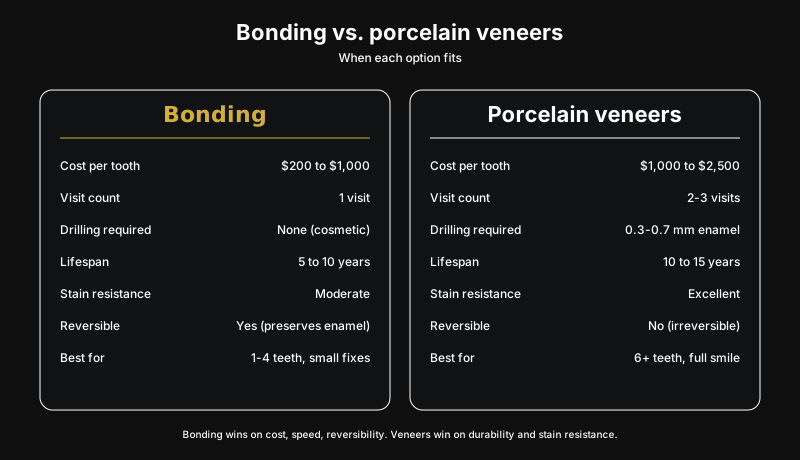
Side-by-side comparison
| Factor | Direct bonding | Porcelain veneers |
|---|---|---|
| Material | Composite resin (filled polymer) | Porcelain (lithium disilicate or feldspathic) |
| Where made | Chairside, freehand by dentist | Custom-made by dental laboratory |
| Visits required | 1 visit | 2 visits (prep + delivery) |
| Time per tooth | 30-90 minutes total | 60-90 min prep + 30-45 min delivery |
| Tooth preparation | Minimal etching only | 0.3-0.7 mm enamel removal usually |
| Reversible? | Yes, mostly | No, enamel does not regrow |
| Cost per tooth | Roughly $300-$600 | Roughly $900-$2,500 |
| Lifespan | 4-8 years (sometimes 10) | 10-15+ years (sometimes 20) |
| Stain resistance | Moderate | High |
| Surface gloss longevity | 1-3 years without polishing | 10+ years |
| Best for | 1-3 teeth, small changes | 6-10 teeth, dramatic changes |
| Repair if chips | Easy chairside patch, minor fee | Full unit remake at lab pricing |
| Insurance coverage | Sometimes (restorative) | Almost never (cosmetic) |
They are not interchangeable.
Cost differences in detail
Per-tooth pricing
| Treatment | Cash price per tooth | With insurance (if covered) |
|---|---|---|
| Direct chip repair bonding | Roughly $150-$400 | Often partially covered as restorative |
| Cosmetic edge bonding | Roughly $250-$500 | Rarely covered |
| Full cosmetic bonding (composite veneer style) | Roughly $400-$800 | Rarely covered |
| Porcelain veneer (traditional) | Roughly $900-$2,500 | Rarely covered |
| No-prep veneer (Lumineers) | Roughly $800-$2,000 | Rarely covered |
| Lithium disilicate (e.max) veneer | Roughly $1,200-$2,500 | Rarely covered |
Whole-case pricing for common scenarios
Most people asking have 4, 6, 8, or 10 teeth in mind, and the honest arithmetic at each of those case sizes is exactly what the table below lays out, midpoint pricing against midpoint pricing.
| Case | Bonding total | Veneers total | Difference |
|---|---|---|---|
| 1 tooth chip | $150-$400 | $900-$2,500 | Roughly $750-$2,100 saved with bonding |
| 4 front teeth | $1,600-$3,200 | $3,600-$10,000 | Roughly $2,000-$6,800 saved |
| 6 front teeth | $2,400-$4,800 | $5,400-$15,000 | Roughly $3,000-$10,200 saved |
| 8 front teeth | $3,200-$6,400 | $7,200-$20,000 | Roughly $4,000-$13,600 saved |
| 10 front teeth | $4,000-$8,000 | $9,000-$25,000 | Roughly $5,000-$17,000 saved |
Upfront, bonding always wins. Factor in 10 to 20 year longevity and the cost-per-year gap narrows considerably, sometimes to the point where the more expensive treatment on paper is the cheaper one per year of actual service delivered.
Insurance coverage
Insurance treats bonding restoratively when it repairs a chipped or damaged tooth, which is the one scenario in this entire comparison where a benefit plan is likely to pay a meaningful share of the fee. Veneers are virtually always coded cosmetic and excluded from coverage.
Chip repairs sometimes get 50 to 80 percent coverage. A porcelain veneer placed on the same tooth would be covered at 0 percent because the veneer is considered an upgrade beyond what is medically necessary. The American Dental Association CDT codes distinguish restorative composite (D2330-D2335) from porcelain veneers (D2960-D2962), and insurance treats them differently.
When bonding makes more sense
Bonding is the better choice when at least three of the following are true:
- Single-tooth focus: chip on one front tooth, gap between two teeth, edge repair on one canine
- Smaller cosmetic ambition: smoothing edges, closing a 1-2 mm gap, lengthening teeth slightly
- Reversibility matters: patient wants the option to undo the work later
- Budget priority: cosmetic improvement on a budget under roughly $2,000
- Younger patient (under 30): preserving enamel for future treatment options
- Teeth otherwise healthy: no large fillings, no cracks, no significant wear
- Insurance partial coverage available: chip is restorative, not cosmetic
- Same-day completion preferred: event next week, no time for lab fabrication
A 24-year-old with a chipped corner from sports who wants to preserve enamel options for the future is virtually always a bonding candidate, not a veneer candidate.
When veneers make more sense
Veneers are the better choice when at least three of the following are true:
- Multi-tooth case (6-10 teeth): broad smile redesign, not single-tooth repair
- Maximum natural appearance demanded: professional public role, photography priority
- 10+ year lifespan priority: patient does not want repeat treatment in 5 years
- Severe staining unresponsive to whitening: tetracycline staining, fluorosis, dark singletons
- Existing large fillings on front teeth: veneer covers them more uniformly
- Significant tooth length needed (1.5+ mm): bonding tends to chip at long edges
- Stain-prone lifestyle: heavy coffee, tea, red wine, or tobacco use
- Adequate enamel for preparation: 0.3-0.7 mm removal will not expose dentin
A 45-year-old executive wanting a unified, photogenic smile across 8 front teeth, with a five-figure budget available and a preference for a 15-year solution, is virtually always a veneer candidate, not a bonding candidate.
When the answer is “neither, yet”
Some smile concerns should not jump straight to bonding or veneers.
Crooked teeth: Invisalign first, then bonding for fine refinement. Either material, asked to mask real misalignment, produces bulk: veneers or bonding thick enough to fake straightness sit forward of the arch, catch light at the wrong angle, and read as artificial from conversational distance.
Yellow teeth: Whitening first (such as the Philips Zoom in-office system Serenity Dental uses), then evaluate whether cosmetic shape work is even needed. Many patients are happy with their teeth after professional whitening alone.
Active gum disease: Gum therapy first. Inflamed gums shorten everything, because neither composite nor porcelain bonds predictably at a margin that bleeds, and the esthetic result of any veneer or bonding case is only ever as good as the gum line framing it.
Active cavities: Restore the cavities first, then evaluate cosmetic options. Cosmetics never jump the line ahead of caries treatment, because sealing active decay under composite or porcelain converts a fixable problem into a hidden one that resurfaces later as pain, fracture, or a root canal.
Pregnancy: Most cosmetic treatment is deferred until after delivery and breastfeeding for prudent care reasons, per American Dental Association maternal oral health guidance.
Teen patients (under 18): Bonding for emergency chip repair is fine, but elective cosmetic veneer cases generally wait until growth is complete.
Visual differences in real cases
Seeing the differences beats describing them.
Single tooth comparison
For one-tooth work, a skilled cosmetic dentist with multi-shade nanohybrid composite can achieve a result virtually indistinguishable from a porcelain veneer, at one-third the cost. The difference shows up at year 5 to 7 when the bonded tooth has slight margin staining and reduced gloss while the veneer still looks new.
6-tooth smile zone
Across 6 teeth, porcelain veneers usually achieve more visual uniformity. Direct bonding requires the dentist to freehand 6 separate teeth, and small variations in shade and shape add up. Veneers are made together in the lab to a planned digital design, so the 6 teeth match each other more cohesively.
10-tooth full smile makeover
For a full smile makeover, veneers are the standard of care for cosmetic dentists who specialize in this work. Ten bonded teeth take 5 to 8 hours of chairside artistry, and even in skilled hands the freehand result rarely matches the uniformity a lab achieves fabricating a matched set of porcelain units against one master model. Full-mouth cosmetic guidance from the American Academy of Cosmetic Dentistry consistently recommends porcelain.
The hybrid approach
Some patients combine the two treatments strategically:
- Veneers on 4 to 6 most-visible teeth + bonding on adjacent teeth. Saves cost while keeping the visual centerpiece in porcelain.
- Bonding now, veneers later. Patient gets cosmetic improvement for a fraction of the veneer fee today; converts to veneers in 6 to 8 years when bonding needs replacement and budget allows.
- Bonding for one chipped tooth + veneers for the rest. Common setup: one tooth needs restorative repair first.
Hybrid plans require thoughtful sequencing and color matching across two materials, which is more complex than a single-treatment approach.
Reddit and patient questions clarified
Several common patient questions deserve direct answers.
“My dentist quoted $600 per tooth for bonding — is that too expensive?” Premium nanohybrid layered composite at $600 per tooth on front teeth is reasonable for a high-end cosmetic case in a metro area, especially when the work includes 60 to 90 minutes of chairside artistry per tooth. It is on the high end of typical bonding pricing. The same fee for a quick chip repair would be excessive.
“My dentist said bonding is the same as veneers — is that true?” No. They are different procedures, different materials, different longevity, and different price points. If a dentist conflates them, ask for clarification on which procedure is being recommended.
“Will bonding chip if I bite an apple?” Properly placed bonding tolerates normal biting forces including apples, salads, and most foods. Avoid biting fingernails, ice, hard candy, pen caps, and using teeth as tools. Hard biting habits shorten bonding life significantly.
“Can I get veneers on bottom teeth too?” Yes, veneers can be placed on lower teeth, but they are less common than upper veneers because the lower teeth show less in most smiles. Lower teeth get bonding more often because of the lower visibility.
What to ask at consultation
Bring this list to a cosmetic consultation:
- Which option do you recommend for my specific case, and why?
- Can I see before-and-after photos of similar cases you have done?
- Could you share the per-tooth and total cost estimate for each option?
- How does your typical 5-year and 10-year outcome compare for each treatment?
- What happens if I do not like the result?
- Is there a warranty or repair policy on each treatment?
- How much enamel will be removed for veneers in my case?
- Which composite or porcelain brand do you use?
- Do you offer a digital simulation or wax-up before treatment?
- Can I phase the treatment across two benefit years for insurance?
Dr. Husna Khan answers all of these at the bonding-vs-veneers consultation, often with side-by-side written estimates so the comparison is concrete. Per the American Academy of Cosmetic Dentistry recommendations for cosmetic case planning, transparent comparison is part of good practice.
Quick decision framework
If most of your “yes” answers fall on one side of this list, that is your direction.
Choose bonding if:
- 1 to 3 teeth involved
- Total budget under roughly $2,000
- Want reversibility
- 5 to 8 year lifespan is acceptable
- Insurance partial coverage helps
- Prefer one-visit completion
- Younger patient preserving enamel options
Choose veneers if:
- 6 to 10 teeth involved
- Budget of several thousand dollars or more
- Want 10 to 15 year lifespan
- Maximum natural appearance demanded
- Heavy stainers (coffee, tea, wine)
- Existing fillings on front teeth
- Two-visit timeline is fine
Need consultation if:
- 4 to 5 teeth (borderline either way)
- Budget lands in the in-between zone, roughly $2,000-$5,000
- Multiple concerns mixed (cosmetic + restorative)
- Considering Invisalign or whitening first
Serenity Dental’s approach
At Serenity Dental of Bloomingdale, both bonding and veneers are offered, and Dr. Husna Khan provides honest comparison rather than steering toward one default:
- Side-by-side cost estimates for both treatments at consultation
- Reference photos of bonding cases and veneer cases done in-office
- Digital simulation for larger cosmetic cases
- Phased planning when whitening or Invisalign should come first
- Transparent material disclosure — nanohybrid composite brand for bonding, porcelain brand for veneers
- Realistic longevity expectations based on 5, 10, and 15 year outcomes
- Insurance benefit verification with restorative versus cosmetic coding clearly explained
- Financing options through Cherry, CareCredit, and Sunbit, with approval and terms set by each provider
Schedule a cosmetic consultation by calling (630) 359-0105. The 30-minute appointment includes intraoral photos, written cost estimates for both treatments, and an honest recommendation based on your case. Related: dental bonding service page · veneers service page.
When to call rather than wait
Whether bonding or a veneer suits you is a chair conversation. These are phone calls.
Call the office when a bonded edge breaks off. It usually snaps clean, the tooth beneath is fine, and a same-week patch keeps the exposed enamel from staining a different shade than the repair.
Call promptly about a dark line creeping in where bonding meets tooth. That line is stain wicking into a microscopic gap, and refreshed bonding stops it; ignored, the gap eventually invites decay.
Contact your dentist about new sensitivity under older bonding. Composite placed years ago can debond invisibly at one corner, letting cold and bacteria reach dentin while everything still looks intact from the front.
A note on what this comparison cannot decide
This article is general education, not individualized medical advice, and the bonding-versus-veneer call depends on enamel condition, bite forces, and goals that only an exam reveals. Written, itemized estimates come standard in our Bloomingdale practice before any bonding or veneer work begins, so the cost side of the decision arrives on paper rather than as a surprise at checkout. Cost figures above are typical Chicago-area reference ranges, not quotes. Financing in our office runs through Cherry, CareCredit, and Sunbit, each on its own approval and terms.
FAQs
Is dental bonding the same as veneers?
Which lasts longer, bonding or veneers?
Is bonding cheaper than veneers in the long run?
Can I get bonding instead of veneers?
Does bonding look as natural as veneers?
Can bonding be removed if I do not like it?
Do veneers require shaving down my teeth?
Which stains less, bonding or veneers?
How do I decide between bonding and veneers?
Educational content only. Recommendations are personalized after an exam and any needed imaging.
About this article
Reviewed by Dr. Husna Khan, DDS, of Serenity Dental of Bloomingdale. Dr. Husna Khan offers both bonding and veneer treatments and provides honest comparison rather than defaulting to one option.
Educational content. The right cosmetic treatment depends on the specific clinical situation, including tooth condition, bite, gum health, esthetic goals, and budget. Schedule a consultation for an evaluation specific to your case. Cited sources: American Dental Association CDT code reference for restorative versus cosmetic procedures, American Academy of Cosmetic Dentistry guidance on case selection between direct and indirect cosmetic treatments, Journal of the American Dental Association studies on composite versus porcelain longevity and stain resistance.
Related: veneers service page.
Need help with this in real life?
Reading helps. Talking to someone who can look at your actual teeth and symptoms helps more. If you want a clear next step, we’re here.
Related articles
Dental bonding for a chipped tooth: cost, process, and what to expect
Bonding can fix a chipped front tooth in a single 30-45 minute visit. How the repair works, how long it lasts, and when you need a crown instead.
Read article →What is dental bonding? Complete patient guide for 2026
Dental bonding uses tooth-colored composite resin to repair chips, gaps, and edges in one visit. What it is, how it works, cost, lifespan, and alternatives.
Read article →