
Dental Implants
Dental Bridge vs Implant: Honest Comparison From a Dentist
Dental bridge vs implant: cost, longevity, healing time, bone preservation, and which is right for your specific case.
Written by Dr. Husna Khan, DDS
Serenity Dental of Bloomingdale · April 29, 2026
Educational purposes only, not a substitute for clinical evaluation. Call (630) 359-0105. Dr. Husna Khan reviews both options honestly at every consultation. Individual results vary based on bone health and adjacent tooth condition.
Implants and bridges are both established options for replacing a missing tooth, and both have valid use cases. Implants are the more durable and bone-preserving choice for most patients, but bridges remain appropriate for specific situations. The right answer depends on the condition of the adjacent teeth, available bone, budget, and timeline, not on a one-size-fits-all recommendation.
This comparison covers the practical differences, cost, longevity, healing time, bone preservation, aesthetic outcome, and effect on adjacent teeth, so patients in our Bloomingdale practice can make an informed decision rather than accepting whichever option a provider happens to favor.
How does a dental bridge actually work?
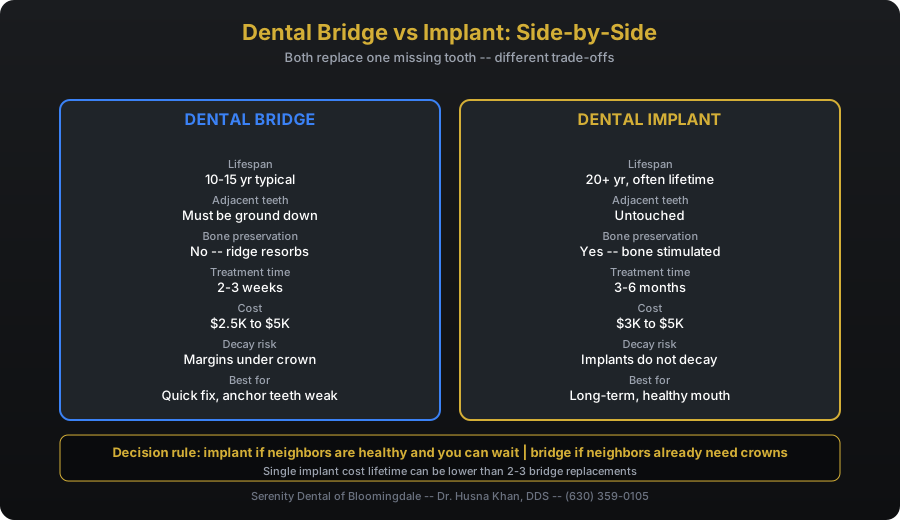
Dental bridge vs implant
| Factor | Dental implant | Dental bridge |
|---|---|---|
| Replaces | Single tooth or root | Single missing tooth using neighbors |
| Affects neighbors? | No | Yes, neighboring teeth are reduced |
| Preserves bone | Yes, stimulates bone | No, bone may resorb |
| Lifespan | 20+ years | 5-15 years |
| Initial cost | $3,500-$6,000 | $3,500-$6,000 |
| Treatment timeline | 3-6 months | 2-3 weeks |
| Cleaning | Floss like a natural tooth | Floss threaders or proxy brush under bridge |
A traditional dental bridge replaces a missing tooth by anchoring a fake tooth (the pontic) between two crowns on the adjacent teeth. Adjacent teeth on each side are ground down to receive crowns; the three units (crown, pontic, crown) are fabricated as a single piece and cemented in place. Above the gum, the result looks tooth-shaped line but the underlying gap remains, the pontic floats above the gum without contacting bone.
Bridges have been used for decades and have predictable outcomes when properly indicated. They are completed in 2 to 3 weeks total, faster than implants. They are sometimes covered better by dental insurance. They avoid surgery for patients who prefer to avoid implant placement. For some patients, these advantages are decisive.
The trade-offs are significant. Grinding down adjacent teeth permanently removes healthy enamel. Per published prosthodontic research, the abutment teeth supporting a bridge fail at higher rates than untreated teeth over 10 to 20 years, often requiring root canals or extraction. The bridge itself typically requires replacement every 10 to 15 years.
How does a dental implant actually work?
A dental implant replaces the missing tooth with a titanium post placed surgically into the jawbone, capped with a custom crown. Three components make up an implant: the titanium post (the artificial tooth root), the abutment (a small connector), and the crown (the visible tooth-shaped restoration). The implant integrates with bone through osseointegration over 3 to 6 months, then functions like a natural tooth root.
Because a bridge borrows structure from the teeth on either side while an implant borrows nothing from anyone, the real comparison in this article is never between two prosthetics but between two philosophies about what to do with healthy enamel.
Implants have been the standard of care for single-tooth replacement for over 30 years. Titanium implant posts are rated for lifetime use; the crown attached lasts 15 to 25 years. Per a 2021 cohort study published in Clinical Implant Dentistry and Related Research that followed 10,871 implants over 22 years, single implants in healthy non-smokers had survival rates above 95 percent at 10 years and above 92 percent at 20 years.
Trade-offs include longer treatment time (3 to 9 months versus 2 to 3 weeks), higher upfront cost, and the need for surgery. Patients with severe bone loss may require grafting before implant placement. Some patients with specific medical conditions are not implant candidates.
Cost comparison: bridge vs implant
What tips the decision in most consultations is the condition of the neighboring teeth, since two heavily filled molars that need crowns anyway make a bridge nearly free of biological cost, while two virgin teeth make the same bridge an expensive sacrifice.
A traditional 3-unit bridge runs $3,500-$6,000. A single dental implant (post, abutment, and crown) runs $3,500-$6,000. These upfront prices are comparable. Bone grafting (when needed) adds $3,500-$6,000 to the implant cost; bridges do not require grafting.
Long-term cost analysis changes the picture. A bridge typically requires replacement every 10 to 15 years, so over a 30-year period, the bridge is replaced 2 to 3 times. In contrast, the implant post stays in place; only the crown attached to it requires replacement (every 15 to 25 years). Over 30 years, the bridge is usually 30 to 50 percent more expensive total than the implant.
Insurance coverage differs plan to plan. Some PPO plans cover bridges better than implants, often 50 percent of the bridge cost versus a flat dollar amount or no coverage for implants. Patients we treat in our Bloomingdale practice receive a written cost analysis at consultation that includes upfront cost, expected lifespan, replacement cost, and total 20-year cost for each option.
Longevity and replacement: what to expect over decades
Over a twenty-year horizon the accounting usually reverses itself, as the bridge that cost less on day one meets its replacement cycle while the implant that cost more keeps working, which is why time horizon belongs in every honest comparison of the two.
Bridge longevity averages 10 to 15 years per published prosthodontic research, with significant variation based on oral hygiene, occlusion, and abutment tooth health. Bridges fail when the cement bond breaks, when an abutment tooth develops decay or root canal need, or when the bridge material fractures. Replacement typically involves removing the bridge, evaluating the abutment teeth, and fabricating a new bridge, if the abutment teeth are still serviceable.
Implant longevity is significantly longer. Per a 2021 cohort study in Clinical Implant Dentistry and Related Research, implant survival exceeds 92 percent at 20 years in healthy non-smokers. The crown attached to the implant typically requires replacement at 15 to 25 years, but this is a $2,500-$5,000 component, not a $3,500-$6,000 full replacement.
Lifetime cost calculations favor implants for most patients. We illustrate this at consultation with a side-by-side 30-year cost projection showing bridge replacement timing versus implant maintenance. For younger patients, the difference is substantial.
Bone preservation: a critical long-term factor
One of the most important long-term differences between bridges and implants is bone preservation. Per a 2016 systematic review in Clinical Oral Implants Research that analyzed post-extraction healing, the jawbone at a missing tooth site loses approximately 25 percent volume in the first year when nothing replaces the root, and continues to resorb thereafter.
Implants stimulate bone the way natural roots do, transmitting chewing forces into the bone and preserving ridge height and width over decades. Bridges do not. Because the pontic floats above the gum without contacting bone, the underlying bone continues to resorb under the bridge.
Over 10 to 20 years, this bone loss can become visible. Patients with longstanding bridges sometimes show a small depression under the pontic where the gum has collapsed inward as bone resorbed. Aesthetically, this can be subtle but noticeable. Functionally, the bone loss can affect adjacent teeth and complicate future treatment if the bridge ever fails and needs replacement.
When is a bridge the better choice?
Despite implants being preferred for most cases, bridges remain appropriate in specific circumstances. When the adjacent teeth already need crowns, because of large fillings, fractures, or root canals, a bridge can replace the missing tooth and address the adjacent teeth in a single restoration. This avoids two separate procedures.
When bone deficiency is severe and the patient prefers not to undergo grafting, a bridge avoids the surgical complexity of implant placement. When timeline is critical (a wedding, a job interview, a major event in 4 weeks), a bridge can be completed in 2 to 3 weeks while an implant requires months.
When systemic health rules out implant surgery, uncontrolled diabetes, recent radiation therapy to the jaw, certain medications, a bridge may be the only durable option. Patients we treat at our Bloomingdale practice in these situations receive honest counseling that a bridge is the right choice for their specific case, not a fallback because the dentist does not place implants.
Aesthetic outcome: how visible is the difference
Both options produce excellent aesthetic results when properly planned and executed, but the path to the result differs. With a bridge, three connected crowns are fabricated and cemented in 2 to 3 weeks; the dentist has full control over color, shape, and contour during fabrication. With an implant, the crown is fabricated months later, after osseointegration is complete; aesthetic planning starts at consultation and continues through final crown placement.
Front-tooth replacement is where the aesthetic comparison becomes most relevant. Per published implant dentistry case studies, the most challenging single-tooth aesthetic scenario is the upper front tooth in a patient with thin gum biotype and a high smile line. Implants in this scenario require careful soft-tissue management and emergence profile planning to produce a natural-looking gum contour around the crown. Bridges sidestep this challenge by anchoring to crowned adjacent teeth, but those crowns introduce their own aesthetic considerations.
Patients we treat at our Bloomingdale practice with high aesthetic expectations review case photos of both bridge and implant outcomes at consultation. Photos of cases similar to theirs, comparable smile line, gum biotype, and adjacent tooth color, are the most informative reference.
When should you call rather than wait?
Specific symptoms after either treatment warrant prompt attention. Pain or sensitivity at a bridge abutment tooth, gum swelling around the bridge, or a feeling that the bridge has loosened should be evaluated within a few days. Severe pain after implant placement that worsens after day 3, persistent bleeding beyond 24 hours, foul taste, visible pus, or sudden mobility of the implant requires immediate attention.
Most issues caught early are addressable; problems that wait often become harder to manage. Call our office at (630) 359-0105, patients with active concerns are seen the same day or next business day.
Related implant guides: Dental Implant Cost · Dental Implant Mistakes to Avoid
Cost figures in this article are typical ranges for the Chicago area, compiled from regional fee data. They are not quotes from Serenity Dental of Bloomingdale; your fee depends on exam findings, materials, and insurance benefits, and we provide a written, itemized estimate before any treatment begins.
This article is general education and not individualized medical advice. Implant decisions come from an exam, imaging, and your health history, not an article.
When to call rather than wait
A bridge or implant decision is rarely urgent, but the situations that force it sometimes are. Call right away at (630) 359-0105 for swelling around a failing bridge abutment, a broken retainer tooth, or pain that wakes you at night, because the treatment options narrow while those problems sit. A loose bridge deserves a call the same week. Everything else can wait for a scheduled consultation without penalty.
A Cochrane review of tooth replacement comparisons reaches the same practical conclusion this article does: the right choice depends on the health of the neighboring teeth more than on the missing tooth itself.
FAQs
Which is better, a dental bridge or an implant?
How much does a dental bridge cost compared to an implant?
How long does each option take to complete?
Will a dental bridge damage the teeth next to it?
Does a bridge or implant preserve more bone?
Are dental implants better than bridges for front teeth?
How long does a bridge last compared to an implant?
Can I switch from a bridge to an implant later?
Educational content only. Recommendations are personalized after an exam and any needed imaging.
About this article
Reviewed by Dr. Husna Khan, DDS, who places dental implants and fabricates dental bridges at Serenity Dental of Bloomingdale, IL. Cited sources: 2021 cohort study in Clinical Implant Dentistry and Related Research (10,871 implants, 22 years), 2016 systematic review in Clinical Oral Implants Research on post-extraction bone resorption, American Dental Association guidelines on tooth replacement options, American Academy of Periodontology data on implant survival, published prosthodontic research on bridge longevity.
Educational content. Individual treatment recommendations depend on clinical evaluation. Schedule a consultation at (630) 359-0105.
Pricing note. Prices shown are approximate Chicago-area 2026 ranges compiled from public cost guides, not a quote or a Serenity Dental fee schedule. Your actual cost depends on your clinical needs, the materials chosen, and your insurance. We provide a written estimate before any treatment begins. Call (630) 359-0105 to confirm pricing for your situation.
Need help with this in real life?
Reading helps. Talking to someone who can look at your actual teeth and symptoms helps more. If you want a clear next step, we’re here.
Related articles
Dental Implant Cost: What You Actually Pay in 2026
Dental implant cost in the Chicago area: post, abutment, crown, CBCT and bone grafting line by line, what insurance pays, and how to spot a padded estimate.
Read article →Dental Implant Healing Stages: From Surgery to Final Crown
Dental implant healing happens in four overlapping stages over 3 to 6 months. Detailed timeline of soft tissue, osseointegration, and bone remodeling.
Read article →Dental Bridges: Types, Cost, and How Long They Last
The four types of dental bridges, Chicago-area cost ranges, how long each lasts, the two-visit procedure, and when an implant is the better choice.
Read article →