Dental Implants
10 Dental Implant Mistakes to Avoid (From a Dentist)
10 common dental implant mistakes that cause failure or regret, provider selection, planning errors, and post-op care, and how to avoid each one.
Written by Dr. Husna Khan, DDS
Serenity Dental of Bloomingdale · April 29, 2026
Educational purposes only, not a substitute for clinical evaluation. Call (630) 359-0105 for an honest implant consultation, written estimates, no pressure. Individual results vary based on bone health and lifestyle factors.
Most dental implant failures and patient regrets are preventable. After placing implants in our Bloomingdale practice for years and consulting on cases referred from other offices, I see the same handful of mistakes repeated. Some happen at consultation, some during the procedure, and some in the months after. The good news is every one of them is avoidable with the right information up front.
This article walks through the 10 most common implant mistakes and the specific questions to ask, or steps to take, to sidestep each one.
Mistake 1: Choosing the cheapest provider without verifying what is included
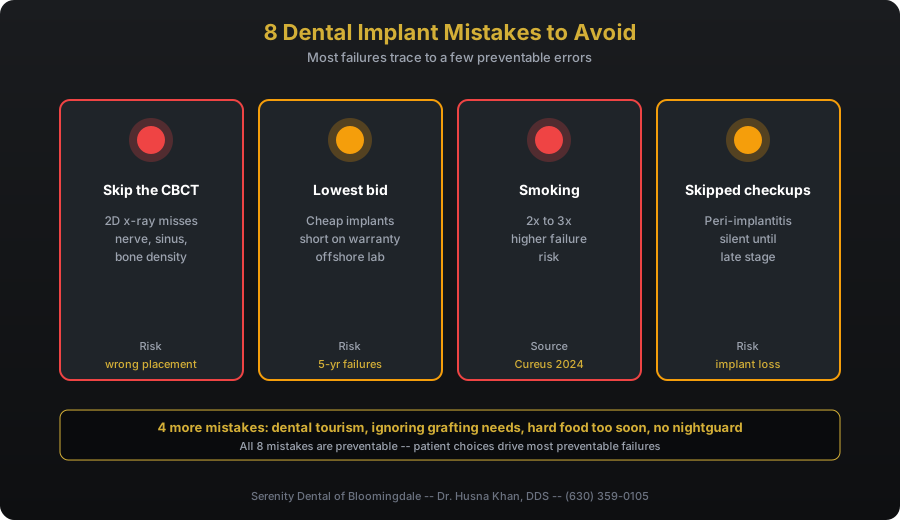
Lowest-bid implant offers frequently exclude key components. A $1,999 “implant special” might cover only the titanium post, not the abutment ($400-$1,200), not the crown ($3,500-$6,000), and not the CBCT 3D scan ($200-$500) needed for safe planning. By the time those components are added, the bid often equals or exceeds mid-tier all-inclusive pricing.
Before committing, request a written itemized estimate that lists every component separately. Ask which implant brand will be used, what the total all-in cost is including CBCT and crown, and what is covered if a complication arises. At our practice, every implant estimate breaks costs down line by line so patients can compare apples to apples.
Mistake 2: Skipping the CBCT scan to save money
Because implant problems tend to announce themselves years after the decisions that caused them, the most expensive mistakes in this article are the ones that felt like savings at the time, made in a moment when price was visible and biology was not.
CBCT (cone beam computed tomography) imaging is the standard of care for implant planning. Per the American Academy of Oral and Maxillofacial Radiology 2018 position paper on CBCT in implant dentistry, 3D imaging shows exact bone height, width, density, and the precise location of nerves and sinuses, information conventional 2D X-rays cannot provide reliably.
Skipping CBCT to save the $300-$550 scan fee dramatically increases nerve injury risk, sinus perforation, and inadequate integration. The downstream cost of a failed implant or nerve damage far exceeds the cost of imaging. If a provider does not use CBCT for implant planning, that is a meaningful red flag.
Mistake 3: Not asking which implant brand will be used
What the unhappy cases we evaluate for second opinions tend to share is not bad luck but a skipped step, a missing CBCT scan here, an untreated gum infection there, each one individually defensible and collectively decisive.
Reputable implant brands. Straumann, Nobel Biocare, Zimmer Biomet, BioHorizons, Astra, have decades of peer-reviewed research, predictable long-term outcomes, and parts available worldwide. Per a 2021 cohort study published in Clinical Implant Dentistry and Related Research that followed 10,871 implants over 22 years, implants from major brands in healthy non-smokers had survival rates above 95 percent at 10 years.
Off-brand implants often save short-term cost but cannot be serviced by other US dentists if the original provider closes or relocates. Years later, finding a replacement abutment or crown for an obscure brand can be impossible. Always ask which brand will be used and verify it is one with US-wide service availability.
Mistake 4: Going abroad for implants without a local follow-up plan
By the time a cut-rate implant fails, the money saved has usually been spent twice over on the repair, which is the arithmetic behind the oldest advice in dentistry: the cheapest implant is the one placed correctly the first time.
Patients sometimes travel to Mexico, Costa Rica, or Eastern Europe for implants at lower cost. Some have excellent outcomes; others experience significant problems. The risks include limited follow-up, harder warranty claims, unfamiliar implant brands US dentists cannot service, complication management requiring expensive return travel, and difficulty obtaining the surgical records.
Before traveling for implants, identify a local dentist willing to perform follow-up care on that specific implant brand. Confirm warranty terms and what happens if a complication develops 6 months later. Get all records (surgical notes, brand, lot number, abutment specifications) in writing.
Mistake 5: Treating implants as a “one and done” decision
The implant post is permanent only if surrounding tissue stays healthy. Implants develop peri-implantitis, the implant equivalent of gum disease, when plaque accumulates around the gum line. Per the American Academy of Periodontology, peri-implantitis affects approximately 10 to 20 percent of implants over 10 years, and untreated cases progress to bone loss and implant failure.
Daily brushing around the implant, daily flossing or use of an interdental brush, and professional cleanings every 6 months are non-negotiable. We tell patients: the surgery is one day, but the maintenance is for life.
Mistake 6: Smoking before, during, or after implant placement
Smoking is the single largest modifiable risk factor for implant failure. Per a 2024 systematic review in Cureus that pooled data from over 30 implant cohort studies, smokers experience implant failure rates 2 to 3 times higher than non-smokers, with risk concentrated in the first 6 months after placement.
Patients we treat at our Bloomingdale practice who quit at least 2 weeks before surgery and stay nicotine-free for 8 weeks after see substantially better outcomes than patients who continue smoking. If quitting permanently is not realistic, a pre-surgery and post-surgery cessation window is the next-best option. Vaping and nicotine pouches affect healing similarly, nicotine constricts blood vessels regardless of delivery method.
Mistake 7: Ignoring uncontrolled diabetes or active gum disease
Two medical conditions raise implant failure risk substantially: uncontrolled diabetes (HbA1c above 8) and active periodontal disease at adjacent teeth. Per a 2020 systematic review in the Journal of Periodontology, patients with HbA1c above 8 had implant failure rates approximately twice that of patients with controlled diabetes.
These conditions are addressable. Patients we treat with diabetes work with their physician to bring HbA1c into target range before surgery. Patients with active gum disease complete periodontal treatment first. Skipping these steps because the patient is eager to proceed sets up a failure that could have been prevented.
Mistake 8: Choosing the wrong tooth replacement option
Implants are not always the right answer. A bridge may be appropriate when adjacent teeth already need crowns. A removable partial denture may be better for patients with multiple missing teeth and significant bone loss. A do-nothing option may be acceptable for patients with no functional or aesthetic concern about the gap.
The decision depends on bone availability, adjacent tooth condition, budget, age, and personal goals. Dr. Husna Khan reviews all options at consultation and provides written pros and cons for each, not just a recommendation for the most expensive treatment.
Mistake 9: Rushing the healing timeline
Osseointegration, the process of bone growing into the implant surface, takes 3 to 6 months. Per published implant dentistry research, loading an implant before integration completes substantially raises the failure rate. Some protocols allow immediate loading in select cases, but not for every patient and not for every site.
When a provider commits to a final crown 6 weeks after surgery without specific clinical justification, ask why. The answer should reference bone quality, primary stability values, and CBCT findings, not a marketing schedule. We give patients a personalized timeline at consultation and adjust based on healing progress at each follow-up.
Mistake 10: Skipping the written treatment plan
Verbal estimates are unreliable. Written treatment plans, itemized by component, with timing, brand, and total cost, protect both patient and provider. They reduce the risk of “surprise” charges, document what was agreed upon, and provide a record if a second opinion is sought later.
Every implant patient at our Bloomingdale practice receives a written plan before any work is scheduled. The plan covers consultation findings, CBCT results, recommended implant brand, abutment and crown specifications, total cost broken into phases, expected timeline, and what is covered if complications develop.
When should you call rather than wait?
Specific symptoms warrant prompt attention rather than waiting for the next scheduled visit. Severe pain that worsens after day 3 (rather than steadily improving) can indicate infection or implant non-integration. Persistent bleeding beyond 24 hours, foul taste, or visible pus at any time during healing requires immediate attention. Fever above 100.4 F, sudden mobility of the implant, or new numbness in the lip or chin should be reported immediately.
Most issues caught early are addressable; problems that wait often become harder to manage. Call our office at (630) 359-0105, patients with active concerns are seen the same day or next business day.
Related implant guides: Dental Implant Cost in Bloomingdale · Dental Implant Healing Stages Timeline
Cost figures in this article are typical ranges for the Chicago area, compiled from regional fee data. They are not quotes from Serenity Dental of Bloomingdale; your fee depends on exam findings, materials, and insurance benefits, and we provide a written, itemized estimate before any treatment begins.
This article is general education and not individualized medical advice. Implant decisions come from an exam, imaging, and your health history, not an article.
When a mistake becomes a call rather than a lesson
Most implant mistakes cost money and time rather than health, and three exceptions deserve the phone. Call right away at (630) 359-0105 for spreading swelling or fever after any implant procedure, for an implant that moves when touched, or for numbness that persists beyond the anesthetic window, because each of those has a clock attached. The CDC estimates a quarter of adults over 65 have lost all their teeth, and the mistakes in this article are overrepresented in how that happens one tooth at a time. Regret can wait for a consultation. Infection cannot.
Counted honestly across everything above, the pattern is that avoidable implant failures cluster around decisions made in the first two weeks of the process, long before any drill touches bone, which means the reader of this article already holds the tool that prevents most of them.
FAQs
What is the most common dental implant mistake?
How do I choose the right implant dentist?
Can a general dentist place dental implants?
What happens if you skip the CBCT scan for an implant?
What happens if I do not care for my dental implant properly?
Should I get a cheaper implant from a budget clinic?
Can I have implants placed in another country to save money?
How do I know if my implant is failing?
Educational content only. Recommendations are personalized after an exam and any needed imaging.
About this article
Reviewed by Dr. Husna Khan, DDS, who places dental implants at Serenity Dental of Bloomingdale, IL. Cited sources: American Academy of Oral and Maxillofacial Radiology 2018 position paper on CBCT in implant dentistry, American Academy of Periodontology guidelines on peri-implantitis, 2021 cohort study in Clinical Implant Dentistry and Related Research (10,871 implants, 22 years), 2024 systematic review in Cureus on smoking and implant outcomes, 2020 systematic review in the Journal of Periodontology on diabetes and implant survival.
Educational content. Individual treatment recommendations depend on clinical evaluation. Schedule a consultation at (630) 359-0105.
Pricing note. Prices shown are approximate Chicago-area 2026 ranges compiled from public cost guides, not a quote or a Serenity Dental fee schedule. Your actual cost depends on your clinical needs, the materials chosen, and your insurance. We provide a written estimate before any treatment begins. Call (630) 359-0105 to confirm pricing for your situation.
Need help with this in real life?
Reading helps. Talking to someone who can look at your actual teeth and symptoms helps more. If you want a clear next step, we’re here.
Related articles
Dental Implant Cost: What You Actually Pay in 2026
Dental implant cost in the Chicago area: post, abutment, crown, CBCT and bone grafting line by line, what insurance pays, and how to spot a padded estimate.
Read article →Dental Implant Healing Stages: From Surgery to Final Crown
Dental implant healing happens in four overlapping stages over 3 to 6 months. Detailed timeline of soft tissue, osseointegration, and bone remodeling.
Read article →Dental Bridges: Types, Cost, and How Long They Last
The four types of dental bridges, Chicago-area cost ranges, how long each lasts, the two-visit procedure, and when an implant is the better choice.
Read article →