Dental Implants
Dental Implants: Complete Guide for Patients Considering Treatment
Comprehensive dental implants guide, what they are, how they work, candidacy, procedure, cost, healing, and how to think about implants vs alternatives.
Written by Dr. Husna Khan, DDS
Serenity Dental of Bloomingdale · April 29, 2026
Educational purposes only, consult your dentist for individualized treatment recommendations. Call (630) 359-0105. Dr. Husna Khan provides comprehensive consultations covering candidacy, procedure, and cost.
Dental implants are titanium posts placed into the jawbone to replace missing teeth, providing a fixed, freestanding replacement tooth that does not affect adjacent teeth. Sixty years of clinical research have established implants as the most durable single-tooth replacement option, with success rates of 95 to 98 percent at 10 years in healthy non-smokers per the American Academy of Implant Dentistry. This is the umbrella overview for patients new to implant treatment, candidacy, procedure, cost, healing, and how to think about the decision overall.
For deeper dives on specific aspects, the dedicated articles below cover each topic in depth:
- Replacing a single tooth? See single tooth dental implant explained for front vs back tooth specifics, neighbor-tooth considerations, and gap-tooth scenarios.
- Cost details? See dental implant cost for the full itemized breakdown, insurance, and financing.
- Healing timeline? See dental implant healing stages for week-by-week milestones.
- Procedure step-by-step? See dental implant procedure step by step.
- Comparing materials? See titanium vs zirconia dental implants and what are dental implants made of.
- Considering full-arch? See All-on-4 dental implants procedure step by step and full-mouth dental implants cost.
We provide individualized consultations at our Bloomingdale practice that walk through CBCT imaging, written cost estimates, and personalized timelines. The information below is the foundation for that conversation, not a replacement for clinical evaluation. Upper back teeth add one more variable, the sinus, and our explainer on sinus lifts for upper implants covers when that extra step applies.
What are dental implants, and how do they work?
A dental implant has three components stacked vertically. The titanium post is surgically placed into the jawbone, this functions as the artificial tooth root and is typically 8 mm to 13 mm long. The abutment is a small connector piece that screws into the implant post and emerges through the gum tissue. The crown is the visible tooth-shaped restoration that attaches to the abutment.
The defining feature of an implant is osseointegration. Over the 3 to 6 months following placement, the patient’s jawbone grows directly into the microscopic pores of the titanium surface, creating a biological lock between the implant and the bone. Once osseointegration completes, the implant functions like a natural tooth root, transmitting chewing forces into the bone and preserving bone density at the site.
Per-Ingvar Branemark, a Swedish orthopedic surgeon, discovered this phenomenon in 1965 when he observed that titanium hardware used in animal experiments had fused permanently with bone. Six decades of subsequent research refined implant design, surface treatments, and surgical protocols. The American Academy of Implant Dentistry confirms titanium implants are the most extensively researched dental device in current clinical use.
Who is a candidate for dental implants?
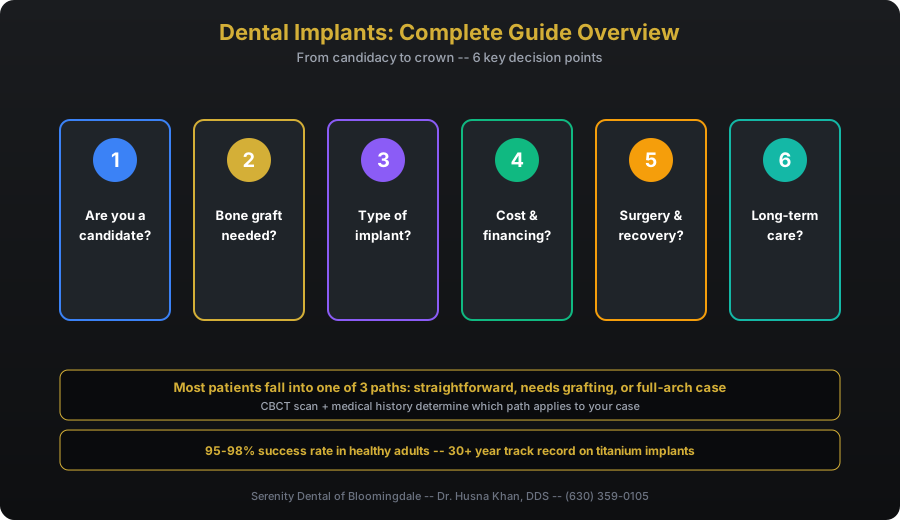
Most healthy adults with missing teeth qualify. Two main criteria matter: adequate bone volume at the implant site, and reasonable overall health.
Because an implant replaces the root rather than just the visible tooth, everything about the process is organized around bone, from the first scan that measures it to the final torque test that confirms the implant has fused with it.
Bone volume is verified by CBCT (cone beam computed tomography) imaging at the consultation. Adequate bone height generally means at least 8 mm of vertical bone in the jaw at the implant site. Bone resorbs at the missing-tooth site at approximately 25 percent volume in the first year after extraction and continues at slower rates thereafter per the American Academy of Periodontology’s published outcomes. Patients who have been missing a tooth for years frequently need bone grafting before implant placement.
Several health conditions affect candidacy without serving as absolute disqualifiers. Active smokers have implant failure rates 2 to 3 times higher than non-smokers per a 2024 systematic review published in Cureus. Uncontrolled diabetes (HbA1c above 8) elevates infection risk. Bisphosphonate medications carry a small but real risk of osteonecrosis at the surgical site. Active gum disease must be treated before implant placement. We discuss these factors honestly at consultation with realistic risk assessments.
Age alone is not a disqualifier. Successful implants are routinely placed in patients in their seventies and eighties at our Bloomingdale practice. The American Dental Association’s clinical guidance confirms implant success rates in healthy seniors match those in younger adults.
The implant procedure step by step
What separates a smooth implant experience from a frustrating one is rarely the surgery itself, which most patients describe as easier than the extraction that preceded it, and almost always the honesty of the timeline conversation that happened before anything was scheduled.
Implant treatment spans three phases over 3 to 9 months. Understanding each phase helps patients plan around work, travel, and other commitments.
Phase 1: Consultation and 3D imaging (1 to 2 weeks). The consultation includes a CBCT scan that produces a detailed 3D image of the jawbone. Dr. Husna Khan reviews the scan with the patient, explains what is possible at the specific site, and provides a written cost estimate before any procedure is scheduled. If bone grafting is needed, that is identified at this stage.
Phase 2: Implant placement (1 surgical visit, 60 to 90 minutes). The titanium post is placed through a small incision in the gum, with placement guided by either a surgical guide (made from the CBCT scan) or freehand technique. Local anesthesia numbs the area completely; oral sedation or nitrous oxide is available for patients who want additional comfort. Most patients feel pressure but no pain during placement. After placement, a healing cap or temporary crown is attached.
Phase 3: Osseointegration and final crown (3 to 6 months). Bone integrates with the implant over the 3 to 4 months in the lower jaw and 4 to 6 months in the upper jaw. Patients eat normally with the temporary in place. We see patients at 1 week, 2 weeks, and 6 weeks for routine checks. Once osseointegration is verified, impressions are taken and the final crown is fabricated by our lab over 2 to 3 weeks. Final crown placement is a 30 to 45 minute appointment.
For specific situations, accelerated protocols compress this timeline. Same-day extraction and implant placement combines two procedures into one visit when bone walls cooperate. Same-day temporary crowns are placed in select front-tooth cases. These protocols are case-specific rather than universal.
What do dental implants cost?
A single dental implant typically runs $3,500-$6,000 fully restored in the United States, including:
Over the three to six months of osseointegration, bone cells grow onto the roughened titanium surface in a process that cannot be rushed by technique, paid for, or negotiated with, which is why any office selling dramatically faster permanent teeth deserves careful questions.
- Implant post: $1,800-$2,800
- Abutment: $400-$950 (stock), $600-$1,200 (custom or zirconia)
- Crown: $1,200-$2,200 depending on material
Additional fees commonly apply. CBCT imaging adds $200-$500. Bone grafting adds $300-$1,200. Sinus lift adds $1,500-$5,000 for upper back implants. Sedation, when elected, is quoted in your estimate; nitrous oxide and oral sedation are available in-office, and the rare case that calls for IV sedation is referred out, with that office quoting its own fee. Tooth extraction adds $150-$350 if needed.
Insurance coverage varies considerably. Many PPO plans cover the implant crown but not the surgical placement; others cover a portion of the surgical fee under major benefits. Annual benefit caps typically run $1,000-$2,000. We verify benefits before treatment begins, identify any applicable coverage, and present financing options (FSA, HSA, CareCredit, Cherry, and Sunbit) for the remaining balance.
Multi-implant cases have configuration-dependent pricing. Two adjacent implants run $7,000-$12,000. A 3-tooth implant bridge on 2 implants runs $7,000-$12,000. Full-arch All-on-4 runs $15,000-$30,000 per arch. We provide written itemized estimates for each specific case rather than relying on advertised “starting” prices.
How do dental implants compare to alternatives?
Three alternatives exist for replacing missing teeth, each with distinct trade-offs.
By the end of the process the numbers that mattered at the start, ridge width in millimeters and stability in torque values, disappear entirely from your life, replaced by the pleasant discovery that you stopped thinking about the tooth at all.
Traditional fixed bridges use crowns on the two teeth adjacent to the missing tooth as anchors for a fake tooth in the middle. Bridges typically cost $3,500-$6,000 and last 10 to 15 years on average per ADA outcome data. The downside is significant: the two adjacent teeth must be ground down to receive crowns, even if those teeth are perfectly healthy. Bridges also do not preserve bone at the missing-tooth site, bone continues to resorb under the bridge over the years.
Removable partial dentures clip onto adjacent teeth with metal clasps. Partials typically cost $3,500-$6,000 and require removal for cleaning. They are the lowest-cost option but the least stable, patients commonly report difficulty eating tougher foods and self-consciousness about visible clasps. Bone resorption at the missing-tooth site continues at full rate.
Doing nothing is technically an option but carries consequences. Adjacent teeth tilt into the gap over months to years. Opposing teeth can over-erupt into the empty space. Bone at the missing-tooth site loses approximately 25 percent volume in the first year. Bite changes can develop, sometimes leading to TMJ symptoms or premature wear on other teeth.
For most patients, an implant is the most durable, least disruptive option even though the upfront cost is highest. Calculated over a 25-year horizon, an implant at $5,000 placed once typically costs less than two bridge replacements at $3,000-$5,000 each, plus the loss of two healthy adjacent teeth.
What does recovery actually look like?
Most patients return to work the next day after implant placement. The first 3 to 5 days involve mild soreness controlled with over-the-counter ibuprofen 400 mg to 600 mg every 6 hours. Swelling peaks at 48 to 72 hours then subsides. A small amount of bleeding for the first 24 hours is normal.
Diet during the first week is soft foods only, yogurt, eggs, smoothies, soft pasta, soft fish. Hot temperatures are avoided for the first 24 hours. Smoking is strongly discouraged for at least 2 weeks (and ideally permanently for implant longevity). Carbonated drinks and straws are avoided for 1 week.
Hygiene during healing is gentle but consistent. Salt water rinses 4 times daily start at 24 hours after surgery. Brushing with a soft toothbrush around (but not directly on) the surgical site starts at 48 hours. Flossing returns to normal at 1 to 2 weeks except at the implant site, where it can resume after suture removal.
After osseointegration completes and the final crown is placed, the implant is treated like a natural tooth. Twice-daily brushing, daily flossing (a floss threader or water flosser helps clean around the implant), and 6-month professional cleanings keep the implant healthy long-term. Implants do not get cavities, but they can develop peri-implantitis (gum inflammation around the implant) if hygiene lapses.
What do we tell patients at consultation?
Three points come up consistently at our Bloomingdale practice. First, the procedure is a multi-month commitment, not a one-visit fix. Patients planning vacations, weddings, or major life events should think about timing.
Second, the CBCT scan tells us what is possible. Some patients arrive expecting a simple implant and learn that grafting is needed first. Imaging on screen makes the reasoning visible and the conversation honest.
Third, we will not take shortcuts that risk implant failure. We do not place implants where bone is inadequate without grafting first. We do not promise same-day-as-extraction implants when socket walls are damaged. We do not skip CBCT to save the patient a few hundred dollars. These shortcuts drive implant failure, and we choose not to take them.
When should you call rather than wait?
After implant placement, specific symptoms warrant prompt attention. Severe pain that worsens after day 3 (rather than steadily improving) can indicate infection. Persistent bleeding beyond 24 hours, foul taste, or visible pus at the surgical site requires immediate attention. Numbness in the lower lip or chin that persists beyond the day of surgery may indicate nerve irritation, rare with proper CBCT planning but worth reporting promptly.
In the months between placement and final crown, mobility of the implant when pressed (it should feel rock-solid), a new gap or visible exposure of implant threads at the gumline, or sudden pain after months of comfort all warrant evaluation. Most issues caught early are addressable; issues that wait often become harder to manage. Call our office at (630) 359-0105, patients with active concerns are seen the same day or next business day.
Cost figures in this article are typical ranges for the Chicago area, compiled from regional fee data. They are not quotes from Serenity Dental of Bloomingdale; your fee depends on exam findings, materials, and insurance benefits, and we provide a written, itemized estimate before any treatment begins.
This article is general education and not individualized medical advice. Implant decisions come from an exam, imaging, and your health history, not an article.
When to call rather than wait
Most of the implant process is scheduled and unhurried. A few moments are not. Call right away at (630) 359-0105 for bleeding that soaks gauze past the first evening, swelling that spreads toward the eye or neck, fever, an implant or temporary that suddenly feels loose, or numbness that outlasts the anesthetic, because every one of those is easier to fix on the day it starts than a week later. The routine soreness fades on its own. These do not.
Read as a whole, this guide keeps returning to a single idea from different directions, because it genuinely is the organizing principle of implant dentistry: the visible tooth is the easy part, and everything that determines whether it lasts happens in bone you will never see, on a timeline biology sets and nobody negotiates.
Framed one last way for the person still deciding, the choice in front of you is rarely implant versus nothing, but rather a planned, imaged, unhurried process versus the slow-motion consequences of a gap left alone, and that comparison has a much clearer answer than any price table suggests.
Weighed over the decades an implant is expected to serve, the weeks spent on scans, planning, and healing shrink to a rounding error, and the patients who internalize that arithmetic early are consistently the ones who describe the whole process, in hindsight, as easier than they feared.
Frequently asked questions about dental implants
What is a dental implant and how do its three components work together?
Who is a candidate for dental implants?
How long does the full implant timeline take, from consultation to final crown?
Do dental implants hurt?
What does a dental implant typically cost when fully itemized?
What does the published research say about how long dental implants last?
When is an implant the better choice than a bridge for a missing tooth?
Are dental implants safe?
Educational content only. Recommendations are personalized after an exam and any needed imaging.
About this article. Written by Dr. Husna Khan, DDS at Serenity Dental of Bloomingdale. Reviewed against ADA, AAID, AAP guidance and 2021 Clinical Implant Dentistry, 2024 Cureus, and 2020 Clinical Oral Implants Research systematic reviews. Updated April 29, 2026. Call (630) 359-0105 to schedule a consultation. Visit 1 Tiffany Pointe, Suite 205,Bloomingdale, IL 60108.
Pricing note. Prices shown are approximate Chicago-area 2026 ranges compiled from public cost guides, not a quote or a Serenity Dental fee schedule. Your actual cost depends on your clinical needs, the materials chosen, and your insurance. We provide a written estimate before any treatment begins. Call (630) 359-0105 to confirm pricing for your situation.
Need help with this in real life?
Reading helps. Talking to someone who can look at your actual teeth and symptoms helps more. If you want a clear next step, we’re here.
Related articles
Dental Implant Cost: What You Actually Pay in 2026
Dental implant cost in the Chicago area: post, abutment, crown, CBCT and bone grafting line by line, what insurance pays, and how to spot a padded estimate.
Read article →Dental Implant Healing Stages: From Surgery to Final Crown
Dental implant healing happens in four overlapping stages over 3 to 6 months. Detailed timeline of soft tissue, osseointegration, and bone remodeling.
Read article →Dental Bridges: Types, Cost, and How Long They Last
The four types of dental bridges, Chicago-area cost ranges, how long each lasts, the two-visit procedure, and when an implant is the better choice.
Read article →