
Crowns
Dental crown cost in 2026: real pricing by material type
Zirconia crowns cost $1,000-$2,500; PFM $900-$2,000; gold $1,200-$3,000. Insurance typically covers 50%. What drives cost and how to budget.
A dental crown typically costs $1,000 to $3,500 in the U.S., depending on material. Zirconia and all-ceramic crowns run $1,000 to $2,500, porcelain-fused-to-metal (PFM) crowns cost $900 to $2,000, and gold crowns range $1,200 to $3,000 based on gold market prices. With PPO insurance covering 50 percent after deductible, patient out-of-pocket drops to $500 to $1,750 per tooth. This guide breaks down what you actually pay by material, what insurance covers, hidden costs to watch for, and how crown costs compare to alternative restorations.

Written by Dr. Husna Khan, DDS
Serenity Dental of Bloomingdale · April 19, 2026
Cost ranges reflect 2026 averages, not treatment quotes. Serenity Dental provides written estimates before treatment begins — call (630) 359-0105.
For the broader picture of crown options and procedures, see the dental crowns service page. For a full restoration decision framework, see crown vs filling vs inlay.
Cost by crown material
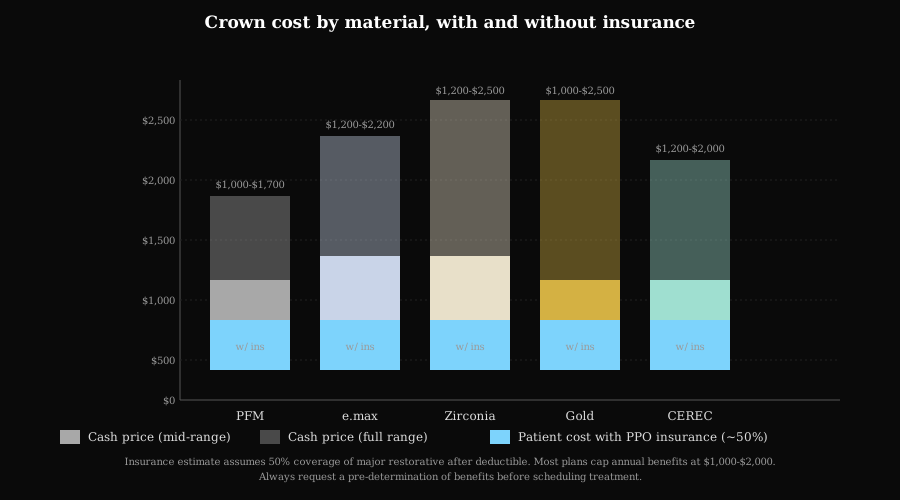
In our Bloomingdale practice, crown planning starts with a written estimate and an insurance breakdown before anyone commits. We see second-opinion visits about crown pricing, and the differences between quotes usually trace to material and lab choices.
Sticker shock around crowns usually softens once the fee is spread across the restoration’s working life, because a tooth that chews comfortably for fifteen or twenty years turns a four-figure invoice into a per-year cost that sits below what many households spend on streaming subscriptions. Durability changes the math. Comparing quotes between offices only works when the quotes describe the same work, and a bare crown fee from one office cannot be compared honestly with a bundled fee from another that already includes the buildup, the temporary, the X-rays, and the adjustment visits.
Crown pricing is primarily driven by material choice. All five main crown types are discussed below with full cash and insured prices.
| Material | CDT code | Cash price | With 50% PPO |
|---|---|---|---|
| Zirconia (solid or layered) | D2740 | $1,000-$2,500 | $500-$1,250 |
| Lithium disilicate (e.max) | D2740 | $1,000-$2,500 | $500-$1,250 |
| Porcelain-fused-to-metal (PFM) | D2750 | $900-$2,000 | $450-$1,000 |
| Gold alloy | D2790 | $1,200-$3,000 | $600-$1,500 |
| Full cast non-precious metal | D2791 | $800-$1,500 | $400-$750 |
| Stainless steel (pediatric) | D2930/2931 | $300-$600 | $150-$300 |
| Same-day CEREC porcelain | D2740 | $1,000-$2,500 | $500-$1,250 |
Prices reflect geographic variation (urban higher, rural lower) and practice overhead. Chicago-area fees typically fall in the middle of these ranges. Serenity Dental’s fees align with standard regional pricing, and written estimates are provided before scheduling.
What each material price includes
A crown fee (regardless of material) typically covers:
- The crown itself (lab-fabricated or CEREC-milled)
- Preparation appointment (45-90 minutes chair time)
- Digital or conventional impression
- Shade matching
- Temporary crown placement
- Cementation appointment (30-45 minutes chair time)
- Bite adjustment and polishing
- One follow-up bite adjustment within 30 days (at Serenity Dental)
Fees do NOT typically include separately-billable procedures like core buildups, posts, crown lengthening, or X-rays. These are discussed below.
What drives crown price differences
Five factors determine your final crown cost:
1. Material choice. The single biggest factor. Zirconia costs 20-40 percent more than PFM. Gold prices fluctuate with the commodity market. Lithium disilicate commands a premium for anterior esthetics.
2. Tooth location. Back tooth (molar) crowns require more material and engineering for bite forces, often priced slightly higher than premolar crowns. Front tooth crowns may cost slightly less but require more esthetic detail work.
3. Geographic area. Urban practices have higher overhead than rural practices. Chicago-area fees run 10-20 percent above the national median; rural Illinois fees run 10-15 percent below.
4. Lab choice. Some practices use premium domestic labs ($150 to $300 more per crown); others use international labs ($100 to $200 less per crown). Lab quality affects fit, esthetics, and longevity. Dr. Husna Khan uses established domestic labs with quality control protocols for predictable outcomes.
5. Same-day vs lab crowns. CEREC same-day crowns eliminate lab time and one office visit. Cost is usually similar to lab-made crowns; the savings are in convenience, not pricing. Per American Association of Endodontists (AAE) outcome data, success rates for both approaches are comparable when appropriately applied.
Hidden costs beyond the crown itself
Some situations add significant cost to the total crown treatment. All should be discussed upfront.
Core buildup (D2950)
If significant tooth structure is missing from decay or fracture, a composite core buildup is placed before the crown to provide foundation. Typical cost: $200 to $450 per tooth. Usually covered by insurance at the filling rate.
Post and core (D2954, D2952)
For root-canaled teeth that have lost most of their crown portion, a post is placed into the root canal to anchor the core. Typical cost: $250 to $500 per tooth, plus the core buildup fee. Usually covered at 50 percent as basic restorative.
Crown lengthening (D4249)
When a cavity or fracture extends below the gumline, gum surgery is sometimes needed to expose enough tooth structure for a proper crown margin. Typical cost: $600 to $1,500 per tooth. Often partially covered at 50 percent under periodontal benefits.
Root canal + crown combination
If a tooth needs a root canal before the crown can be placed, the total cost is substantially higher. See the table below for combined expectations.
X-rays
Pre-operative periapical X-rays ($25 to $50 per film) may be needed. Post-operative X-rays may be taken to verify fit. Usually bundled into the crown fee at most practices; occasionally billed separately.
Bruxism nightguard
Patients with bruxism (teeth grinding) are strongly advised to wear a custom nightguard to protect new crowns. Cost: $300 to $800. A custom nightguard can extend crown life by 5-10 years, saving $1,000 or more in eventual replacement costs.
Combined restoration costs
Most crown situations involve only the crown fee, but complex cases involve multiple procedures.
| Scenario | Components | Total cost range |
|---|---|---|
| Simple crown | Crown only | $1,000-$3,500 |
| Crown + buildup | Crown + D2950 | $1,200-$4,000 |
| Crown after root canal (posterior) | RCT + post + core + crown | $2,300-$5,500 |
| Crown with crown lengthening | Crown + D4249 | $1,600-$5,000 |
| Complex tooth reconstruction | RCT + post + core + CL + crown | $2,900-$7,500 |
| Replace failed crown (no decay) | New crown only | $1,000-$3,500 |
| Replace failed crown with buildup | Buildup + new crown | $1,200-$4,000 |
Dr. Husna Khan provides a complete written estimate including all expected components before treatment begins, so there are no surprises mid-procedure.
Insurance coverage for crowns
Dental insurance treats crowns as “major restorative services,” which are covered at lower percentages than basic services like fillings.
Typical PPO coverage
| Plan feature | Typical range |
|---|---|
| Coverage percentage | 50% after deductible |
| Deductible | $50-$150 per person per year |
| Annual maximum | $1,000-$2,000 per year |
| Waiting period (new enrollees) | 6-12 months typical |
| Pre-authorization | Often required |
| Frequency limit | Once per tooth per 5-7 years |
Example calculations
Zirconia crown, $1,500 fee, PPO with $50 deductible and 50% coverage:
- Deductible first: $50
- Remaining: $1,450
- Insurance pays 50%: $725
- Patient out-of-pocket: $775
PFM crown, $1,200 fee, same plan (deductible already met):
- No deductible this visit
- Insurance pays 50%: $600
- Patient out-of-pocket: $600
Zirconia crown, $1,500 fee, annual max already used ($1,500 exhausted):
- Insurance pays: nothing (maximum exhausted)
- Patient pays: $1,500 (full cash-pay rate)
Annual maximum planning
A single crown often uses 50-100 percent of the annual dental maximum. If you need multiple crowns, phase them across two benefit years:
- Year 1: Complete first crown (uses most of the $1,500 maximum)
- Year 2: Complete second crown (uses most of the renewed maximum)
This saves up to $750 per crown compared to completing both in the same year. Serenity Dental helps patients plan this timing when multiple crowns are needed.
HMO and discount plans
Dental HMO/DMO plans: Fixed copay per crown, typically $300 to $500. Limited dentist choice. No annual maximum but narrower provider networks.
Dental discount plans: 10-30 percent off fee schedule. Annual membership runs $100 to $200. Can be worth it for patients without traditional insurance who need 2+ crowns per year.
Missing tooth clause: Some plans exclude coverage for crowns placed on teeth that were already broken or missing before the policy started. Check your plan.
Cost comparison: crown vs alternative treatments
Understanding where crowns fit in the overall cost picture helps decision-making.
| Treatment | Typical cost | Lifespan | Best for |
|---|---|---|---|
| Composite filling | $150-$550 | 7-15 years | Small-medium cavities |
| Porcelain inlay/onlay | $650-$1,500 | 15-25 years | Large cavities, intact cusps |
| Dental crown | $1,000-$3,500 | 15-25 years | Significantly damaged teeth |
| Root canal + crown | $1,800-$5,000 | 15-25 years | Infected pulp with restorable tooth |
| Extraction + bridge | $2,200-$5,500 | 10-15 years | Non-restorable tooth, adjacent teeth present |
| Extraction + implant | $3,500-$6,000 | 25+ years | Non-restorable tooth, missing replacement |
The cost-per-year analysis
Dividing cost by expected lifespan gives cost-per-year, a useful way to compare options:
| Treatment | Average cost | Average lifespan | Cost per year |
|---|---|---|---|
| Large composite filling | $300-$550 | 10 years | $30-$55/year |
| Porcelain inlay | $650-$1,500 | 20 years | $35-$75/year |
| PFM crown | $900-$2,000 | 12 years | $75-$165/year |
| Zirconia crown | $1,000-$2,500 | 20 years | $50-$125/year |
| Gold crown | $1,200-$3,000 | 28 years | $45-$105/year |
Zirconia and gold crowns offer better cost-per-year than PFM despite higher upfront cost, because they last longer. For patients planning long-term, the premium materials often represent better value.
What to ask before scheduling a crown
Specific questions that help you get accurate cost information:
- What is the fee for the specific crown material you recommend?
- Is a buildup needed? At what cost?
- Is a post required? At what cost?
- Will crown lengthening or other preliminary work be needed?
- What is my insurance benefit for this procedure?
- How much of my annual maximum remains this year?
- Is pre-authorization required before treatment?
- What is the estimated total out-of-pocket cost, in writing?
- Is the lab used domestic or international?
- Is a follow-up bite adjustment included at no charge?
At Serenity Dental, all of these are discussed transparently at the consultation with a written cost estimate provided before treatment begins.
Ways to reduce crown costs
Several legitimate strategies reduce the financial burden of crowns.
1. Use insurance benefits strategically
Schedule the crown when your annual maximum is fresh (January for most plans). Avoid scheduling when your maximum is nearly used up.
2. Choose PFM over zirconia if budget is tight
PFM crowns cost $100 to $500 less than zirconia. The tradeoff is slightly shorter average lifespan (10-15 vs 15-25 years) and potential dark margin line at the gum over years. For back teeth where appearance is less critical, PFM is a reasonable budget choice.
3. Consider dental discount plans
If you do not have traditional insurance, a $100 to $200 annual dental discount plan with 20 percent off can save $200 to $700 per crown.
4. Use CareCredit or in-office financing
CareCredit offers 6, 12, or 18 month interest-free financing on qualifying balances. A $1,500 crown spread over 12 months is $125 per month with no interest. Plan to pay off within the promotional period to avoid deferred interest.
5. Ask about prompt-pay discounts
Some practices offer 5-10 percent off for cash or check payment at time of service. On a $1,500 crown, that is $75 to $150 in savings.
6. Consider dental schools
University dental schools offer supervised student treatment at 50-75 percent of standard fees. Longer appointment times but significant savings. Only available if you live near a dental school (closest to Bloomingdale: University of Illinois Chicago College of Dentistry).
7. Phase multiple crowns across benefit years
If you need 2 or 3 crowns, phase them across 2 benefit years to maximize insurance coverage. A dental office can help plan this.
8. Don’t delay small problems
The cost progression of delaying dental care is steep:
- Small filling ($150 to $450) → delayed → Large filling ($300 to $550)
- Large filling ($300 to $550) → delayed → Crown ($1,000 to $3,500)
- Crown-able tooth ($1,000 to $3,500) → delayed → Root canal + crown ($1,800 to $5,000)
- Root canal tooth ($1,800 to $5,000 already invested) → delayed → Extraction + implant ($3,500 to $6,000)
Catching problems at the filling stage and preventing progression to crowns is the single most cost-effective dental strategy.
Serenity Dental’s approach to crown costs
At Serenity Dental, crown cost transparency is standard:
- Written estimates provided before treatment begins
- Insurance benefits verified before scheduling
- All material options discussed with cost and longevity tradeoffs
- Pre-authorization submitted when helpful
- Core buildups and posts discussed and priced upfront
- Follow-up bite adjustments included within 30 days
- CareCredit financing available for qualifying patients
- Phasing across insurance years planned when multiple crowns are needed
Schedule a crown evaluation at Serenity Dental by calling (630) 359-0105. Dr. Husna Khan provides honest recommendations — sometimes a crown is the right choice, sometimes a less invasive option works. The goal is transparent information to make an informed decision. Related: dental crowns service page · what a dental crown is.

Insurance behavior around crowns follows a predictable script once you know the three levers, which are the 50 percent coverage rate that most PPO plans apply to major work, the deductible that comes off the top before anything is shared, and the annual maximum that caps the plan’s total contribution. Three levers, one bill. Financing spreads the same total across months rather than shrinking it, so the useful comparison is not financed versus unfinanced but rather whether an interest-free promotional window genuinely fits your payoff timeline or quietly converts into deferred interest that outweighs the convenience.
A note on this article
This pricing guide is general information for patients budgeting for a crown. It does not replace an in-person exam or a written estimate. Your fee depends on the tooth, the material, what sits under the old restoration, and your insurance benefits.
Reading a crown estimate line by line takes five minutes and removes most of the anxiety from the number, because once the crown fee, the buildup, the possible post, and the insurance share are each visible on their own line, the total stops feeling arbitrary and starts feeling like arithmetic. Ask for the breakdown. Timing deserves the same scrutiny as material choice, since a patient who schedules one crown in December and the second in January can pull from two separate annual maximums and keep hundreds of dollars that a same-year schedule would have handed back to the plan. Calendars move money. Second opinions on crown recommendations are reasonable and normal, and the productive version brings the X-rays along, asks each dentist to point at the specific structural problem on the image, and compares the two proposed materials and fees against the same tooth rather than against each other in the abstract, which is the comparison mode where confusion usually starts. Bring the images.
When to call rather than wait
Budget planning can take weeks. These three situations cannot.
Call the same day if a crowned tooth starts throbbing or wakes you at night. Spontaneous pain under an existing crown usually means the pulp is involved, and waiting converts a crown-only bill into a root canal plus crown bill.
Call promptly when a crown comes off. Keep it, bring it in, and avoid chewing on that side. Rebonding an intact crown is one of the least expensive visits in this article; replacing a fractured prepared tooth is one of the most expensive.
Call right away at (630) 359-0105 for swelling near a tooth that is scheduled for a crown. Swelling changes the treatment plan and the price, and earlier is cheaper.
Cost figures in this article are Chicago-area reference ranges compiled from regional fee data, not quotes from Serenity Dental of Bloomingdale. Every dental insurance carrier negotiates its own fee schedule, and Medicaid and Medicare Advantage plans set separate schedules of their own, so the amount a plan allows can sit above or below these ranges. Your actual fee depends on exam findings, materials, and benefits, and we provide a written, itemized estimate before any treatment begins.
FAQs
How does crown cost change without insurance vs with PPO coverage?
How much is a crown with dental insurance?
Why are dental crowns so expensive?
Is there a cheaper alternative to a crown?
What is the cost of a crown after a root canal?
Does Medicare cover dental crowns?
How can I lower the cost of a dental crown?
What is the cheapest type of dental crown?
What are the types of dental crowns and cost for each?
Educational content only. Recommendations are personalized after an exam and any needed imaging.
About this article
Reviewed by Dr. Husna Khan, DDS, of Serenity Dental of Bloomingdale. Dr. Husna Khan provides written cost estimates and verifies insurance benefits before scheduling, so crown cost is transparent before treatment begins.
Educational content. Individual fees differ and the ranges reflect 2026 averages rather than a treatment quote — schedule a consultation for a specific written estimate. Contact the office to arrange an evaluation or for urgent dental emergency concerns. Final pricing depends on material choice, tooth location, insurance benefits, and whether supplementary procedures (buildup, post, crown lengthening) are needed. Cited sources: American Dental Association CDT code reference (2026), American Association of Endodontists outcome data for restored endodontically treated teeth, Centers for Disease Control and Prevention (CDC) oral health surveillance data on restoration outcomes.
Related: dental crowns service page.
Need help with this in real life?
Reading helps. Talking to someone who can look at your actual teeth and symptoms helps more. If you want a clear next step, we’re here.
Related articles
Dental filling cost in 2026: real pricing explained
Composite fillings cost $150-$550; amalgam runs $100-$400. What insurance covers, how surface count affects price, and what to expect without insurance.
Read article →Temporary crown guide: care, problems, and what to expect
Temporary crowns bridge the gap between prep and final. What to eat and avoid, what to do if it falls off, pain troubleshooting, care tips.
Read article →What is a dental crown? Complete guide for patients
A dental crown is a tooth-shaped cap that covers a damaged tooth. What crowns do, when they are needed, materials, procedure, and cost.
Read article →