
Fillings
Dental filling cost in 2026: real pricing explained
Composite fillings cost $150-$550; amalgam runs $100-$400. What insurance covers, how surface count affects price, and what to expect without insurance.
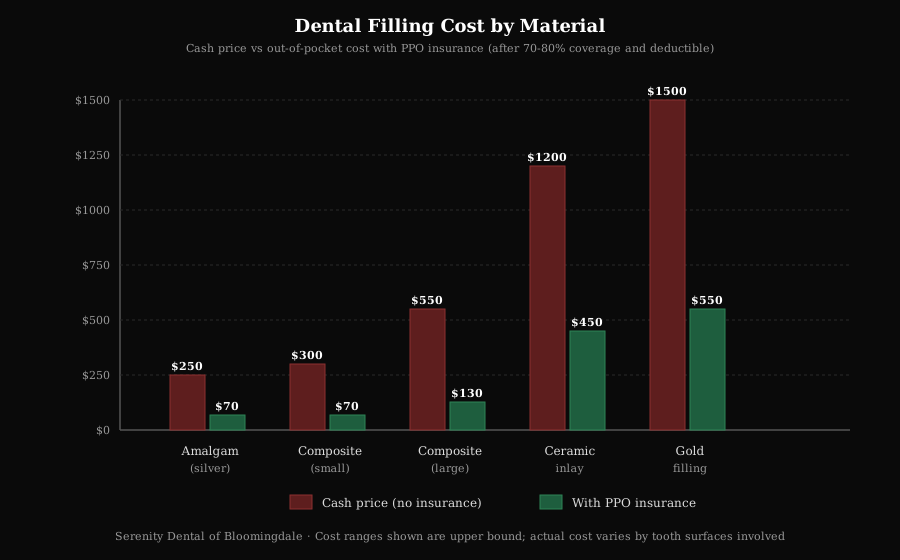
A standard tooth-colored cavity filling costs $150 to $550 in the U.S. depending on size. Amalgam (silver) fillings run $100 to $400. With PPO insurance covering 70 to 80 percent, out-of-pocket cost typically drops to $30 to $165 per tooth. This guide breaks down what you actually pay by filling type, what insurance covers, why prices vary, and how to evaluate discount offers.

Written by Dr. Husna Khan, DDS
Serenity Dental of Bloomingdale · April 19, 2026
Cost ranges reflect 2026 averages, not treatment quotes. Serenity Dental provides written estimates before treatment begins — call (630) 359-0105.
For the broader picture of filling options and procedures, see the dental fillings service page. For cost comparison with crowns, see filling vs crown decision guide.
Cost by filling type and size
Fillings are billed by the number of tooth surfaces restored, not by the time taken. A molar has five surfaces (top/chewing, front, back, cheek-side, tongue-side). A cavity on one face is a one-surface filling; across the chewing surface and one wall is two surfaces; three or more surfaces is a large filling.
In our Bloomingdale office, filling estimates are built from surface count first, which keeps the fee side predictable. We see downgrade provisions catch patients off guard, which is why we verify benefits before the appointment rather than after.
Price shopping for fillings has a short shelf life because untreated decay grows on its own schedule, and the difference between offices on a routine composite is usually a fraction of the cost jump that happens when a small cavity crosses into two-surface or three-surface territory while you compare. Decay ignores deadlines. Cash payers hold more leverage than they usually realize, given that prompt-pay discounts, in-house membership plans, and third-party discount networks each shave a different slice off the fee schedule and can be combined with phased scheduling to keep any single month’s dental spending inside an ordinary budget. Ask about every discount.
| Filling type | CDT code | Cash price | With PPO |
|---|---|---|---|
| Composite 1 surface (posterior) | D2391 | $150-$450 | $30-$135 |
| Composite 2 surface (posterior) | D2392 | $250-$450 | $50-$135 |
| Composite 3 surface (posterior) | D2393 | $300-$550 | $60-$165 |
| Composite 4+ surface (posterior) | D2394 | $350-$600 | $70-$180 |
| Composite anterior (front tooth) | D2330-D2335 | $150-$450 | $30-$135 |
| Amalgam 1 surface | D2140 | $100-$250 | $20-$75 |
| Amalgam 2 surface | D2150 | $150-$300 | $30-$90 |
| Amalgam 3+ surface | D2160-D2161 | $200-$400 | $40-$120 |
Ranges reflect geographic variation (urban areas higher, rural lower) and practice overhead. Serenity Dental’s fees fall within this range. The American Dental Association publishes CDT codes and guidelines for how fillings are classified and billed.
What drives filling price differences
Five factors determine your final cost:
1. Number of surfaces. The biggest single factor. Each additional surface adds $75 to $150 to the price. A three-surface filling requires more material, more curing cycles, more shaping time, and more bite adjustment than a one-surface filling.
2. Material choice. Composite costs 40 to 60 percent more than amalgam because composite material itself is pricier, placement requires more chair time (bonding, layering, curing), and technique-sensitive isolation drives cost. Patients pay more for tooth-colored appearance and conservative tooth preservation.
3. Tooth location. Back teeth (molars) are more expensive than front teeth because they have larger surface areas and higher bite forces, requiring more material and thicker restorations. Front tooth composites often cost slightly less.
4. Geographic area. Urban practices have higher overhead (rent, staffing, specialty equipment) than rural practices. Chicago-area fees typically run 10 to 20 percent above national median, while rural Illinois rural fees run 10 to 15 percent below.
5. Practice philosophy. High-volume insurance-network practices may price at insurance-allowed fees, while fee-for-service practices often charge 15 to 25 percent higher for longer chair time and premium materials. Neither model is inherently better — what matters is clinical quality and appropriate time per filling.
At Serenity Dental, Dr. Husna Khan schedules 45 to 60 minutes for a single-surface posterior composite filling, which allows proper isolation, careful bonding technique, and thorough bite adjustment. Rushed fillings (15-20 minute slots) have measurably higher post-op complication rates and shorter lifespan.
Insurance coverage breakdown
Fillings are classified as “basic restorative services” under most dental insurance plans, typically covered at 70 to 80 percent after the deductible.
| Plan type | Coverage | Annual max | What to expect |
|---|---|---|---|
| PPO (Delta Dental, Cigna, etc.) | 70-80% after deductible | $1,000-$2,000 | Free choice of dentist; higher benefit in-network |
| HMO (DMO) | Fixed copay per service | No max typically | $20-$85 copay per filling; limited dentist choice |
| Indemnity (traditional) | 50-80% of UCR fees | $1,000-$2,000 | Rare now; full freedom of choice |
| Discount plan / membership | 10-30% discount off fees | No insurance | Annual membership fee applies |
| Medicare Advantage w/ dental | Varies by plan | $1,000-$1,500 typical | Check plan details |
| No insurance (cash pay) | Pay 100% | N/A | Ask about prompt-pay discount (5-10% off) |
Deductibles typically range $50 to $150 per person per year. The deductible is met first before any insurance coverage applies. A $250 filling with a $50 deductible and 80 percent coverage = $50 (deductible) + $40 (20 percent of the remaining $200) = $90 patient responsibility.
Annual maximums are the cap on what insurance pays in a benefit year. If you have had a crown ($1,000 to $3,500) and a root canal ($650 to $1,500) earlier in the year, the $1,500 annual maximum may be reached before fillings are covered.
Downgrade provisions apply to some plans for posterior composite fillings. The plan pays what it would have paid for amalgam (e.g., $180) and the patient covers the difference between composite and amalgam rates. This often means $40 to $100 extra per composite filling. Ask your plan administrator whether downgrades apply.
Cost without insurance
Cash-pay options exist and are straightforward at most practices.
Prompt-pay discounts. Many practices offer 5 to 10 percent off for payment at time of service. On a $250 composite filling, that is $12 to $25 off. Always ask before the appointment.
Dental discount plans. Membership plans like Aetna Dental Access or Careington offer 10 to 30 percent off fee schedule for an annual membership fee of $100 to $200. Break-even is typically 3+ services per year.
In-house membership plans. Some practices offer their own annual memberships ($399 per year at Serenity Dental, plus $299 for each additional family member) that include cleanings and a discount on other services. Serenity Dental’s approach to fees is discussed openly during consultation.
Payment plans via CareCredit. CareCredit offers dental financing with promotional interest-free periods of 6, 12, or 18 months. If you pay off the balance within the promotional period, there is no interest. After the promotional period, deferred interest may apply, so timing matters.
Phased treatment. If multiple fillings are recommended, you can elect to treat the most urgent first and schedule the rest over 6 to 12 months. This spreads costs across two insurance benefit years if annual maximums are a concern.
For a complete cost comparison of restorative treatments, see filling vs crown vs inlay.
What to ask about cost before scheduling
Transparent practices will answer all of these clearly:
- What is the CDT code and fee for my specific filling?
- How many surfaces are being filled?
- What material is being used (composite, amalgam, glass ionomer)?
- What does my insurance cover, and what is my estimated out-of-pocket cost?
- Does my plan have a downgrade provision on posterior composite?
- What is the annual maximum and how much has been used this year?
- Is there a prompt-pay discount for cash or check payment?
Serenity Dental verifies insurance benefits before the appointment, discusses any downgrade provisions, and provides a written estimate. Dr. Husna Khan explains any change in treatment plan during the visit before additional work begins, never after.
Hidden costs to watch for
Some filling appointments generate additional fees. Not all are avoidable, but all should be discussed upfront.
Local anesthetic fee (D9230). Typically bundled into the filling fee, but a few practices charge separately ($25 to $75).
Rubber dam isolation (D9310). Rarely billed separately for fillings but sometimes listed as an add-on ($25 to $50). Rubber dam improves composite bonding and is standard-of-care, not optional.
Bite adjustment at follow-up (D9951). If the filling feels high and needs adjustment at a follow-up visit, some practices bill $50 to $75. Many include this at no charge within 30 days of placement.
X-rays if needed. Post-operative X-rays ($25 to $50 per film) are sometimes needed to verify fit of large fillings. Bitewing X-rays at recall appointments ($35 to $70 for two films) check for recurrent decay around fillings.
Core buildup (D2950). If a cavity is deeper than X-rays suggested and requires a foundation before the final filling, a core buildup adds $200 to $450. This is usually discussed during the procedure if needed.
When a filling is more cost-effective than delay
Cavities progress. A small filling today is dramatically cheaper than the treatment required when decay spreads.
| What you delay | Cost now | Cost if delayed |
|---|---|---|
| Small composite filling | $150-$450 | — |
| Larger filling if allowed to grow | — | $300-$550 |
| Crown if tooth needs full coverage | — | $1,000-$3,500 |
| Root canal + crown if pulp involved | — | $1,800-$5,000 |
| Extraction + implant if not restorable | — | $3,500-$6,000 |
A single filling delayed by 18 to 24 months can easily become a $2,000 to $5,000 problem. Bitewing X-rays at preventive visits catch cavities when a simple filling is still sufficient, which is why the American Dental Association recommends individualized X-ray frequency based on cavity risk rather than skipping X-rays to save cost.
Serenity Dental’s approach
At Serenity Dental, our approach to filling pricing centers on predictability:
- Insurance benefits verified before scheduling
- Written estimate provided before treatment
- Composite material used by default (amalgam on request)
- 45 to 60 minutes scheduled per single filling for careful technique
- Any mid-procedure change in plan discussed before continuing
- Follow-up bite adjustments included within 30 days
- CareCredit and payment plan options available
- Prompt-pay discounts for cash or check
Schedule a filling evaluation at Serenity Dental by calling (630) 359-0105. Dr. Husna Khan provides honest recommendations — small fillings are often conservative; large fillings sometimes need crowns or inlays, and the reasoning is explained before treatment. Related: what is a dental filling · dental fillings service page · filling material options.

Cost figures in this article are Chicago-area reference ranges compiled from regional fee data, not quotes from Serenity Dental of Bloomingdale. Every dental insurance carrier negotiates its own fee schedule, and Medicaid and Medicare Advantage plans set separate schedules of their own, so the amount a plan allows can sit above or below these ranges. Your actual fee depends on exam findings, materials, and benefits, and we provide a written, itemized estimate before any treatment begins.
A note on these numbers
This pricing guide is general information for budgeting, drawn from regional fee data and the American Dental Association (ADA) Survey of Dental Fees. It does not replace an in-person exam or a written estimate. Your fee depends on cavity size, tooth location, material, and insurance benefits.
A useful way to sanity-check any filling quote is to ask which surfaces are involved and then map that answer against the ranges in this guide, because a two-surface quote that lands near the top of the one-surface band is ordinary while one that doubles it deserves a question. Surfaces set the price. Benefit verification before the appointment beats dispute resolution after it, since a five-minute call that confirms your deductible status, your remaining annual maximum, and whether your plan downgrades posterior composites converts every number on the treatment plan from an estimate into something close to a receipt. Verify first, sign second. Regional price differences inside the Chicago area follow office overhead more than clinical quality, because rent in a downtown tower and rent in a suburban plaza sit far apart while the composite, the bonding agents, and the curing lights inside both offices come from the same catalogs.
When to call rather than wait
Price research can take a week. Some symptoms should not.
Call the same day for spontaneous throbbing, night pain, or a tooth that hurts without any trigger. Those signs mean the decay is at or near the pulp, and every week of waiting moves the bill up a bracket.
Call promptly if a chunk of tooth or an old filling breaks away. An open cavity picks up bacteria fast, and a temporary seal is inexpensive protection. The CDC reports that about 1 in 4 U.S. adults aged 20 to 64 has at least one untreated cavity, and untreated is exactly how a $250 repair becomes a $2,500 one.
Call right away at (630) 359-0105 for swelling, a bad taste from one spot, or a pimple on the gum. Those are abscess signs that need an exam within a day, not a better price quote.
FAQs
How much does a cavity filling cost without insurance?
How much does a filling cost with insurance?
What is the price difference between composite and amalgam fillings?
Why do fillings cost different amounts on different teeth?
Does Medicare cover dental fillings?
Can I get a payment plan for fillings?
Do cheaper fillings come with quality tradeoffs?
Are dental discount plans worth it for fillings?
Educational content only. Recommendations are personalized after an exam and any needed imaging.
About this article
Reviewed by Dr. Husna Khan, DDS, of Serenity Dental of Bloomingdale. Dr. Husna Khan provides written cost estimates and verifies insurance benefits before scheduling, so visit cost is transparent before treatment begins.
Educational content. Cost ranges reflect 2026 averages and are not a treatment quote. Final pricing depends on cavity size, tooth location, material, and insurance benefits assessed at consultation. Cited sources: American Dental Association coding guidelines (CDT 2026), American Academy of Pediatric Dentistry guidance for pediatric fillings, Centers for Disease Control and Prevention oral health surveillance data.
Related: dental fillings service page · filling materials.
Need help with this in real life?
Reading helps. Talking to someone who can look at your actual teeth and symptoms helps more. If you want a clear next step, we’re here.
Related articles
Dental crown cost in 2026: real pricing by material type
Zirconia crowns cost $1,000-$2,500; PFM $900-$2,000; gold $1,200-$3,000. Insurance typically covers 50%. What drives cost and how to budget.
Read article →Dental filling materials compared: composite vs amalgam
Composite, amalgam, glass ionomer, porcelain, gold: lifespan, cost, appearance, and which material is right for your cavity location.
Read article →Dental Filling Procedure Step by Step: What to Expect
Exactly what happens during a filling, from numbing to bite check. Timing, tools, sensations, and what to expect at each of the 7 stages.
Read article →