Dental Implants
Dental Implant Cost: What You Actually Pay in 2026
Dental implant cost in the Chicago area: post, abutment, crown, CBCT and bone grafting line by line, what insurance pays, and how to spot a padded estimate.

Written by Dr. Husna Khan, DDS
Serenity Dental of Bloomingdale · October 7, 2026
Educational purposes only, not a substitute for clinical evaluation. Call (630) 359-0105 for a written itemized estimate at your implant consultation. Individual costs vary based on bone health and complexity.
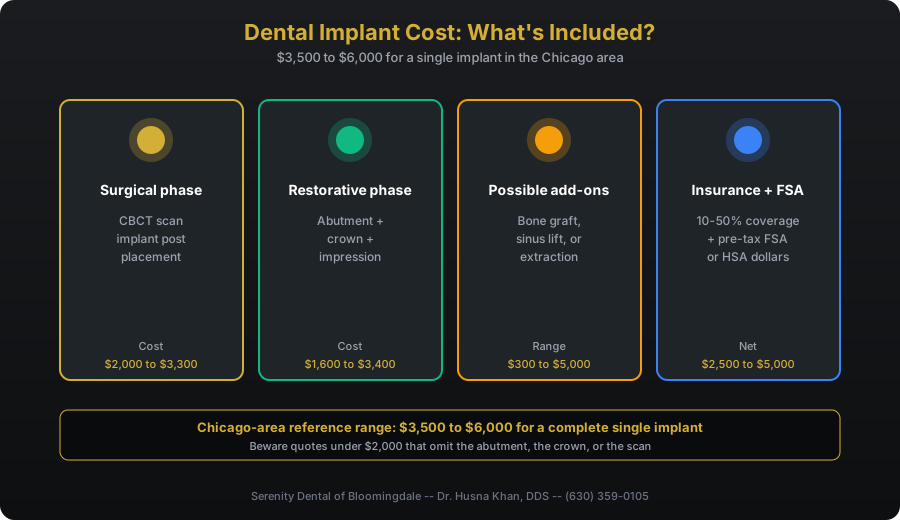
A single dental implant costs $3,500 to $6,000 in the Chicago area including the titanium post, abutment, and crown. Bone grafting, when needed, adds $300 to $3,000. CBCT 3D imaging adds $200 to $500. Total cost depends on case complexity, regional variation, implant brand, and whether grafting is required. Lowest-bid offers often exclude critical components, so understanding the line items lets you compare estimates fairly.
This breakdown covers each cost component, what insurance typically covers, financing options, regional variation, and how to evaluate whether an estimate is fair value or padded.
Component-by-component breakdown
Single-tooth dental implant cost
| Component | What’s included | Typical cost |
|---|---|---|
| Titanium implant post | The screw placed in the jaw | $1,800 to $2,800 |
| Abutment | Connector between post and crown | $400 to $1,200 |
| Crown | Visible tooth replacement | $1,200 to $2,200 |
| CBCT 3D imaging | Surgical planning scan | $200 to $500 |
| Bone graft (when needed) | Adds bone before or at placement | $300 to $3,000 |
| Subtotal (single tooth, no graft) | Post, abutment, crown, scan | $3,500 to $6,000 |
A complete dental implant has three core components plus required diagnostics. Understanding each line item makes comparing estimates simple.
The implant post is the titanium screw placed surgically into the jawbone. Cost typically runs $1,800 to $2,800. This includes the implant component itself ($300 to $600 for a major-brand implant such as Straumann, Nobel Biocare, or Zimmer Biomet), the surgical placement fee, local anesthesia, and the first follow-up visit. Off-brand implants reduce component cost but introduce serviceability problems years later, when a replacement screw or abutment has to be sourced for a system nobody stocks.
The abutment is the connector that screws into the implant post and emerges through the gum tissue. Cost typically runs $400 to $1,200. A stock abutment sits at the low end; a custom abutment, milled for the patient’s anatomy and crown design, sits at the high end. Stock abutments are cheaper but produce less ideal results on front teeth, where the gum contour shows.
The crown is the visible tooth-shaped restoration that attaches to the abutment. Cost typically runs $1,200 to $2,200 depending on material (porcelain-fused-to-metal at the lower end, all-zirconia or e.max in the middle, layered porcelain-on-zirconia at the higher end). Crown cost includes lab fabrication ($300 to $600), a digital scan or impression, a fitting appointment, and final cementation or screw retention.
CBCT 3D imaging is the imaging method of choice for implant planning per the American Academy of Oral and Maxillofacial Radiology position statement. Cost runs $200 to $500. The scan shows exact bone height, width, density, and proximity to nerves and sinuses, information that conventional 2D X-rays cannot provide reliably.
Bone grafting: the variable cost component
Bone grafting is needed when there is not enough natural jawbone to support the implant. A systematic review in Clinical Oral Implants Research found that the ridge loses 29 to 63 percent of its width (about 3.8 millimeters) and 11 to 22 percent of its height within six months of an extraction, which makes grafting necessary for many delayed implant cases. Grafting the socket at the time of extraction is the usual way to limit that loss and avoid a larger graft later, and the American Association of Oral and Maxillofacial Surgeons (AAOMS) clinical statements note that implant placement may call for hard- or soft-tissue grafting depending on the ridge.
Cost varies by graft size and complexity. Socket preservation grafts placed at the time of extraction cost $300 to $800. They are the lowest-cost grafting option and often the most cost-effective long term, because they prevent the larger bone loss that would otherwise follow. Ridge augmentation grafts cost $800 to $2,000 and are used when moderate horizontal or vertical bone volume needs to be rebuilt. Sinus lifts cost $1,500 to $2,500 for the crestal (osteotome) approach or $2,500 to $5,000 for the lateral window approach. Major ridge reconstruction cases involving extensive bone loss can run $3,000 or more.
CBCT imaging at consultation determines what grafting is needed. Patients we treat in our Bloomingdale practice receive a written itemized estimate that lists each component (the implant, abutment, crown, CBCT, and any required grafting) on separate lines so total cost is transparent.
Regional cost variation across the United States
Implant costs vary substantially by region, primarily driven by cost of living and local labor rates rather than quality differences. Major coastal metros (San Francisco, New York, Boston, Los Angeles) typically charge $5,000 to $7,500 per complete single implant. Midwest metros (Chicago, Minneapolis, Cleveland) typically charge $3,500 to $6,000. Smaller metros and rural areas typically charge $3,000 to $4,500.
Bloomingdale, Illinois sits in the Chicago metro area, so the midwestern metro range applies. In our Bloomingdale office, a standard single-implant case (post, abutment, and crown) is offered as a $2,999 no-insurance package after a free implant consultation; extraction, grafting, and sedation are itemized separately on the written estimate, and the package does not combine with insurance fee schedules. The current terms are on the offers page.
National fee surveys from the American Dental Association place a complete single implant near the middle of the $3,500 to $6,000 range. Regional variation around that midpoint is meaningful but not enormous.
What dental insurance typically covers
Insurance coverage for implants is the most variable cost factor patients face. Coverage falls into three patterns. Some PPO plans cover 50 percent of the implant component up to an annual maximum (typically $1,000 to $2,000), so a $4,500 implant might receive $1,500 in coverage, leaving $3,000 of patient responsibility. Some plans cover the crown attached to the implant but not the implant post itself, partial coverage that addresses one of the three components. Some plans exclude implants entirely as a “cosmetic” procedure and pay nothing toward any component.
Medicare and Medicaid generally do not cover dental implants. Some Medicare Advantage (Part C) plans include limited dental benefits that may apply to implants; coverage varies widely and verification at consultation is essential. Some Veterans Affairs benefits cover implants for service-connected conditions.
We verify specific plan benefits at consultation and provide patients with the codes (D6010 for the implant, D6056 for the abutment, D6058 for the crown, D7950 for ridge augmentation, D6190 for the surgical guide) so they can confirm coverage with their insurer directly. Pre-authorization requests submitted before treatment provide written confirmation of what will be covered.
Financing and payment options
For patients without sufficient insurance coverage or savings, several financing options can spread implant cost over time. Third-party financing through Cherry, CareCredit, and Sunbit offers 0 percent promotional interest for 6 to 24 months for qualified applicants, with longer terms at standard interest rates. FSA (flexible spending account) and HSA (health savings account) funds, when available, provide tax-advantaged payment for the year of treatment.
Patients we treat in our Bloomingdale practice often combine sources: partial insurance coverage, an FSA contribution, and a 12-month promotional financing plan together cover the typical treatment without a large lump sum. We discuss financing options at consultation alongside the treatment plan.
Dental school clinics offer another path. Treatment costs at university dental schools typically run 30 to 50 percent below private practice rates because students perform the work under faculty supervision. Trade-offs include longer appointments, slower treatment timelines, and rotating student providers between visits. For patients with significant cost constraints and flexibility on timing, this can be a viable option.
How to evaluate whether an estimate is fair
Three signals indicate a fair estimate. First, the estimate is itemized line by line: the implant post, abutment, crown, CBCT, any grafting, and follow-up visits each appear separately with individual prices. Second, the estimate names the implant brand. Reputable brands have decades of research; unfamiliar brands raise questions. Third, the estimate clarifies what is included and what is not, specifically whether all three implant components are included or whether the abutment or crown is billed separately later.
Three signals indicate an estimate worth questioning. First, a single bundled price with no itemization. Second, prices that are 30 to 40 percent below regional norms for a “complete implant,” because the saving usually means components are excluded or off-brand implants are being used. Third, refusal to provide a written estimate before scheduling.
Patients we treat at our Bloomingdale practice receive a written itemized estimate at consultation that includes every component, the implant brand, and what is covered if complications develop. This same estimate format makes comparison shopping easy.
A note on these numbers
This pricing guide is general information for budgeting, drawn from regional fee data and the American Dental Association Survey of Dental Fees. It does not replace an in-person exam or a written estimate. Your fee depends on bone volume, the tooth’s position, the implant system, the crown material, and your benefits.
Read a quote the way a lender reads a loan. The total matters less than the terms. A $3,200 quote that covers the post alone and leaves the abutment and crown for “phase two” is a $5,500 implant described one third at a time, while a $4,800 quote that lists the scan, the surgery, the custom abutment, the zirconia crown, and two years of follow-up visits is the whole tooth on one page, and the second office is the cheaper one even though its number is bigger. Count the lines. Then compare.
Cost figures in this article are Chicago-area reference ranges compiled from regional fee data, not quotes from Serenity Dental of Bloomingdale. Every dental insurance carrier negotiates its own fee schedule, and Medicaid and Medicare Advantage plans set separate schedules of their own, so the amount a plan allows can sit above or below these ranges. Your actual fee depends on exam findings, materials, and benefits, and we provide a written, itemized estimate before any treatment begins.
When to call rather than wait
Specific symptoms after implant placement warrant prompt attention. Severe pain that worsens after day 3, persistent bleeding beyond 24 hours, a foul taste, or visible pus at any time during healing requires immediate evaluation. Fever above 100.4 F, sudden mobility of the implant, or new numbness in the lip or chin should be reported immediately.
Most issues caught early are addressable; problems that wait often become harder to manage. Call right away at (630) 359-0105 with any of these signs. Patients with active concerns are seen the same day or next business day.
Related implant guides: dental bridge vs implant · dental implants in Bloomingdale
FAQs
How much does a dental implant cost in the United States?
Why do dental implants cost so much?
Are cheap dental implants safe?
How much does bone grafting add to implant cost?
How does implant cost compare across regions of the United States?
Are dental implants worth the cost long-term?
Does Serenity Dental offer a single implant package price?
Can I finance a dental implant?
Educational content only. Recommendations are personalized after an exam and any needed imaging.
About this article
Reviewed by Dr. Husna Khan, DDS, who places dental implants at Serenity Dental of Bloomingdale, IL. Cited sources: American Dental Association Survey of Dental Fees, 2021 cohort study in Clinical Implant Dentistry and Related Research (10,871 implants, up to 22 years), 2012 systematic review in Clinical Oral Implants Research on post-extraction ridge changes, American Academy of Oral and Maxillofacial Radiology guidelines on CBCT imaging, American Association of Oral and Maxillofacial Surgeons (AAOMS) parameters of care, American Academy of Implant Dentistry patient guidance on the implant process. The full list is under Sources below.
Educational content. Individual treatment recommendations depend on clinical evaluation. Schedule a consultation at (630) 359-0105.
Sources
- American Dental Association, 2022 Survey of Dental Fees (Health Policy Institute). Self-reported fees for more than 200 procedures from a national sample of dentists, reported nationally and by region
- French D, Ofec R, Levin L. Long term clinical performance of 10 871 dental implants with up to 22 years of follow-up: a cohort study in 4247 patients. Clin Implant Dent Relat Res 2021;23(3):289-297. Implant survival of 98.5 percent at 5 years and 96.8 percent at 10 years; smoking and diabetes were linked to failure
- Howe MS, Keys W, Richards D. Long-term (10-year) dental implant survival: a systematic review and sensitivity meta-analysis. J Dent 2019;84:9-21. Pooled 10-year implant survival of 96.4 percent
- Tan WL, Wong TL, Wong MC, Lang NP. A systematic review of post-extractional alveolar hard and soft tissue dimensional changes in humans. Clin Oral Implants Res 2012;23 Suppl 5:1-21. The ridge loses 29 to 63 percent of its width (about 3.8 mm) and 11 to 22 percent of its height within six months of an extraction
- Tyndall DA et al. Position statement of the American Academy of Oral and Maxillofacial Radiology on selection criteria for the use of radiology in dental implantology with emphasis on cone beam computed tomography. Oral Surg Oral Med Oral Pathol Oral Radiol 2012;113(6):817-826. Cross-sectional imaging for every implant site, with CBCT the imaging method of choice
- AAOMS Parameters of Care: Clinical Practice Guidelines for Oral and Maxillofacial Surgery (ParCare), 7th edition. Practice guidelines covering dentoalveolar and implant surgery
- AAOMS clinical paper: Oral and Craniomaxillofacial Implant Surgery (2017). Reports implant success rates of 89 to 98 percent and the use of hard- and soft-tissue grafts as indicated
- American Academy of Implant Dentistry, What to Expect. Patient guide to the implant process; the full course typically takes three to nine months
Need help with this in real life?
Reading helps. Talking to someone who can look at your actual teeth and symptoms helps more. If you want a clear next step, we’re here.
Related articles
Dental Implant Healing Stages: From Surgery to Final Crown
Dental implant healing happens in four overlapping stages over 3 to 6 months. Detailed timeline of soft tissue, osseointegration, and bone remodeling.
Read article →Dental Bridges: Types, Cost, and How Long They Last
The four types of dental bridges, Chicago-area cost ranges, how long each lasts, the two-visit procedure, and when an implant is the better choice.
Read article →All-on-4 with Bone Loss: Can You Still Qualify Without Bone Grafting?
Most patients with bone loss qualify for All-on-4 without grafting, thanks to angled posterior implants. When grafting is needed and the alternatives.
Read article →