Dental Implants
Dental Implant Healing Stages: From Surgery to Final Crown
Dental implant healing happens in four overlapping stages over 3 to 6 months. Detailed timeline of soft tissue, osseointegration, and bone remodeling.

Written by Dr. Husna Khan, DDS
Serenity Dental of Bloomingdale · October 7, 2026
Educational purposes only. Healing varies by individual factors. Call (630) 359-0105 if pain worsens after day 3 or if you notice unusual symptoms during recovery.
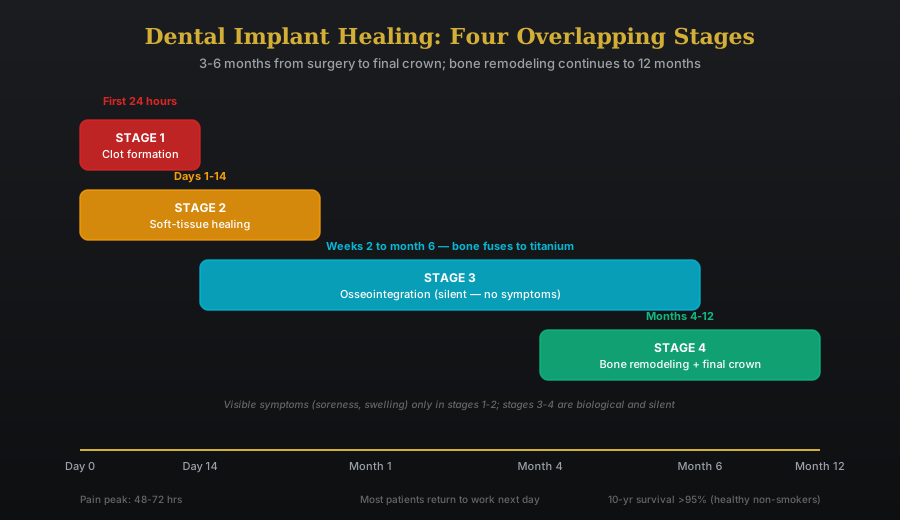
Dental implant healing happens in four overlapping biological stages over 3 to 6 months. Only the first stage brings visible soreness or swelling. Three silent processes follow it happening at the bone-titanium interface, and they are the reason the wait between implant placement and final crown is non-negotiable. Here is what is happening at each stage and what to watch for.
Stage 1: Hemostasis and clot formation (first 24 hours)
Stage one starts the moment the implant post is placed and is largely complete within 24 hours. Blood pools at the surgical site, platelets aggregate, and a stable fibrin clot forms around the implant. The clot is what protects the underlying bone and starts the cascade of cellular signals that build new tissue around the post.
Three things matter in the first 24 hours. Do not disturb the clot. That means no smoking, no straws, no vigorous rinsing, and no spitting. Apply ice to the cheek for 15 minutes on, 15 minutes off, for the first 4 to 6 hours to limit swelling. Take ibuprofen on a schedule (typically 600 mg every 6 hours) rather than waiting for pain to start. In our practice we send patients home with written postoperative instructions and the office number, which carries after-hours instructions for urgent problems.
By the end of day 1, most patients describe the sensation as soreness rather than sharp pain. Mild swelling is normal and peaks at 48 to 72 hours. Bruising is uncommon for single-tooth cases but possible.
Stage 2: Soft-tissue healing (days 1 to 14)
During this stage the gum tissue around the implant is closing. Sutures (when used) dissolve on their own within 7 to 14 days. Around the implant or healing cap, the gum forms a tight collar, sealing the surgical site from oral bacteria. By day 7, most patients can return to a near-normal diet excluding the implant side. By day 14, the gum is closed and the visible part of healing is essentially complete.
Pain follows a predictable curve. Day 1 to 3 has the most discomfort. By day 4 to 5, ibuprofen alone (or even nothing) is sufficient for most patients. Day 7 to 10 should feel essentially normal at the site. Pain that worsens after day 3 instead of improving is the single most important warning sign for infection or implant complications. If you experience that, call our office promptly rather than waiting.
What to do during this stage: rinse gently with warm salt water 3 to 4 times a day starting on day 2, keep the implant area clean with a soft toothbrush avoiding direct pressure on the implant, eat soft foods like eggs, yogurt, soft pasta, and well-cooked vegetables, and continue ice for the first 48 hours if swelling is significant.
Stage 3: Osseointegration (weeks 2 through month 4)
This is the longest and most clinically important stage, and it is invisible. Osseointegration is the biological process where bone cells (osteoblasts) migrate to the titanium implant surface and lay down new bone in direct contact with the post. The bond that forms is mechanically strong enough to withstand normal chewing forces.
Lower jaws integrate faster than upper jaws because lower-jaw bone is denser. In our protocol, lower-jaw implants are typically allowed 3 to 4 months and upper-jaw implants 4 to 6 months. In the largest single-practice cohort published to date, 10,871 implants followed for up to 22 years in Clinical Implant Dentistry and Related Research, 98.5 percent were still in place at five years and 96.8 percent at ten, and a 2019 meta-analysis in the Journal of Dentistry pooled 10-year survival at 96.4 percent. The implants that fail early are mostly the ones placed in thin bone, in smokers, or in patients with uncontrolled systemic disease.
Almost nothing is felt at the surface during this stage. A temporary tooth (a flipper, temporary bridge, or in some cases nothing) is worn during the integration period. A short follow-up visit at the 4 to 8 week mark confirms the gum tissue is healthy and the implant is stable. The integration check at 4 to 6 months uses imaging and stability testing to confirm the post is ready for the final crown — when used, a resonance frequency analysis (Osstell ISQ measurement) above 65 indicates adequate integration. Cochrane’s review of loading times found no convincing difference in failure between immediate, early, and conventional loading when the implant is firmly stable at placement; the rule that still holds is that an implant without that primary stability is left unloaded until it integrates.
Five factors slow this stage: smoking is the largest single risk factor and roughly doubles failure rates (6.4 versus 3.2 percent in a 2015 meta-analysis in the Journal of Dentistry), uncontrolled diabetes with HbA1c above 8, bisphosphonate and steroid medications, poor oral hygiene at the implant site, and clenching or grinding that loads the implant before integration completes. Most are modifiable. The single most impactful action is smoking cessation for at least 2 weeks before surgery and 8 weeks after.
Stage 4: Bone remodeling and final crown (months 4 to 12)
Once integration is confirmed, the abutment is placed and the final crown is fabricated and delivered. Final crown placement is brief — typically 30 to 45 minutes. The healing cap or temporary is removed, the custom abutment is connected and torqued to manufacturer specification (typically 25 to 35 Ncm), the crown is tried in and evaluated for fit and shade, then either cemented or screw-retained. Bite is checked and adjusted if needed. The implant is now functionally loaded, meaning it bears chewing forces. Bone continues to remodel and adapt to those forces for up to 12 months after crown placement, refining the bone-implant interface in response to the bite pattern.
This stage is symptom-free. An integrated implant feels and functions like a natural tooth, and its crown is shaped and shaded to match adjacent teeth. Patients typically describe the final result as indistinguishable from their natural teeth. A 2021 cohort study tracked in Clinical Implant Dentistry and Related Research followed 10,871 implants and reported 96.8 percent survival at 10 years, with smoking and diabetes the factors most tied to failure, and failures clustering in the integration period rather than in this remodeling stage.
For front-tooth implants, soft-tissue maturation matters aesthetically and continues invisibly through this stage. The papilla — the gum tissue between the implant and adjacent teeth — can take 6 to 12 months to fully fill in. A long-running study of single-implant crowns in the International Journal of Periodontics and Restorative Dentistry found the papillae kept regenerating for one to three years after the crown went in, which is why the final look of a front-tooth implant is not judged for at least 12 months after restoration. For back-tooth implants, the maturation phase is less visible but still occurring as the bone density at the implant site continues to increase modestly through year 1.
For long-term care during and after this stage, see dental implant aftercare and maintenance and how long do dental implants last.
What slows healing and what speeds it up
Nothing reliably accelerates osseointegration once the implant is placed; that is the honest answer on speeding up healing. Biology sets the timeline. What can be done is removing the factors that slow it down.
Smoking is the single biggest modifiable risk: a 2015 meta-analysis in the Journal of Dentistry found implant failure of 6.4 percent in smokers against 3.2 percent in non-smokers. Patients who quit at least 2 weeks before surgery and remain smoke-free for 8 weeks after see substantially better outcomes than continuing smokers. Diabetes management matters: in a one-year study in the Journal of the American Dental Association, implants survived at similar rates in non-diabetic, well-controlled, and poorly controlled patients, but stabilization was delayed when glycemic control was poor, and in long-term cohorts diabetes is one of the factors tied to failure. For more on this specific case, see dental implants and diabetes.
Sleep, hydration, protein intake, and avoiding loading the implant before integration are all modest contributors. Heavy alcohol use, recreational drug use, and certain prescription medications (bisphosphonates particularly) require disclosure at consultation so the treatment plan can account for them.
When to call rather than wait
Pain that worsens after day 3, swelling that worsens after day 5, fever, foul taste at the site, drainage, a sense that the implant is loose, or any sudden change at the implant site at any point during healing are reasons to call our office promptly. Schedule an appointment or call us directly so we can evaluate. Early intervention catches complications when they are still reversible.
For specific failure warning signs and the underlying biology, see signs of dental implant failure. For procedure context before healing begins, see dental implant procedure step by step.
Day-by-day at home: what helps healing
Those first 72 hours set the trajectory for the entire healing process. In our practice we send patients home with a written postoperative instruction sheet and the office number, which carries after-hours instructions for urgent problems, and the patients who follow the instructions closely have noticeably fewer complications than the ones who decide on day two that they feel fine and resume normal activity.
Days 1 to 3: Ice 15 minutes on, 15 minutes off, for the first 4 to 6 hours. Ibuprofen 600 mg every 6 hours on a schedule, not as needed, for the first 48 hours. Soft foods only — yogurt, smoothies (no straws, ever, in the first 7 days), eggs, well-cooked oatmeal, mashed potatoes, soft pasta. No smoking. No alcohol while taking pain medication. Sleep with your head slightly elevated for the first 2 nights to reduce swelling.
Days 4 to 7: Pain typically fades to mild soreness or none at all. Switch to gentle warm salt water rinses three to four times daily after meals. Begin brushing the implant area with a soft toothbrush, avoiding direct pressure on the implant or sutures. Continue soft foods on the implant side. Resume normal activity but avoid heavy lifting or vigorous exercise that increases blood pressure for the first week.
Days 8 to 14: Sutures dissolve. Gum tissue closes around the implant. Soft-to-normal diet excluding crunchy foods on the implant side. Resume normal oral hygiene including flossing of adjacent natural teeth. The follow-up visit at this stage confirms the soft-tissue healing is on track.
Months 1 to 4: Largely symptom-free. Continue wearing your temporary tooth (when applicable). Avoid hard or crunchy foods on the implant side. Maintain excellent home oral hygiene. Keep the integration check appointment.
Call (630) 359-0105 with any concerns during your healing — we would rather see you for a quick check than have you wait at home worrying. Related: dental implants service page.
Quick reference
| Stage | What to expect |
|---|---|
| Days 1 to 3 | Mild swelling, soreness, possible light bleeding; soft food only; no smoking |
| Week 1 to 2 | Suture removal if needed; swelling resolves; gentle hygiene around the site |
| Weeks 2 to 6 | Soft tissue heals fully; gradual return to normal foods on the implant side |
| Months 3 to 6 | Bone integrates with implant (osseointegration) |
| Months 4 to 6 | Crown placement when integration is confirmed |
| Year 1 onward | Routine cleanings every 6 months; monitor for peri-implant inflammation |
Dental implant healing stages -- questions answered
What are the dental implant healing stages?
How long does it take for a dental implant to heal?
What is the first stage of dental implant healing?
What is osseointegration and how long does it take?
How long does it take to get dental implants from start to finish?
What does dental implant recovery feel like day by day?
What slows down dental implant healing?
When can I eat normally after a dental implant?
Educational content only. Recommendations are personalized after an exam and any needed imaging.
About this article
General information for patients, not a substitute for the post-operative instructions you receive after your own surgery. Healing timelines reflect typical single-tooth implant cases per American Academy of Implant Dentistry patient guidance and AAOMS clinical statements; the studies behind the figures are listed under Sources below. Individual results vary by bone quality, systemic health, smoking status, and adherence to postoperative instructions.
Related: dental implants.
Sources
- American Academy of Implant Dentistry, What to Expect. Patient guide to the implant process; the full course typically takes three to nine months
- AAOMS Parameters of Care: Clinical Practice Guidelines for Oral and Maxillofacial Surgery (ParCare), 7th edition. Practice guidelines covering dentoalveolar and implant surgery
- AAOMS clinical paper: Oral and Craniomaxillofacial Implant Surgery (2017). Reports implant success rates of 89 to 98 percent and the use of hard- and soft-tissue grafts as indicated
- French D, Ofec R, Levin L. Long term clinical performance of 10 871 dental implants with up to 22 years of follow-up: a cohort study in 4247 patients. Clin Implant Dent Relat Res 2021;23(3):289-297. Implant survival of 98.5 percent at 5 years and 96.8 percent at 10 years; smoking and diabetes were linked to failure
- Howe MS, Keys W, Richards D. Long-term (10-year) dental implant survival: a systematic review and sensitivity meta-analysis. J Dent 2019;84:9-21. Pooled 10-year implant survival of 96.4 percent
- Chrcanovic BR, Albrektsson T, Wennerberg A. Smoking and dental implants: a systematic review and meta-analysis. J Dent 2015;43(5):487-498. Implant failure of 6.35 percent in smokers versus 3.18 percent in non-smokers across 107 studies
- Oates TW et al. The effects of elevated hemoglobin A1c in patients with type 2 diabetes mellitus on dental implants: survival and stability at one year. J Am Dent Assoc 2014;145(12):1218-1226. One-year survival was similar across glycemic groups, but implant stabilization was delayed with poor glycemic control
- Esposito M, Grusovin MG, Maghaireh H, Worthington HV. Interventions for replacing missing teeth: different times for loading dental implants. Cochrane Database Syst Rev 2013;(3):CD003878. No convincing evidence of a clinically important difference in failure between immediate, early and conventional loading
- Jemt T. Regeneration of gingival papillae after single-implant treatment. Int J Periodontics Restorative Dent 1997;17(4):326-333. Papillae beside single-implant crowns kept regenerating over 1 to 3 years of follow-up
Need help with this in real life?
Reading helps. Talking to someone who can look at your actual teeth and symptoms helps more. If you want a clear next step, we’re here.
Related articles
Dental Implant Cost: What You Actually Pay in 2026
Dental implant cost in the Chicago area: post, abutment, crown, CBCT and bone grafting line by line, what insurance pays, and how to spot a padded estimate.
Read article →Dental Bridges: Types, Cost, and How Long They Last
The four types of dental bridges, Chicago-area cost ranges, how long each lasts, the two-visit procedure, and when an implant is the better choice.
Read article →All-on-4 with Bone Loss: Can You Still Qualify Without Bone Grafting?
Most patients with bone loss qualify for All-on-4 without grafting, thanks to angled posterior implants. When grafting is needed and the alternatives.
Read article →