
Cosmetic Dentistry
How Long Do Dental Veneers Last? Lifespan, Wear, and Replacement
Real numbers on how long porcelain and composite veneers last, what wears them down, and how to make them last longer, from a Bloomingdale, IL dentist.

Porcelain veneers typically last between ten and fifteen years on average, with many cases lasting longer when home care, recall visits, and night-time grinding are well managed. Composite veneers usually last between five and seven years before they need refurbishing or replacement.
Those numbers are averages from published dental literature, not predictions about your specific teeth. The honest answer to how long veneers will last is that the case is half the dentistry and half what happens in the patient’s mouth over the next decade.
Where the lifespan numbers come from
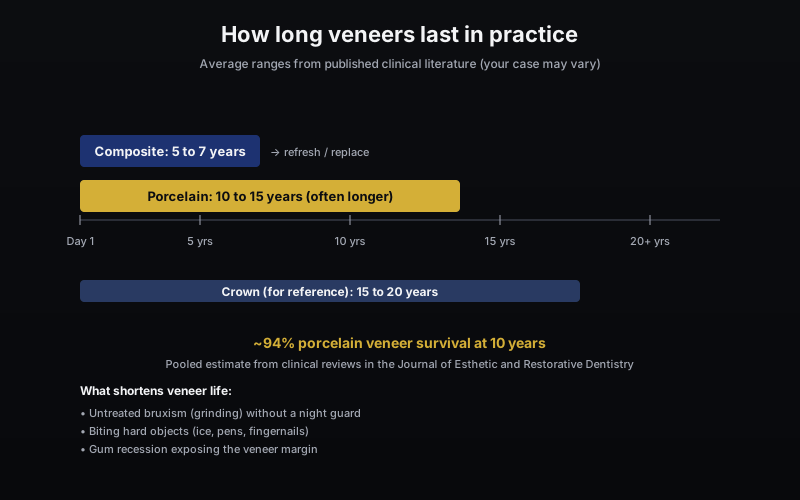
A systematic review in the Journal of Esthetic and Restorative Dentistry has reported survival rates above ninety percent at ten years for porcelain veneers placed under normal conditions in suitable patients. Some long-term retrospective studies show survival above eighty percent at twenty years. The Cochrane group and JADA have both published on veneer longevity, and the consistent finding is that porcelain outperforms composite over time.
Composite veneers tend to need refreshing or replacement on a five to seven year cycle. Surface wear and stain accumulate, and freehand-shaped composite cannot quite match the polish retention of lab-fired porcelain.
In our Bloomingdale practice, the cases that hold up the longest are the ones where Dr. Husna Khan has matched the material to the patient’s habits, not just to the cosmetic goal.
What actually wears veneers down
Three patterns drive most veneer failure or wear we see at recall visits.
Grinding and clenching, called bruxism, are by far the biggest factor. Grinding stress measurably shortens restoration life, a finding the Cochrane review on bruxism management has documented. Patients who grind at night without a guard can crack porcelain within a few years. That same patient wearing a custom night guard can hold the result well past a decade.
Edge contact during chewing matters next. Biting fingernails, opening packages with teeth, or chewing pens or ice all hit the thin edges of front veneers. Those edges are where porcelain fractures most often.
Gum recession over time exposes the line where the veneer meets the tooth. As recession progresses, the cosmetic match between the veneer and the natural root surface becomes less convincing, and at some point the veneer needs to be remade to cover the new gum line.
What helps veneers last
Five practical habits change the math:
Wear a custom night guard during sleep if you grind. Occlusal guards are recognized by the American Dental Association as standard care for bruxism, and we make custom guards for veneer patients who grind.
Daily flossing and brushing with a non-abrasive toothpaste. Some whitening toothpastes are too abrasive for the polished surface of a veneer. We can recommend brands that work well alongside cosmetic restorations.
Regular hygiene visits at six month intervals. Hygienists using the right tools and polishing pastes will not damage the veneer surface, and early signs of edge wear or gum recession get caught at recall.
Avoiding teeth-as-tools habits. Pen caps, fingernails, ice, and beer bottle caps are among the most common causes of porcelain edge chips we see at our Bloomingdale practice.
Consistent recall photos. Comparing photos year over year makes wear and color change obvious before the patient notices it in the mirror, which gives more time to plan a touch-up rather than a full replacement.
Why the lifespan range is so wide
Two patients with identical-looking veneer cases can end up with very different lifespans. Several variables drive that gap.
How the bite is balanced when the veneers are seated. Leave the bite slightly heavy on the veneers and they fatigue faster than they would with load shared across the rest of the teeth.
Whether the patient grinds, and whether they actually wear the night guard.
How well the gums are maintained. Periodontal disease around a veneer compromises the bond and accelerates the need for replacement.
Diet and habits. Heavy coffee, tea, red wine, and tobacco use stain composite faster than they affect porcelain.
Skill and material choice in the original case matter as much as anything the patient does. Technique sensitivity affects long-term outcomes, a point the American Academy of Cosmetic Dentistry has published on repeatedly.
What the first decade usually looks like
Nothing dramatic happens in years one through three. Bonded porcelain that was seated on a balanced bite behaves like enamel. Patients forget which teeth are veneered.
Somewhere between years four and eight, small things start showing up at recall: a hairline wear facet on an incisal edge, a fraction of a millimeter of gum migration, a shade difference that only appears in photographs taken under the same lighting as the originals. None of it requires action. All of it is worth documenting, because the trajectory matters more than any single visit.
Years nine through fifteen are where the decision arrives. By then a case either still looks right, in which case nothing changes, or it has accumulated enough marginal staining, recession, and edge wear that remaking the visible units becomes the honest recommendation. Patients who have watched their own annual photographs tend to reach that conclusion before we raise it.
When a veneer needs to be replaced
Signs that a veneer is nearing the end of its lifespan are usually visible if you know what to look for.
Chips on the biting edge come first. Small chips can sometimes be polished, but a chip that exposes the bond line usually means the veneer needs to be remade.
Color changes at the gum line follow, where the veneer meets the natural tooth, especially as recession exposes more of the root.
Sensitivity at the margin of the veneer, which can mean the bond is leaking and bacteria are reaching the underlying tooth.
Visible cracks in porcelain usually indicate fatigue from grinding, and they predict a fracture.
When any of these show up at a recall visit, the conversation shifts toward planning for a replacement on a comfortable timeline rather than waiting for an emergency.
Composite versus porcelain over fifteen years
Comparing the two materials on sticker price alone gets the arithmetic wrong.
Consider a patient who chooses composite at roughly half the porcelain fee. Composite typically needs refurbishing or replacement every five to seven years, so across a fifteen-year window that case is likely to be redone twice. Porcelain over the same window is often still in service on its original placement. Total spend lands in a similar place, but the composite patient has sat through several more appointments and lived with more shade drift along the way.
None of which makes composite the wrong choice. Younger patients whose gum levels are still changing, patients who want a reversible option, and patients who need a result in a single visit all have good reasons to choose it. Knowing the replacement cycle in advance simply means the second and third appointments arrive as planned rather than as a surprise.
The question behind the question
Most people asking how long veneers last are really asking something else: will I regret this in ten years.
That is a fair thing to want an answer to, and the honest version is that regret in veneer cases tracks far more closely with how the case was planned than with how many years the porcelain survives, because a well-planned set that needs remaking at year twelve leaves a patient satisfied while a poorly planned set leaves them unhappy at year two with porcelain that is still technically intact. Planning is the durable part. Porcelain is replaceable.
Which is why the consultation matters more than the material. Ask how many similar cases the dentist has completed. Ask to see photographs of results at five and ten years, not just the week they were seated. Ask what the plan is when the veneers eventually need replacing, because a dentist who has thought that far ahead is the one who prepared the teeth conservatively enough to make it possible.
What replacement looks like
Replacing a veneer is similar to placing one. Dr. Husna Khan removes the old veneer, evaluates the underlying tooth, and either rebonds a new veneer or, if structural damage is present, recommends a crown.
In most cases the underlying tooth still has enough enamel to support a new veneer if the original case was prepared conservatively. That is one of the practical reasons we keep preparation as minimal as the case allows when the original veneers are placed.
When to call rather than wait
Most veneer maintenance questions belong at a routine recall visit. Four situations do not.
Call the office the same day if a veneer debonds completely. Keep the veneer dry, bring it with you, and skip any household adhesive. Rebonding an intact veneer is straightforward when the underlying tooth is sound, and far less costly than a remake.
Call promptly for sharp sensitivity to cold or sweetness at a veneer margin. Sensitivity along the bond line can indicate leakage, and bacteria reaching the tooth beneath porcelain becomes an expensive problem the longer it sits.
Call if the gum around a veneer swells, bleeds when brushed, or pulls away from the margin. Marginal inflammation sometimes traces to an overhang or a bonding issue that is simple to correct early and much harder once bone has been lost.
Seek urgent care within 24 hours of any blow to a front tooth, veneered or not. The International Association of Dental Traumatology (IADT) recommends evaluation inside that first 24-hour window, because pulp status can shift over the days after an injury.
A note on what this article cannot tell you
This is general information about veneer lifespan based on published dental literature and our clinical experience. Your specific lifespan will depend on your bite, your habits, your gum health, and the quality of the original case. Estimating properly takes a recall exam with photos, radiographs, and a conversation about how your teeth are wearing.
If you have veneers that are aging, or you are considering veneers and want to understand what maintenance will look like over the next decade, contact our Bloomingdale office to schedule an exam with Dr. Husna Khan.
FAQs
How long do porcelain veneers actually last?
How long do composite veneers last?
Are veneers permanent?
Do veneers stain over time?
Does grinding shorten the life of veneers?
Can a chipped veneer be repaired without replacing it?
What happens to the tooth when a veneer is removed?
Do veneers need to be replaced all at once?
How often should veneers be checked?
Educational content only. Recommendations are personalized after an exam and any needed imaging.
Need help with this in real life?
Reading helps. Talking to someone who can look at your actual teeth and symptoms helps more. If you want a clear next step, we’re here.
Related articles
Does Insurance Cover Dental Veneers? Coverage and Payment Options
Plain answers about veneer insurance coverage, what counts as cosmetic, and what payment plans actually work for patients in Bloomingdale, IL.
Read article →Porcelain vs Composite Veneers: An Honest Comparison
Porcelain or composite veneers? A Bloomingdale, IL dentist breaks down cost, lifespan, appearance, and which option fits which kind of patient.
Read article →Snap-On Veneers vs Permanent Veneers: An Honest Comparison
Snap-on or pop-on veneers vs bonded porcelain. A Bloomingdale, IL dentist explains who each one is for and where the marketing is misleading.
Read article →