Cosmetic Dentistry
Snap-On Veneers vs Permanent Veneers: An Honest Comparison
Snap-on or pop-on veneers vs bonded porcelain. A Bloomingdale, IL dentist explains who each one is for and where the marketing is misleading.

Snap-on and pop-on veneers are not the same thing as permanent veneers, even though the marketing for both often uses the same word. A snap-on product is a removable cover that fits over the front teeth like a thin tray, made from acrylic or a similar plastic. Bonded veneers stay put.
Patients in our Bloomingdale practice ask about snap-on options regularly because they are advertised heavily online and the price looks attractive. Below, the honest comparison covers what each one actually is, what each one can do, and where the marketing tends to overstate the result.
What snap-on veneers actually are
Snap-on veneers vs permanent veneers
| Factor | Snap-on (clip-on) veneers | Permanent veneers |
|---|---|---|
| Type | Removable plastic shell | Bonded porcelain or composite |
| Permanence | Removable | Permanent (enamel reduced) |
| Eating with them | Limited; cosmetic only | Eat normally |
| Lifespan | 1-3 years | 5-15 years |
| Cost (full smile) | Roughly $300-$600 per arch | Roughly $5,400-$20,000 for 6-8 teeth |
| Custom fit | OK fit; bulkier | Precision fit |
| Best for | Cosmetic events, temporary trial | Long-term smile change |
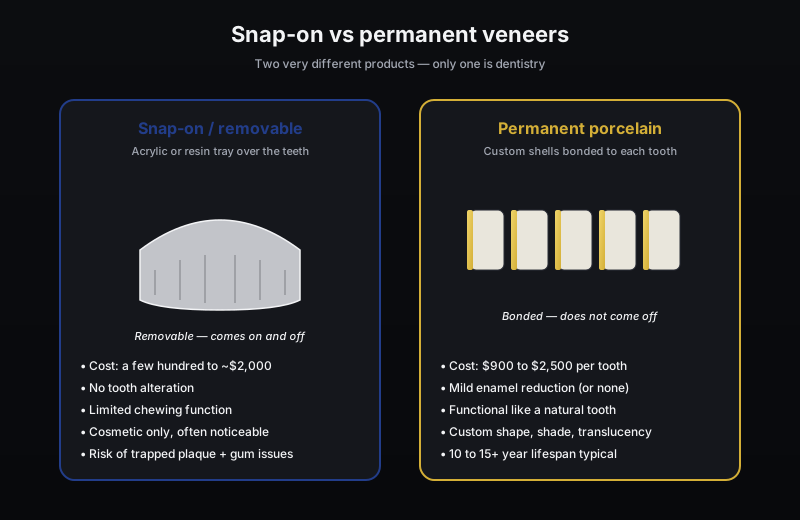
Snap-ons are trays. Removable plastic, custom-fitted to your teeth, put on and taken off at will, and everything else about how the two compare follows from that single difference in how they attach. Underneath, nothing changes. While worn, the tray is the smile.
Most snap-on products are sold direct to consumers through online retailers. Ordering usually means the company mails an impression kit, the patient takes impressions at home and shipsng them back, and the company fabricating the tray and mailing it back several weeks later. Some pricier services involve an in-person dental visit for the impression.
Neither restorative nor cosmetic dentistry is how the American Dental Association classifies snap-on veneers, and that regulatory gap tells you a lot about where these products actually live in the landscape. Think denture, not bonded veneer.
What permanent veneers actually are
Permanent veneers, the kind placed in a dental office, are porcelain or composite shells bonded to the front of a tooth with dental adhesive. They are designed to stay on the tooth for ten or more years on average, and they cannot be removed without specialized dental tools.
Bonded veneers arrive differently. Exam first. Then photographs, a treatment plan, and a licensed dentist doing the placement. No mail-order route exists. Fabrication involves either a dental lab or chairside composite.
The Academy of General Dentistry has noted that bonded restorations like veneers integrate with the tooth in a way that removable appliances do not, which affects both the appearance and the long-term function.
What snap-ons can and cannot do
Temporarily, a snap-on changes apparent color and shape. For some patients, they offer a low-cost way to test the look of a different smile or to wear a more even-looking smile for a special event.
A few real limitations are worth knowing before ordering a snap-on product:
Eating and drinking are limited. Most snap-on products are not designed for chewing harder foods, and many manufacturers recommend removing the tray to eat. Eating normally with the improvement in place is exactly the thing they cannot offer, and for many patients that single limitation ends up mattering more than price, appearance, and convenience combined.
Speech can be affected. Adding any thickness to the front of the teeth changes how the lips and tongue interact with the teeth during speech. Most patients adapt within days, but some do not.
Hygiene is harder. Snap-on trays trap food debris and saliva against the teeth underneath, which can increase plaque buildup and bad breath if the tray is worn for long periods without cleaning. The CDC has published on the importance of consistent oral hygiene, and a poorly maintained snap-on can work against that.
Long-term wear can affect the bite. Continuous wear of any acrylic device that changes the bite slightly can cause jaw and muscle discomfort over time.
Cosmetically, the result rarely matches custom porcelain placed by a cosmetic dentist, because a milled thermoplastic tray produced from a mail-in impression simply cannot reproduce the translucency and surface detail a ceramist builds by hand. Snap-on trays cover all the front teeth as one unit, which usually produces a flatter, more uniform look than the natural variation a custom veneer case can achieve.
When a snap-on might make sense
Snap-on veneers are not always the wrong answer. A few situations where they are worth considering:
A patient who wants a temporary cosmetic improvement for a single event, such as a wedding or a milestone photo, and is not ready to invest in permanent treatment.
Someone missing several teeth, waiting for permanent work to finish. During implant healing, a snap-on can sometimes provide a temporary cosmetic fill while the bone heals or the fixture integrates.
A patient who wants to preview what a different smile shape would look like before committing to permanent veneers. It does not predict the porcelain result perfectly. It can help with the decision.
Patients in our Bloomingdale practice do ask about snap-ons for these reasons, and when they do, Dr. Husna Khan walks through the realistic expectations, what the tray can and cannot deliver at each price point, and whether the option genuinely fits the situation or merely postpones the decision the patient actually came in to make.
When a snap-on is not the right answer
A few situations come up often where a snap-on is the wrong tool:
Patients who want a long-term cosmetic improvement they can wear all the time without thinking about it. Tray life does not match that goal.
Patients with significant bite issues or grinding. Unbalanced bites get worse under a tray.
Patients with active gum disease or untreated cavities. Trays over unhealthy teeth accelerate the problem. The Cochrane group has reviewed evidence on plaque control, and the consensus is that any device that reduces oral hygiene access carries risk for vulnerable teeth.
Social-media-grade results are a bonded-porcelain expectation. Custom porcelain veneers from an in-person cosmetic dentist produce results that thin acrylic trays simply cannot match.
A common scenario from our chair
A common situation in our Bloomingdale practice is a patient who has worn a mail-order snap-on for several months and now wants to talk about a long-term restoration. Two patterns repeat:
Someone happy with the general idea of an improved smile but unhappy with the limitations of the tray. A consultation about permanent veneers usually goes well from there because the patient already has clear expectations about what they want to change.
Someone who has developed gum inflammation or new cavities under the appliance from inconsistent cleaning, since ongoing disease under a tray is a clinical problem that no amount of cosmetic camouflage on top of it can outrun. Treatment then starts with the underlying dental health, and only once decay is handled and gums are stable does any cosmetic plan, removable or bonded, get to move forward.
In both cases the snap-on served as a useful preview, but the long-term answer was a different kind of restoration.
What we recommend
If you are weighing a snap-on veneer because the price looks attractive, three questions are worth asking before ordering one:
Will I actually wear this every day, or will I take it out for meals and end up not wearing it?
Am I expecting this to look like a bonded porcelain veneer, or am I expecting a more uniform, removable cosmetic option?
Is there an underlying dental issue, like gum inflammation or a tooth that needs attention, that should be addressed first?
This article is general information rather than individualized medical advice. Picking the right cosmetic option for your teeth takes a clinical exam and a conversation with a dentist who can review your specific situation.
To talk through your options, including whether a temporary snap-on or a permanent veneer is the right fit for your goals, set up a consultation at our Bloomingdale office with Dr. Husna Khan.
When to call rather than wait
Most appliance questions belong at a regular visit. These do not.
Call promptly about sores or ulcers where a snap-on appliance rubs. Pressure spots that have not settled within the first week are a fit problem, and fit problems only worsen with wear time.
Call the office about any cracked appliance with a sharp edge, and stop wearing it until it is smoothed or replaced, because broken acrylic against the inside of a lip does damage fast.
Contact your dentist right away if a tooth under the appliance starts aching. An appliance can mask early decay or gum trouble on the teeth it covers, and pain that appears under a snap-on is a sign something underneath needs attention now, not at the next recall.
Cost figures in this article are typical ranges for the Chicago area, compiled from regional fee data. They are not quotes from Serenity Dental of Bloomingdale; your fee depends on exam findings, materials, and insurance benefits, and we provide a written, itemized estimate before any treatment begins.
FAQs
Are snap-on veneers the same as permanent veneers?
Can I eat with snap-on veneers?
Are snap-on veneers safe?
Do snap-on veneers look like real veneers?
How much do snap-on veneers cost compared with permanent veneers?
Do snap-on veneers damage your natural teeth?
How long do snap-on veneers last?
Can you sleep in snap-on veneers?
Are snap-on veneers covered by insurance?
Educational content only. Recommendations are personalized after an exam and any needed imaging.
Need help with this in real life?
Reading helps. Talking to someone who can look at your actual teeth and symptoms helps more. If you want a clear next step, we’re here.
Related articles
Does Insurance Cover Dental Veneers? Coverage and Payment Options
Plain answers about veneer insurance coverage, what counts as cosmetic, and what payment plans actually work for patients in Bloomingdale, IL.
Read article →How Long Do Dental Veneers Last? Lifespan, Wear, and Replacement
Real numbers on how long porcelain and composite veneers last, what wears them down, and how to make them last longer, from a Bloomingdale, IL dentist.
Read article →Porcelain vs Composite Veneers: An Honest Comparison
Porcelain or composite veneers? A Bloomingdale, IL dentist breaks down cost, lifespan, appearance, and which option fits which kind of patient.
Read article →