
Fillings
Dental filling materials compared: composite vs amalgam
Composite, amalgam, glass ionomer, porcelain, gold: lifespan, cost, appearance, and which material is right for your cavity location.
Five materials are used for dental fillings today: composite resin (tooth-colored, bonded, most common), amalgam (silver-colored, mechanically retained, budget option), glass ionomer (fluoride-releasing, soft, pediatric and root surface use), porcelain (lab-made ceramic, highest esthetics for large restorations), and gold (rare but most durable). Each material has clinical strengths and tradeoffs. This guide compares them on cost, lifespan, appearance, and clinical appropriateness so you can have an informed conversation with your dentist about which fits your situation.

Written by Dr. Husna Khan, DDS
Serenity Dental of Bloomingdale · April 19, 2026
Educational content. Filling material selection depends on cavity size, tooth location, bite forces, and patient preferences — call (630) 359-0105 to discuss options.
For the broader picture of filling options, see the dental fillings service page. For material costs specifically, see dental filling cost.
Quick comparison: all five materials
Here is how the five main filling materials compare across the factors that matter most when choosing.
In our Bloomingdale office, tooth-colored composite is the default recommendation for most cavities. We see glass ionomer chosen mainly for root-surface cavities and pediatric work, where fluoride release matters more than polish.
Esthetics and strength stopped being a strict trade-off about a decade ago, since modern nanofilled composites polish to a gloss that hides in a smile while carrying bite loads that would have cracked their predecessors, and that shift is most of the reason silver fillings became the exception rather than the rule. Chemistry closed the gap. Patients weighing gold or porcelain against direct composite are really weighing two appointment models against each other, because lab-fabricated restorations trade a second visit and a higher fee for marginal fit and wear behavior that direct placement cannot quite match on large back-tooth repairs.
| Factor | Composite | Amalgam | Glass ionomer | Porcelain | Gold |
|---|---|---|---|---|---|
| Appearance | Tooth-colored | Silver/gray | Tooth-colored | Tooth-colored | Gold |
| Bonds to tooth | Yes | No (mechanical) | Yes (chemical) | Yes (cemented) | No (cemented) |
| Tooth preservation | Most conservative | More removal needed | Conservative | Needs more removal | Needs more removal |
| Average lifespan | 7-15 years | 10-20 years | 5-7 years | 15-25 years | 20-30+ years |
| Cost (per filling) | $150-$550 | $100-$400 | $100-$300 | $650-$1,500 | $800-$2,000 |
| Visits required | 1 | 1 | 1 | 2 (lab-made) | 2 (lab-made) |
| Insurance coverage | 70-80% PPO | 80% PPO | 70-80% PPO | 50-80% PPO | 50% PPO |
| Fluoride release | No | No | Yes | No | No |
| Best for | Most fillings | Back teeth, budget | Baby teeth, root decay | Large back-tooth restorations | Maximum durability |
Composite is used for approximately 90 percent of fillings placed in the U.S. today. Amalgam has decreased from 60 percent of fillings in 1990 to under 10 percent in 2026, reflecting both patient preference for tooth-colored restorations and improvements in composite materials.
The 4 main types of dental fillings explained
Dentists today routinely place four main types of fillings, plus gold as a premium fifth option. Different sources count these slightly differently — some lists include gold, some treat porcelain inlays and onlays as a separate category from porcelain fillings — but the practical clinical answer is four core types of fillings patients will encounter in everyday dentistry:
-
Composite (tooth-colored) fillings — the most common choice today, used for approximately 9 out of every 10 new fillings. Made from plastic resin and glass particles, color-matched to the surrounding tooth. Bonds chemically to the tooth and works for most cavity sizes and locations.
-
Amalgam (silver) fillings — the traditional silver-colored alloy of mercury, silver, tin, and copper. Very durable, inexpensive, but visible on chewing surfaces. Now used in less than 10 percent of new fillings, primarily on back teeth where esthetics do not matter and cost is a priority.
-
Glass ionomer fillings — a glass-and-acid cement that releases fluoride slowly into the tooth. Used in non-load-bearing areas, root surface decay, baby teeth, and as a temporary filling. Less wear-resistant than composite or amalgam.
-
Ceramic (porcelain) inlays and onlays — lab-made porcelain fillings cemented onto the prepared tooth. Used for larger cavities where composite would not last as long. More expensive than composite but more durable. Typically requires two visits.
A premium fifth option, gold alloy fillings, is also available for patients prioritizing maximum longevity. Gold fillings are extremely long-lasting (20 to 30 or more years) but expensive ($800 to $2,000 per tooth) and visibly metallic.
For the cost details on each type, see dental filling cost. For the foundational explanation of what fillings are and how they work, see what is a dental filling.
Composite (tooth-colored) fillings
Composite resin is the standard modern filling material. At Serenity Dental, composite is used by default for nearly all fillings because it combines good durability, excellent appearance, and conservative tooth preservation.
How composite works
Composite is a mixture of plastic resin (bisphenol A-glycidyl methacrylate, known as Bis-GMA) and filler particles (ceramic, glass, or silica). It comes in various shades to match tooth color. The material is placed in the cavity as a soft paste, shaped to match the tooth contours, then cured (hardened) with a blue LED light. The light triggers a chemical reaction (photopolymerization) that transforms the soft paste into a hard restoration in seconds.
Crucially, composite bonds chemically to tooth structure through a process called adhesive dentistry. The tooth is etched with phosphoric acid to create microscopic surface roughness, a primer is applied, then the composite bonds to that primed surface. This bonding eliminates the need for the mechanical retention (undercuts) that amalgam requires, so the dentist can preserve more healthy tooth.
Composite advantages
- Esthetics: Matches natural tooth shade; invisible when done well
- Conservative preparation: Less healthy tooth removal than amalgam requires
- Bonded: Strengthens the remaining tooth structure
- No mercury: Made of plastic resin and ceramic/glass filler
- Repairable: Small chips or defects can be patched without full replacement
- Single visit: Direct placement, no lab required
Composite disadvantages
- Technique-sensitive: Moisture contamination during placement weakens the bond; requires dry field and skilled placement
- Shorter average lifespan: 7-15 years vs 10-20 for amalgam on same tooth
- Can absorb stain: Over years, composite margins may pick up coffee, tea, or wine staining
- Polymerization shrinkage: Slight shrinkage during curing can create stress at margins, contributing to marginal leakage over time
- Cost: 40-60 percent more than amalgam
When composite is ideal
- Front teeth (esthetics are priority)
- Small to medium cavities on back teeth
- Patients with mercury sensitivity or preference against amalgam
- Cavities where preservation of healthy tooth structure is important
- Children’s permanent teeth
For more on tooth-colored composite fillings specifically, see tooth-colored fillings explained.
Amalgam (silver) fillings
Amalgam has been used in dentistry for over 150 years and remains a valid choice for certain situations, despite declining use.
How amalgam works
Amalgam is a mixture of liquid mercury (about 50 percent by weight) combined with a silver alloy powder containing silver, tin, copper, and sometimes zinc. The mercury and alloy are mixed in a small amalgamator at the chairside, producing a soft silver putty. The dentist packs the putty into the cavity using mechanical condensation, shapes it before it hardens, and burnishes the surface. Over the next 24 hours, the mercury binds chemically with the alloy, creating a hard, silver-colored restoration.
Amalgam does not bond to tooth structure. It stays in place through mechanical retention — undercuts the dentist creates in the cavity preparation. This requires removing slightly more healthy tooth structure than composite does. The retention is mechanical (like a wedge), not chemical.
Amalgam advantages
- Durable: 10-20 year average lifespan, often longer
- Forgiving of technique: Less sensitive to moisture during placement than composite
- Budget-friendly: 40-60 percent less than composite
- Strong in heavy bite areas: Resists wear and fracture under high bite forces
- No shrinkage: Does not shrink during setting (unlike composite)
Amalgam disadvantages
- Silver appearance: Visible when smiling or showing teeth
- Contains mercury: Although bound within the alloy, this raises concerns for some patients
- Requires more tooth removal: Undercuts needed for mechanical retention
- Corrosion: Can produce dark discoloration of surrounding tooth structure over decades
- Thermal conductivity: Can transmit temperature sensation to the tooth more than composite
- Does not strengthen tooth: Unlike bonded composite, amalgam does not reinforce remaining tooth structure
- Not placed in pregnant women or young children per FDA guidance
Mercury safety
The mercury in amalgam is the most common reason patients ask about replacement. The American Dental Association, FDA, WHO, and CDC all consider amalgam safe for general use. Mercury released from amalgam fillings (through chewing, grinding, or placement/removal) is much lower than the mercury intake from eating seafood. Research has not shown harm from properly placed amalgam fillings.
The FDA issued updated recommendations in 2020 suggesting that amalgam be avoided as a precaution in certain groups:
- Pregnant women and women planning pregnancy
- Nursing women and infants under 12 months
- Children under 6
- Patients with impaired kidney function
- Patients with neurological disease or cognitive impairment
- Patients with known mercury sensitivity
These are precautionary recommendations, not findings of harm. For everyone else, amalgam remains an acceptable option.
When amalgam might be chosen
- Budget is the primary constraint
- Cavity is on a back tooth (not visible)
- Previous successful amalgam history in the patient
- High bite forces requiring maximum durability
- Area where isolation for composite is extremely difficult
Most patients at Serenity Dental choose composite over amalgam even for back teeth. Amalgam is offered when specifically requested or when cost is the determining factor. For existing amalgam replacement, see replacing amalgam fillings.
Glass ionomer fillings
Glass ionomer is a specialty material used in specific clinical situations rather than as a general-purpose filling.
How glass ionomer works
Glass ionomer consists of glass powder (fluoroaluminosilicate) mixed with polyacrylic acid liquid. When mixed, they undergo an acid-base reaction that hardens the material into a tooth-colored restoration. Glass ionomer chemically bonds to tooth structure, similar to composite, and uniquely releases fluoride slowly over years — which provides some protection against future decay near the filling.
Glass ionomer advantages
- Fluoride release: Helps prevent recurrent decay
- Chemical bond to tooth: Does not require undercuts
- Tooth-colored: Matches tooth (though less precisely than composite)
- Moisture-tolerant: Can be placed in conditions where composite would fail
- Biocompatible: Very low allergy and sensitivity rates
- Lower cost than composite
Glass ionomer disadvantages
- Softer than composite or amalgam: Wears faster, especially on biting surfaces
- Shorter lifespan: 5-7 years average
- Less esthetic than composite: Does not polish to the same luster
- Limited to smaller restorations: Not strong enough for large cavities or high-stress areas
- Can be abraded by brushing over years
When glass ionomer is ideal
- Baby teeth (deciduous dentition): Tooth will be lost naturally; glass ionomer’s fluoride release and ease of placement suit pediatric cases well
- Root surface cavities: Decay on exposed root surfaces (common in older adults with gum recession) benefits from glass ionomer’s moisture tolerance and chemical bond to root dentin
- Very small cavities in non-biting areas: Tiny incipient cavities can be filled with glass ionomer as a more conservative, fluoride-releasing alternative
- Temporary restorations: When the patient needs something to protect the tooth before definitive treatment
- Base or liner under a larger filling: Layered beneath composite in deep cavities for its fluoride release and insulating properties
Porcelain inlays and onlays
Porcelain restorations are lab-fabricated and cemented into a prepared cavity. They bridge the gap between direct fillings (placed in one visit) and full crowns (covering the entire tooth).
How porcelain restorations work
The dentist prepares the cavity, takes a digital or physical impression, and sends the case to a dental laboratory. The lab fabricates a porcelain inlay (fits inside the cavity) or onlay (covers one or more cusps) custom-shaped to the tooth. At a second appointment (usually 1-3 weeks later), the porcelain restoration is cemented in place.
Some practices with CEREC or other same-day crown technology can mill porcelain inlays in-office in about 90 minutes, eliminating the second visit. Serenity Dental uses traditional lab-made porcelain restorations for the highest esthetics and material quality.
Porcelain advantages
- Longest-lasting tooth-colored option: 15-25 years average, often longer
- Excellent esthetics: Indistinguishable from natural tooth
- Stain-resistant: Does not pick up coffee, tea, or wine stains like composite can
- Wear-resistant: Much harder than composite; resists bite forces well
- Strengthens the tooth: When bonded, porcelain reinforces the remaining tooth structure
Porcelain disadvantages
- Two visits required: Preparation, temporary, then final cementation
- Higher cost: $650 to $1,500 per restoration
- Lab time: 1-3 weeks between visits
- Requires more tooth reduction than composite: Though less than a full crown
- Can fracture under extreme bite forces: Especially in bruxism patients
When porcelain is ideal
- Large cavities on back teeth (too large for composite, not severe enough for crown)
- Replacement of failed very large composite or amalgam fillings
- Patients seeking maximum longevity with natural appearance
- Teeth with significant existing restoration but adequate remaining tooth structure
Gold inlays and onlays
Gold is the most durable filling material ever developed but has fallen from favor due to esthetic preferences.
How gold restorations work
Similar to porcelain, gold inlays and onlays are lab-fabricated. The lab casts the restoration in gold alloy (typically 50 to 70 percent gold mixed with other metals for strength). At a second appointment, the gold restoration is cemented in place.
Gold advantages
- Longest lifespan of any dental material: 20-30+ years, often 40+ years
- Perfectly biocompatible: No allergies or sensitivities in nearly all patients
- Minimal wear: Wears at roughly the same rate as natural tooth enamel
- Does not fracture: Gold is ductile and absorbs forces without cracking
- Precise fit: Gold’s properties allow extremely accurate margin fit
- Wears at same rate as opposing natural tooth: No damage to opposing dentition
Gold disadvantages
- Gold color: Very visible; unacceptable to most patients for esthetic reasons
- Two visits required
- Cost: $800 to $2,000, moving with the gold market
- Lab time: 1-3 weeks between visits
- Requires more tooth reduction than composite
When gold might be chosen
Rarely. Most patients who prioritize durability now choose porcelain for similar longevity with better esthetics. Gold remains an option for patients who specifically request it, often older patients who had positive experiences with gold restorations decades ago.
Choosing a filling material: a practical framework
The best material depends on five factors. Here is how the decision typically plays out at Serenity Dental:
Factor 1: Tooth location.
- Front tooth → composite (esthetics critical)
- Back tooth, small cavity → composite
- Back tooth, large cavity → composite or porcelain inlay
- Back tooth, very large cavity → porcelain onlay or crown
Factor 2: Cavity size.
- Small (1-2 surfaces) → composite
- Medium (2-3 surfaces) → composite or porcelain inlay
- Large (3+ surfaces, missing cusp) → porcelain onlay, gold onlay, or crown
Factor 3: Budget.
- Tight budget → amalgam (if back tooth), composite (if front tooth)
- Moderate budget → composite
- Unlimited budget → porcelain for esthetics, gold for longevity
Factor 4: Insurance coverage.
- PPO that downgrades posterior composite → Consider amalgam or accept the downgrade fee
- PPO with full composite coverage → composite
- No insurance → composite unless budget requires amalgam
Factor 5: Patient preferences.
- Avoids mercury → composite, glass ionomer, or porcelain
- Priority on esthetics → composite or porcelain
- Priority on longevity → porcelain or gold
- Children’s baby teeth → glass ionomer or composite
Material selection at Serenity Dental
Dr. Husna Khan’s general approach by situation:
- Default: Composite for 90+ percent of fillings
- Back-tooth large cavities (3+ surfaces): Evaluate for porcelain inlay/onlay vs large composite based on long-term outlook
- Pediatric (baby teeth): Glass ionomer or composite
- Root-surface decay in older adults: Glass ionomer or composite with glass ionomer liner
- Amalgam: Available on request or for budget-driven cases, with patient informed consent about appearance
- Gold: Rarely placed but available on request
All options are discussed at the consultation with expected longevity, cost, and esthetic tradeoffs. Written estimates are provided before treatment begins.
Comparing filling material longevity vs cost
A common question is “Which material is the best value over time?” Here is the cost-per-year math for a typical posterior two-surface filling.
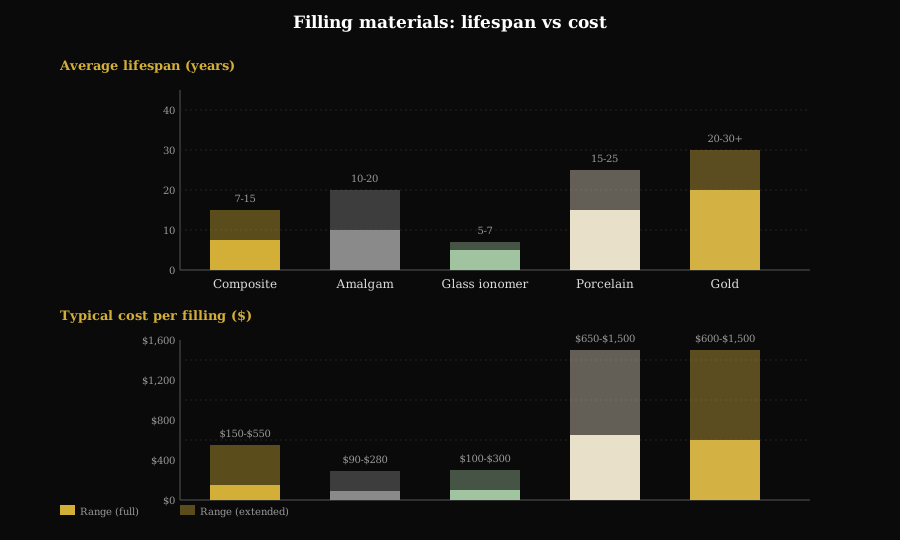
| Material | Typical cost | Average lifespan | Cost per year |
|---|---|---|---|
| Amalgam | $100-$400 | 15 years | $10-$25/year |
| Composite | $150-$550 | 10 years | $15-$55/year |
| Glass ionomer | $100-$300 | 6 years | $15-$50/year |
| Porcelain inlay | $650-$1,500 | 20 years | $35-$75/year |
| Gold inlay | $800-$2,000 | 28 years | $30-$70/year |
Amalgam has the lowest cost-per-year. Composite and glass ionomer are similar per-year costs. Porcelain and gold are higher per-year but offer the best esthetics (porcelain) and durability (gold).
Keep in mind these are averages. A composite placed with excellent technique on a low-stress tooth can last 20+ years, putting its cost-per-year closer to amalgam. A gold inlay in a bruxism patient might only last 15 years, raising its cost-per-year. Individual circumstances matter.
What to ask your dentist about material choice
Specific questions that help you make an informed decision:
- What materials are appropriate for my specific cavity?
- What are the pros and cons of each option in my situation?
- How many surfaces will the filling be?
- What is the expected lifespan of each material on this specific tooth?
- Does my insurance plan downgrade composite on back teeth?
- If a lab-made restoration (inlay/onlay) is considered, would it outlast a composite in this situation?
- Are there any clinical factors about my bite or oral hygiene that affect material choice?
- Is rubber dam isolation used for composite placement?
At Serenity Dental, Dr. Husna Khan discusses all applicable options with expected longevity and cost. The goal is informed consent, not upselling — if amalgam is a reasonable option for your situation, we will say so.
Schedule a filling consultation
Call Serenity Dental at (630) 359-0105 to discuss filling options for your specific situation. Material selection is part of the consultation — your cavity size, tooth location, insurance coverage, and personal preferences all factor into the recommendation. Written estimates are provided before treatment begins. Related: dental fillings service page · tooth-colored fillings · filling costs.

Fifty years of restorative research boils down to a simple summary, which is that every material on this page works well inside its lane and the failures dentists actually see come from lane violations, such as glass ionomer asked to survive molar chewing or composite placed where the tooth could not be kept dry. Match material to job. Longevity comparisons also reward a second look at the denominator, because a material that costs twice as much but lasts three times as long is cheaper per year of service, which is why the per-year column in the table above often ranks the options in a different order than the price column does. Divide by the years. Allergy and sensitivity histories belong in the material conversation from the start, because a documented metal sensitivity removes amalgam from the list before price enters the discussion, and a heavy clenching habit pushes the choice toward materials that shrug off compressive force instead of the most photogenic option on the shade guide. History narrows the menu.
When to call rather than wait
Material selection is consultation material. These situations are not.
Call the same day if a filling of any material falls out and the tooth is sensitive to air or cold. An open cavity collects bacteria fast, and a quick temporary seal protects the tooth until the permanent repair.
Call promptly for a cracked or sharp-edged filling, whatever it is made of. Sharp amalgam or composite edges cut the tongue, and a crack lets decay start underneath where you cannot see it.
Call right away at (630) 359-0105 if the gum next to any filled tooth swells or a pimple appears on it. That is an abscess sign, not a material problem, and it needs an exam within a day.
Cost figures in this article are Chicago-area reference ranges compiled from regional fee data, not quotes from Serenity Dental of Bloomingdale. Every dental insurance carrier negotiates its own fee schedule, and Medicaid and Medicare Advantage plans set separate schedules of their own, so the amount a plan allows can sit above or below these ranges. Your actual fee depends on exam findings, materials, and benefits, and we provide a written, itemized estimate before any treatment begins.
One practical rule cuts through most material debates at the chair, and it is that the smallest cavity gets the most material options while the largest cavity gets the fewest, so catching decay early is quietly the biggest material decision a patient ever makes. Small cavities, big choices.
A note on this comparison
This side-by-side is general information about material trade-offs. It does not replace an in-person exam. The right material for a specific cavity depends on its size, position, moisture control during placement, and your bite forces.
FAQs
What is the best dental filling material?
Are silver (amalgam) fillings safe?
Should I replace my silver fillings with white ones?
What are tooth-colored fillings made of?
How much do different filling materials cost?
What is a glass ionomer filling?
Are gold fillings still used?
Can I be allergic to filling materials?
Educational content only. Recommendations are personalized after an exam and any needed imaging.
About this article
Reviewed by Dr. Husna Khan, DDS, of Serenity Dental of Bloomingdale. Dr. Husna Khan presents all appropriate material options at consultation with honest discussion of longevity, cost, and esthetic tradeoffs — the goal is informed consent, not upselling.
Educational content. Material selection depends on multiple clinical and patient factors. Cited sources: American Dental Association evidence-based clinical recommendations on filling materials, FDA Safety Communication on dental amalgam (September 2020), Cochrane Collaboration systematic reviews comparing composite and amalgam restoration longevity.
Related: dental fillings service page · tooth-colored fillings.
Need help with this in real life?
Reading helps. Talking to someone who can look at your actual teeth and symptoms helps more. If you want a clear next step, we’re here.
Related articles
Dental filling cost in 2026: real pricing explained
Composite fillings cost $150-$550; amalgam runs $100-$400. What insurance covers, how surface count affects price, and what to expect without insurance.
Read article →Dental Filling Procedure Step by Step: What to Expect
Exactly what happens during a filling, from numbing to bite check. Timing, tools, sensations, and what to expect at each of the 7 stages.
Read article →What is a dental filling? Complete patient guide
A dental filling is a tooth-shaped repair that seals a cavity and restores chewing function. What fillings are made of, how they work, cost, and longevity.
Read article →