
Fillings
What is a dental filling? Complete patient guide
A dental filling is a tooth-shaped repair that seals a cavity and restores chewing function. What fillings are made of, how they work, cost, and longevity.
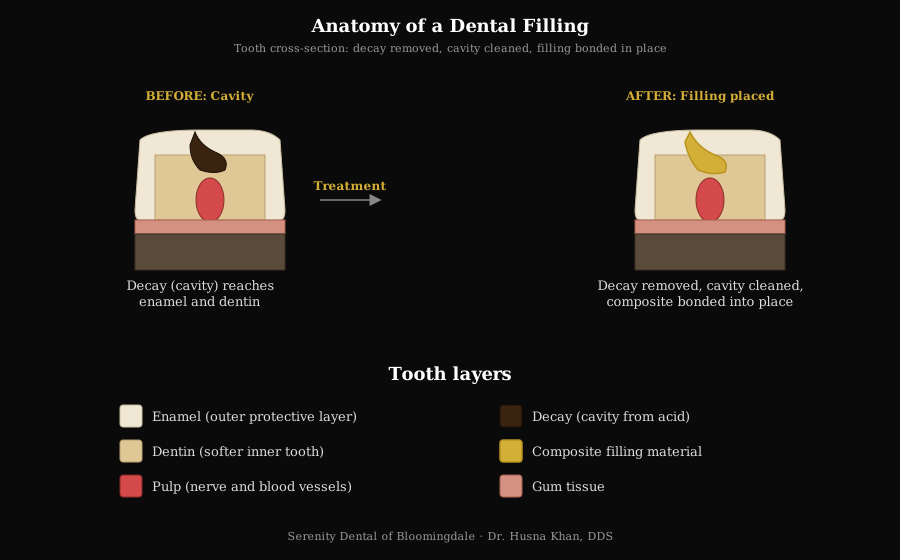
A dental filling is a tooth-shaped repair that seals a cavity (the hole caused by tooth decay) and restores normal chewing, biting, and appearance. After the decayed material is removed, the cleaned space is bonded or packed with a restorative material — most commonly tooth-colored composite resin today, though amalgam (silver), glass ionomer, gold, and ceramic are also used. A filling is the most conservative tooth repair available; it preserves the maximum amount of healthy tooth structure and typically lasts 7 to 15 years depending on material and cavity size. Cost ranges from $150 to $550 without insurance and $30 to $165 with PPO coverage. This guide explains what a filling is, how it works, how it differs from a cavity, what materials are used, what to expect at the appointment, and how fillings compare with crowns, inlays, and onlays.

Written by Dr. Husna Khan, DDS
Serenity Dental of Bloomingdale · April 26, 2026
Call (630) 359-0105 to schedule a filling evaluation. Written cost estimates come before treatment.
For the full filling service overview, see the dental fillings service page. Side-by-side material details are in filling materials compared.
The short answer
A dental filling is the standard repair for a cavity. The dentist removes the decayed tooth material, cleans the space, and bonds or packs a restorative material into it that hardens and functions like the original tooth. Once polished, the filling is barely visible (composite) or noticeable as a metallic surface (amalgam, gold) but feels like a normal tooth.
In our Bloomingdale office, small fillings caught at routine checkups are quick appointments, often finished inside half an hour. We see what bitewing timing changes, because a cavity found on schedule is a filling while the same cavity found late can mean a crown.
Materials get most of the attention in filling conversations while placement quality quietly does most of the work, because a well-bonded, properly cured, correctly contoured composite outlasts a rushed one made from the same syringe, which is why technique questions are fair game at any consultation. Technique outlasts material. Fillings also serve as the early-warning layer of a lifetime dental strategy, given that each one marks a spot where hygiene or diet briefly lost, and a pattern of new cavities across checkups is actionable feedback about fluoride, snacking, and dry mouth long before larger restorations enter the picture. Patterns teach prevention.
Three things a filling does:
- Seals the cavity so bacteria cannot continue to eat into the tooth
- Restores the original shape so the bite is correct and food does not pack into the area
- Returns full function for chewing and biting
Three things a filling does NOT do:
- Reverse decay that has already destroyed tooth structure
- Last forever (every filling is eventually replaced or upgraded)
- Strengthen the tooth back to its original state — a heavily filled tooth is always slightly weaker than an unfilled tooth
Cavity vs filling: what is the difference?
These two words are often confused because they appear together so often. The distinction matters:
| Term | What it is |
|---|---|
| Cavity | The problem — a hole in the tooth caused by decay (acids made by bacteria dissolving enamel and dentin) |
| Filling | The fix — the restorative material placed in the cavity after decay is removed |
A cavity is a clinical finding (something the dentist sees on exam or X-ray). A filling is a clinical procedure (something the dentist does to repair it). Cavities that are not filled keep growing because bacteria continue to feed on sugars and produce more acid. A small cavity that could have been a $150 to $450 filling can become a $1,000 to $3,500 crown or an $800 to $1,500 root canal if left unaddressed for one to three years.
For more on detecting and preventing cavities, see signs of a cavity and the cavity prevention guide.
What dental fillings are made of
Modern fillings come in four main materials. Each has different properties and ideal use cases.
Composite resin (tooth-colored)
The most widely used material today. Composite is a mixture of plastic resin and microscopic glass or ceramic particles, color-matched to the patient’s tooth. It bonds chemically to the tooth (rather than just sitting in a hole), preserves more healthy tooth structure, and is virtually invisible. The American Dental Association (ADA) reports composite is now used in over 70 percent of new fillings placed in the United States.
- Best for: Front teeth, visible back teeth, small to medium cavities, esthetic-conscious patients
- Lifespan: 7 to 10 years on average, longer with small cavities
- Cost: $150 to $550 per tooth without insurance
Amalgam (silver)
The traditional metal filling, in use for over 150 years. Amalgam is an alloy of mercury, silver, tin, and copper. It is silver-colored, very durable under chewing forces, and inexpensive. It does not bond to the tooth — it relies on a mechanically prepared cavity shape to stay in place. The U.S. Food and Drug Administration (FDA) considers amalgam safe for adults and children over six, with specific recommendations to avoid placement in pregnant women, nursing mothers, and children under six when alternatives exist.
- Best for: Large back-tooth cavities where esthetics do not matter, patients with budget constraints, areas hard to keep dry during placement
- Lifespan: 10 to 15 years on average, sometimes 20 or more
- Cost: $100 to $400 per tooth
Glass ionomer
A glass-and-acid cement that bonds to the tooth and slowly releases fluoride. Less wear-resistant than composite or amalgam, so it is used in non-chewing areas or as a temporary filling. Frequently used in pediatric dentistry on baby teeth.
- Best for: Baby teeth, root cavities, areas below the gumline, temporary fillings
- Lifespan: 5 to 7 years on average
- Cost: $100 to $300 per tooth
Gold and ceramic (premium)
Gold alloy fillings (cast gold) and ceramic inlays are premium options. Both are made in a dental lab from an impression of the prepared tooth and cemented at a second visit. They last longer than composite but cost considerably more.
- Best for: Long-term durability, larger cavities where structural integrity matters, patients prioritizing longevity over esthetics or cost
- Lifespan: 15 to 30 or more years for gold; 10 to 15 for ceramic
- Cost: $650 to $2,000 per tooth
For a deeper material comparison, see dental filling materials compared. For the tooth-colored option specifically, see tooth-colored fillings.
How a dental filling works (the procedure)
A typical filling appointment runs 30 to 60 minutes and follows this sequence.
1. Clinical exam and X-ray review
The dentist confirms the cavity location and depth, often with bitewing X-rays. Cavity depth determines whether a simple filling will work or whether the decay has reached the pulp (nerve) and needs a root canal.
2. Local anesthetic
A small amount of topical numbing gel is applied to the gum, then a local anesthetic (lidocaine or articaine) is injected near the tooth. Within 3 to 5 minutes the tooth and surrounding gum are fully numb. The injection is the only briefly uncomfortable part of most fillings.
3. Decay removal
The dentist uses a high-speed handpiece (drill) to remove the decayed enamel and dentin, then a slower instrument to clean the cavity. The goal is to remove all decayed material while preserving as much healthy tooth as possible. A rubber dam or cotton roll isolates the tooth and keeps it dry.
4. Cavity preparation
For composite: the cleaned tooth is etched with mild acid (creating microscopic roughness for bonding), rinsed, and treated with a bonding agent that adheres to both the tooth and the composite material.
For amalgam: the cavity is mechanically shaped with slight undercuts that hold the silver alloy in place once it sets.
5. Filling placement
For composite: the resin is added in thin layers, each cured (hardened) with a blue LED curing light for 10 to 20 seconds before the next layer is added. Thin layering produces stronger bonds and reduces shrinkage.
For amalgam: the freshly mixed alloy is packed into the cavity in increments and condensed firmly to remove air pockets.
6. Shaping and bite check
Once the filling is hardened, the dentist shapes it to match the tooth’s normal contour, then has the patient bite on articulating paper (colored carbon) to mark high spots. Any high spots are gently ground down so the filling does not interfere with the bite.
7. Polishing
The final filling is polished smooth so it does not collect plaque and feels comfortable on the tongue.
For a fully detailed walkthrough, see the dental filling procedure step-by-step.
Filling vs other restorations
A filling is the most conservative tooth repair. When more tooth structure is missing, larger restorations are needed.
| Restoration | Coverage | Typical use | Cost (cash) |
|---|---|---|---|
| Filling | Small portion of tooth | Cavities up to about 50 percent of the tooth | $150-$550 |
| Inlay | Between cusps of back tooth | Medium cavities, more durable than filling | $650-$1,200 |
| Onlay | Covers one or more cusps | Larger cavities, preserves more tooth than crown | $800-$1,500 |
| Crown | Entire visible tooth | Significantly damaged or weakened teeth | $1,000-$3,500 |
The decision among these is based on how much healthy tooth remains after decay is removed. A filling is appropriate when most of the tooth structure is intact. When more than about half of the tooth is gone, a filling alone often cannot reliably restore long-term function and the tooth needs an inlay, onlay, or crown. When the answer is not clearly a filling, see filling vs inlay vs crown.
Where on the tooth fillings can be placed
Fillings can repair almost any cavity location. The most common positions:
- Occlusal (chewing surface) of molars and premolars — the deep grooves on the top of back teeth, the most common cavity site
- Interproximal (between teeth) — where flossing was missed and decay developed at the contact point
- Smooth surface (cheek-side or tongue-side) — less common, often associated with gumline recession or dry mouth
- Front teeth (incisors and canines) — esthetic priority, almost always composite for color match
- Near the gumline (cervical) — usually from gum recession or aggressive brushing
Each location has slightly different challenges. Interproximal cavities are harder to access and require a matrix band to shape the filling between the teeth. Cervical (gumline) fillings often use glass ionomer or composite with extra moisture control. Front-tooth fillings need careful shade matching and surface polish to be invisible. For the esthetic zone specifically, see front tooth fillings.
How long fillings last
Average lifespans vary by material and tooth position, with bite forces and oral hygiene playing a major role.
| Material | Average lifespan | Common reasons for failure |
|---|---|---|
| Composite | 7 to 10 years | Marginal breakdown, recurrent decay, fracture |
| Amalgam | 10 to 15 years | Marginal corrosion, tooth fracture around filling |
| Glass ionomer | 5 to 7 years | Wear, fracture |
| Ceramic inlay | 10 to 15 years | Fracture, debonding |
| Gold | 20 to 30 or more years | Recurrent decay, occasional debonding |
Fillings on smaller cavities last longer than fillings on large cavities because there is more healthy tooth supporting the restoration. Patients who grind (bruxism) shorten filling life by 30 to 50 percent. Patients with high decay rates often see recurrent decay form at filling margins within a few years. Detailed lifespan data by material and patient factors is in how long do dental fillings last.
When a filling is not enough
Some cavities are too large or too deep for a filling to work reliably. Three common scenarios:
The decay has reached the nerve
If decay has extended into the pulp chamber (the inner nerve-and-blood-vessel space), a filling cannot stop the inflammation already underway. The tooth needs a root canal procedure, which removes the inflamed pulp, then a crown to protect the now-hollow tooth.
More than half the tooth is gone
When more than 50 percent of the tooth’s chewing surface has been lost to decay, a filling has too little remaining tooth to bond to and tends to fail by fracture. An inlay, onlay, or crown is more reliable.
A cusp has cracked off
If a cusp (a corner of the chewing surface) has fractured, a filling alone cannot rebuild the missing structure with adequate strength. An onlay or crown is needed.
When more is needed, see filling vs crown vs inlay.
What patients ask Dr. Husna Khan most often
A few questions come up in nearly every filling consultation at Serenity Dental of Bloomingdale.
Will the new filling match my other teeth?
Composite fillings are color-matched at the appointment using a shade guide. On front teeth and visible back teeth the match is usually invisible at normal viewing distance. Slightly translucent or multi-shade composite is layered for the most natural appearance on front teeth.
Can I just leave the cavity if it does not hurt?
Cavities almost always grow without symptoms until they reach the pulp — and by then a filling is usually no longer enough. Treating cavities early is significantly cheaper, faster, and less invasive than treating them late. A small cavity caught at a routine checkup is the best-case scenario.
Why does my old silver filling need to come out?
Old amalgam fillings do not need replacement just because they are silver. Replacement is indicated when there is marginal leakage (gap at the edge), recurrent decay, a crack in the filling or tooth, or the filling has broken down. Esthetic replacement (silver to tooth-colored) is a patient preference, not a clinical requirement. For full guidance, see replacing silver amalgam fillings.
Can I drive home after a filling?
Yes. A standard filling uses local anesthetic only — no sedation — so driving is safe immediately afterward. The numbness wears off in 1 to 3 hours.
Why Serenity Dental patients choose us for fillings
The standard of care at Serenity Dental of Bloomingdale includes:
- Tooth-colored composite as the default for new fillings, with amalgam available on request
- Written cost estimates before treatment begins and verified insurance benefits
- Conservative philosophy — the smallest restoration that will work long-term is preferred
- Rubber dam isolation for composite fillings, which produces stronger bonds and longer lifespan
- Bite check with articulating paper at every filling so the new filling does not feel high
- Same-day completion for most fillings; no separate visit required for routine cases
- Transparent material discussion so patients understand why a particular material was chosen
Schedule a filling evaluation by calling (630) 359-0105. If a cavity has been spotted on a previous exam and you are deciding when to address it, sooner is almost always cheaper and easier than later.
Related: dental fillings service page · dental filling cost · filling materials compared · filling procedure step-by-step.

Understanding what a filling actually replaces makes every other question on this page easier, because the procedure removes only the softened, bacteria-laden portion of the tooth and rebuilds exactly that void, which is why catching decay while the void is small preserves both money and enamel. Small holes, small fixes. Symptoms are a lagging indicator in cavity care rather than a starting gun, since decay spends months working through enamel before anything hurts, and by the time cold or sweets trigger a reliable twinge the repair conversation has often moved from a simple filling toward something larger. Pain arrives late. Prevention economics around fillings are lopsided enough to be worth stating plainly, because the fluoride toothpaste, the floss, and the two annual checkups that prevent a cavity cost less per year than a single surface of composite, and they protect every tooth at once instead of repairing one after the damage arrives. Prevention wins twice. Timing questions about existing fillings follow one reliable principle, since a filling that feels normal needs no calendar-based replacement while any change in how it feels to the tongue, the floss, or the bite is the retirement notice worth acting on.
When to call rather than wait
Deciding on a filling material can wait for a consultation. Cavity symptoms should not.
Call the same day for a visible hole you can feel with your tongue, or for food that packs painfully into one spot at every meal. Both mean the cavity has reached restoration size, and smaller is always cheaper.
Call promptly for cold sensitivity that lingers more than a few seconds after the cold is gone. Lingering is the signal that decay is approaching the nerve, and knowing when to call keeps a filling from becoming a root canal.
Call right away at (630) 359-0105 for spontaneous toothache, night pain, or swelling. Those are past-the-filling-stage symptoms that need an exam within a day.
Cost figures in this article are Chicago-area reference ranges compiled from regional fee data, not quotes from Serenity Dental of Bloomingdale. Every dental insurance carrier negotiates its own fee schedule, and Medicaid and Medicare Advantage plans set separate schedules of their own, so the amount a plan allows can sit above or below these ranges. Your actual fee depends on exam findings, materials, and benefits, and we provide a written, itemized estimate before any treatment begins.
A note on this article
This explainer is general information about fillings as a treatment. It does not replace an in-person exam. Whether a cavity needs a filling, an onlay, or something larger is a judgment call made from X-rays and direct examination.
FAQs
What is a dental filling?
What is the difference between a cavity and a filling?
What materials are modern dental fillings made of, and what is each best for?
How does a dental filling work?
What does a dental filling look like?
How long does a dental filling last?
What is the cost range for each filling material type?
Does a filling hurt?
Educational content only. Recommendations are personalized after an exam and any needed imaging.
About this article
Reviewed by Dr. Husna Khan, DDS, of Serenity Dental of Bloomingdale. The standard of care at Serenity Dental aligns with American Dental Association (ADA) restorative care guidelines, which recommend tooth-colored composite as the default material for most cavities and reserve crowns and inlays for situations where a filling cannot reliably restore long-term function.
Educational content. Individual treatment recommendations depend on clinical evaluation. Cited sources: American Dental Association (ADA) restorative care guidelines, U.S. Food and Drug Administration (FDA) recommendations on dental amalgam, Centers for Disease Control and Prevention (CDC) oral health surveillance data, American Academy of Pediatric Dentistry (AAPD) guidelines on pediatric restorations.
Related: dental fillings service page · dental filling cost.
Need help with this in real life?
Reading helps. Talking to someone who can look at your actual teeth and symptoms helps more. If you want a clear next step, we’re here.
Related articles
Dental filling cost in 2026: real pricing explained
Composite fillings cost $150-$550; amalgam runs $100-$400. What insurance covers, how surface count affects price, and what to expect without insurance.
Read article →Dental filling materials compared: composite vs amalgam
Composite, amalgam, glass ionomer, porcelain, gold: lifespan, cost, appearance, and which material is right for your cavity location.
Read article →Dental Filling Procedure Step by Step: What to Expect
Exactly what happens during a filling, from numbing to bite check. Timing, tools, sensations, and what to expect at each of the 7 stages.
Read article →