
Restorative Dentistry
Do Root Canals Hurt? Modern Anesthesia Explained
Why root canals aren't as painful as their reputation. Anesthesia explained, post-op soreness, sedation options, and the truth on root canal safety.
Short answer: not nearly as much as their reputation suggests, and typically less than the pain that brought you in. Modern root canal treatment with proper anesthesia is routinely compared to getting a filling. The reputation for severe pain comes from outdated techniques decades ago, combined with the fact that most patients arrive already in considerable pain from the underlying infection.
This guide covers what modern anesthesia actually feels like, what soreness to expect afterward, sedation options for anxious patients, and an honest answer to the “are root canals dangerous?” myth that circulates online.
If cost is your main concern, the root canal cost article covers pricing by tooth type. This article is about pain and safety specifically.
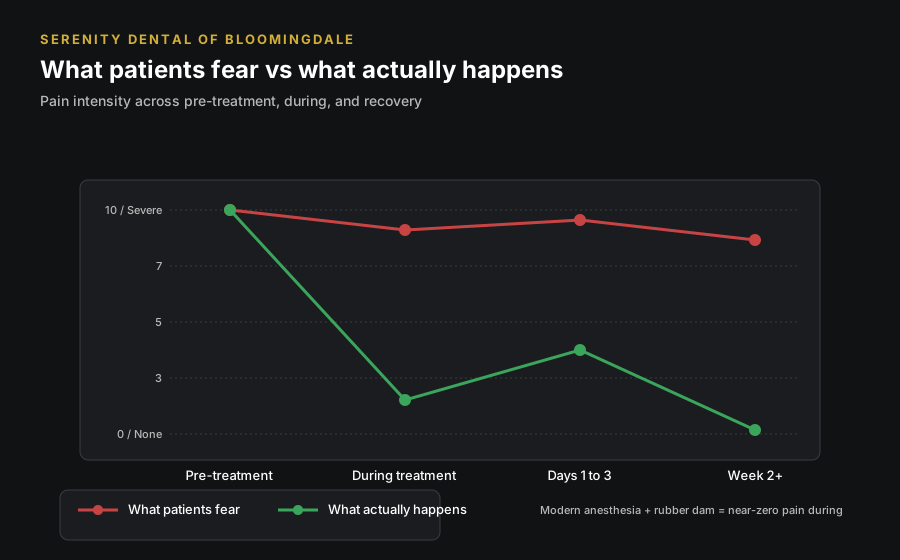
Where the “painful root canal” reputation comes from
Three factors combined to give root canals their historical reputation:
Older anesthesia techniques. Decades ago, local anesthesia was less reliable, especially on infected teeth where the acidic environment reduces the effectiveness of standard numbing agents. Modern supplemental injection techniques — intraosseous injections, PDL injections, buffered anesthetic — have largely solved this.
Patients arriving in severe pain. Most root canal patients come in because a tooth is already hurting significantly. Any residual discomfort during treatment feels worse against that baseline. Patients arriving with pain that’s kept them awake for days have a hard time separating “the procedure” from “the dental experience as a whole.”
Cultural repetition. Movies, TV shows, and stand-up comedy have repeated the “root canal = worst pain imaginable” trope for decades. That comparison has outlasted the reality by a generation or more.
The research backs this up. A systematic review in the Journal of Endodontics found that pain before a root canal is common and moderate, drops substantially within a day of treatment, and is minimal by the end of the first week. The gap between reputation and reality is real.
What modern anesthesia actually feels like
A root canal appointment follows a consistent anesthesia sequence that makes the procedure itself routine for most patients.
Before the injection: topical gel
A small amount of flavored topical numbing gel is applied to the gum at the injection site for 1 to 2 minutes. This numbs the surface tissue so the needle doesn’t create a sharp sensation going in.
The injection itself
Most patients feel a small pinch. Slight pressure, nothing more. Some feel almost nothing at all thanks to the topical, and the ones who do notice it usually describe a pinch that is over before they have finished registering it, which is a very different experience from the sharp sting that older injection techniques used to produce. Thirty to sixty seconds, and it is done. If the tooth is lower jaw (requiring a mandibular block), the injection is deeper and the tongue and lip will numb along with the tooth.
Waiting for full numbness
Onset takes 5 to 10 minutes typically. Then we check. Before any drilling starts, the provider tests the tooth with cold or tapping, and if anything is still sensitive, more anesthetic goes in first.
During the procedure
You should feel pressure and vibration but not sharp pain. If at any point something feels sharp, tell your provider immediately — additional anesthesia can be added until you’re fully comfortable. No reputable provider wants you uncomfortable during treatment.
The rubber dam isolation placed over the tooth also contributes to comfort. It holds the cheek and tongue away from the working area, which eliminates the sensation of instruments brushing soft tissue. The American Association of Endodontists calls dental dam isolation the standard of care for root canal treatment, primarily for infection control — but the comfort benefit is real.
After treatment
Numbness wears off over 4 to 6 hours, which is long enough that a late-afternoon appointment can mean eating dinner on one side of your mouth, so plan something soft and lukewarm rather than the hot soup that feels like the obvious choice. During this window, avoid chewing on the treated side and be cautious with hot liquids. Some patients have residual numbness in the lip or chin for up to 8 hours after lower-jaw procedures.
The “hot tooth” exception
Infected teeth with severe pulp inflammation (sometimes called “hot teeth”) can be harder to numb because the acidic infection reduces the effectiveness of standard local anesthesia. In these cases, providers use supplemental techniques — intraosseous injection, intraligamentary injection, or buffered anesthetic — that reliably achieve full numbness. In our Bloomingdale office, a hot lower molar is the case where we most often add an intraosseous or intraligamentary injection before the first file goes in. If standard injection isn’t working, we adapt.
Pain after a root canal: what’s normal
Mild to moderate soreness for 1 to 3 days is normal and expected. It follows a predictable curve. In our office, the most common day-two call is tenderness on biting, not throbbing, and it usually settles once the bite on the temporary filling is adjusted. The soreness comes from the periapical tissues at the root tip — the ligament and bone that surround the root — which are mildly inflamed from the instrumentation inside the canal. This is local and temporary, not a sign that something is wrong.
Pain patterns also vary by tooth type. Molars and premolars tend to produce slightly more post-op soreness than front teeth because they have more canals to instrument and larger periapical footprints. A front tooth with a single canal often has almost no post-op pain at all. A molar with three or four canals and a larger periapical region may produce moderate soreness for a few days, partly because more canals mean more instrumentation, and partly because the chewing load on a back tooth keeps reminding you it is there every time you bite down.
| Day | What’s typical |
|---|---|
| Day 0 (evening of) | Mild ache as numbness wears off. Tenderness when biting. Ibuprofen controls it well. |
| Day 1 | Some inflammation peaks. Mild to moderate soreness. Full normal diet on opposite side. |
| Day 2 | Steady improvement. Most patients return to work. |
| Day 3 | Notable improvement. Pain should be decreasing each day by this point. |
| Days 4 to 7 | Mild lingering tenderness, especially when biting directly on the tooth. Minimal impact on daily life. |
| Week 2+ | Tooth feels near-normal. Minor awareness possible until the final crown is placed. |
When to call: Pain that worsens after day 3 instead of improving, significant swelling, fever above 100.4°F, or severe pain that doesn’t respond to OTC medication. These are unusual and warrant evaluation. See the pain after root canal article for deeper discussion of normal vs concerning post-op pain.
Pain control that works
Evidence-based pain management after root canal treatment:
- Ibuprofen (Advil/Motrin) 400 to 600 mg every 6 hours. Addresses both pain and inflammation.
- Acetaminophen (Tylenol) 500 to 1,000 mg every 4 to 6 hours. Additional coverage when combined with ibuprofen.
- Alternating them every 3 hours (ibuprofen at noon, acetaminophen at 3 PM, ibuprofen at 6 PM, etc.) provides better coverage than either alone.
- Maximum daily doses: 2,400 mg ibuprofen, 3,000 mg acetaminophen.
Prescription opioids are rarely needed for routine root canal recovery. The American Dental Association’s 2024 guideline on acute dental pain puts NSAIDs such as ibuprofen, alone or with acetaminophen, first, and reserves opioids for limited circumstances. It works.
Sedation options for anxious patients
Not everyone faces a root canal with calm confidence. For patients with significant dental anxiety, sedation options are available that make the experience genuinely comfortable from start to finish.
Nitrous oxide (laughing gas)
Most common sedation option. A small mask over the nose delivers a mixture of nitrous oxide and oxygen. Effects start within minutes, produce mild relaxation and sometimes a mild euphoric feeling. Effects wear off within 5 minutes of the mask coming off — you can drive yourself home. Adds $50 to $125 to the procedure cost.
Oral sedation
A prescription pill (typically a benzodiazepine) taken 30 to 60 minutes before the appointment. Produces deeper relaxation; most patients are awake but deeply relaxed and may have little memory of the procedure afterward. Requires a ride home and a responsible adult for the day. Adds $200 to $400.
IV sedation (by referral)
Reserved for severe anxiety, complex cases, or patients who have had bad experiences, and arranged through referral to a provider with dedicated sedation credentials. An IV administers medication titrated to the desired level of sedation. Patient is awake but deeply relaxed with minimal memory of the procedure. Requires pre-op fasting, a ride home, and a full day of recovery. That provider sets and bills the fee separately.
All sedation options include local anesthesia at the site as well.
Cost figures in this article are Chicago-area reference ranges compiled from regional fee data, not quotes from Serenity Dental of Bloomingdale. Every dental insurance carrier negotiates its own fee schedule, and Medicaid and Medicare Advantage plans set separate schedules of their own, so the amount a plan allows can sit above or below these ranges. Your actual fee depends on exam findings, materials, and benefits, and we provide a written, itemized estimate before any treatment begins. Sedation manages anxiety. Local anesthesia manages the tooth.
If dental anxiety has been keeping you from needed treatment, discuss sedation options at the consultation. See the sedation dentistry service page for details.
The “are root canals dangerous?” claims
Search results frequently surface claims that root canals cause cancer, heart disease, autoimmune conditions, or various systemic illnesses. These claims originate from a scientific theory from the 1920s (the “focal infection theory”) that was discredited within 20 years of its introduction.
What the science actually shows
The American Association of Endodontists publishes a root canal safety fact sheet that reviews this history, and the American Dental Association has addressed the same claims. The consistent findings:
- No causal link between root canal treatment and cancer
- No causal link between root canal treatment and heart disease
- No causal link between root canal treatment and autoimmune disease
- Saving a natural tooth via root canal is typically healthier than extraction without replacement, because missing teeth cause bite problems, bone loss, and nutritional changes
The original focal infection theory claimed that all infected teeth should be extracted because they “seeded” infection throughout the body. That theory was based on flawed research methodology, with no proper control groups, and better-designed studies had discredited it by the early 1930s. Nobody has revived it with evidence since.
Where the online claims come from
Several dentists and alternative health practitioners continue to promote the focal infection theory despite the scientific rejection, often as part of recommending expensive alternative treatments. Social media amplifies them. None of it survives contact with the research evidence.
If a provider tells you to have all your root canals extracted for your general health, the current weight of scientific evidence does not support that recommendation. The American Dental Association publishes a consumer-facing guide to this topic that’s worth reading for context.
What is actually risky
- Untreated tooth infections can spread and cause serious complications, including Ludwig’s angina, brain abscess, and sepsis. Those are real.
- Poorly performed root canals that leave bacteria in the canals can fail and need retreatment or extraction.
- Delaying treatment while pain worsens is genuinely bad for the tooth and your overall health.
Treatment is the safer path, not avoidance.
What if pain is managing you, not the other way around
Some patients arrive for a root canal consultation already in significant pain — the kind that’s preventing sleep, interfering with work, and not responding to ibuprofen. In these cases:
Emergency evaluation same-day. Severe pain, facial swelling, fever, or suspected abscess warrants same-day evaluation. Call directly rather than waiting for the next available routine appointment. See the emergency root canal article for context.
Antibiotics first (sometimes). If significant infection is present, antibiotics may be started 24 to 72 hours before the root canal to reduce bacterial load. Not universal. Per the American Dental Association’s 2019 antibiotic guideline and AAE guidance, antibiotics are reserved for cases with spreading infection or systemic signs.
Pain control while waiting. Maximum-dose ibuprofen (600 mg every 6 hours) plus acetaminophen (1,000 mg every 6 hours, alternated with the ibuprofen), warm saltwater rinses, and sleeping with head elevated all help during the wait.
Individual cases vary, and the right approach depends on clinical examination findings. Dr. Husna Khan walks through anesthesia and pain-management options at the consultation rather than a one-size-fits-all script.
Schedule a root canal evaluation at Serenity Dental by calling (630) 359-0105. Same-day appointments are available for acute pain, and sedation options are offered for anxious patients. Dr. Husna Khan performs endodontic treatment in-house and discusses numbing, sedation, and expected comfort with every patient before beginning. Related: root canal service page · root canal cost · pain after root canal · emergency root canal care.

Clinical references and sourcing
Clinical guidance in this article reflects current standards from the American Association of Endodontists (AAE) position statements on dental dams, antibiotics and root canal safety; the American Dental Association (ADA) guidelines on antibiotics (2019) and acute dental pain (2024); the Cochrane review of single-visit versus multiple-visit treatment; and pain and outcome studies in the Journal of Endodontics (JOE). Each one is listed with a link under Sources below.
Do root canals hurt - questions answered
Do root canals hurt during the procedure?
Why do root canals have a reputation for being painful?
Is the pain before a root canal worse than the procedure?
How much does a root canal hurt afterward?
Can I be sedated for a root canal?
Are root canals dangerous or bad for you?
What is the most uncomfortable part of a root canal?
How long does root canal numbness last?
Educational content only. Recommendations are personalized after an exam and any needed imaging.
About this article
Reviewed by Dr. Husna Khan, DDS, of Serenity Dental of Bloomingdale. Dr. Husna Khan performs endodontic treatment in-house at our office using rubber-dam isolation, rotary nickel-titanium instrumentation, electronic apex location, and CBCT imaging when canal anatomy warrants it.
This article is for general educational and informational purposes and is not a substitute for an in-person dental evaluation. Individual cases vary — a specific treatment plan is determined after clinical examination and imaging. If you have ongoing tooth pain, swelling, or a tooth you are unsure about, please call our office or schedule an evaluation so we can examine the tooth and review your imaging with you.
Cited sources: AAE position statements and root canal safety fact sheet, ADA antibiotic and acute pain guidelines, the Cochrane single-visit review, and Journal of Endodontics studies, all linked under Sources.
Sources
- Pak JG, White SN. Pain prevalence and severity before, during, and after root canal treatment: a systematic review. J Endod 2011;37(4):429-438. Pain is common and moderate before treatment, falls substantially within a day of the root canal and is minimal by a week
- American Association of Endodontists, Root Canal Safety fact sheet. No valid scientific evidence links root-canal-treated teeth to systemic disease; the 1920s focal infection theory was discredited by the 1930s
- American Association of Endodontists, Position Statement: Dental Dams (2024). Tooth isolation with a dental dam is the standard of care for root canal treatment
- American Association of Endodontists, Guidance on the Use of Systemic Antibiotics in Endodontics (2017). Antibiotics only as an adjunct when there is systemic involvement or a spreading infection, not for a localized infection once the tooth is treated
- Lockhart PB et al. Evidence-based clinical practice guideline on antibiotic use for the urgent management of pulpal- and periapical-related dental pain and intraoral swelling: a report from the American Dental Association. J Am Dent Assoc 2019;150(11):906-921. Recommends against antibiotics in most cases of dental pain and swelling; reserve them for fever, malaise or a spreading infection
- American Dental Association, 2024 clinical practice guideline on the pharmacologic management of acute dental pain (ADA News summary of the JADA guideline). NSAIDs such as ibuprofen, alone or with acetaminophen, are first-line for acute dental pain; opioids only in limited circumstances
- Manfredi M et al. Single versus multiple visits for endodontic treatment of permanent teeth. Cochrane Database Syst Rev 2022;12:CD005296. No evidence of a difference in outcomes between root canals finished in one visit and in several
- Salehrabi R, Rotstein I. Endodontic treatment outcomes in a large patient population in the USA: an epidemiological study. J Endod 2004;30(12):846-850. 1.46 million root canals in 1.1 million patients; 97 percent of teeth were still in place 8 years later
Need help with this in real life?
Reading helps. Talking to someone who can look at your actual teeth and symptoms helps more. If you want a clear next step, we’re here.
Related articles
Root Canal Cost in 2026: What You Actually Pay
Real root canal costs by tooth type -- front, premolar, molar. What insurance covers, the crown cost after, financing, and the $99 root canal trap explained.
Read article →Root Canal Recovery Time: Day-by-Day What to Expect
Root canal recovery timeline -- when pain resolves, what to eat, when to return to work, chewing restrictions, and the crown appointment timing.
Read article →Laughing Gas at the Dentist: Cost, How It Works, and What to Expect
Nitrous oxide at the dentist: what it actually feels like, how much it costs with and without insurance, whether it helps anxiety, and who can use it.
Read article →