Restorative Dentistry
Root Canal Cost in 2026: What You Actually Pay
Real root canal costs by tooth type -- front, premolar, molar. What insurance covers, the crown cost after, financing, and the $99 root canal trap explained.
A root canal at most U.S. practices costs $700 to $1,600 depending on the tooth, plus $1,000 to $2,500 for the crown afterward. Front teeth land at the lower end. Molars run highest because they have more canals and complex anatomy. This guide breaks down what you actually pay by tooth type, what insurance typically covers, and the financial traps to watch for — starting with the advertised “$99 specials” that almost never cover real cases.
If you’re still deciding whether to save the tooth or extract it, the tooth extraction vs root canal article covers that decision with cost comparisons at year 1 and year 10. This guide is specifically for patients who know the root canal is happening and want clarity on the financial picture before committing.
Cost by tooth type
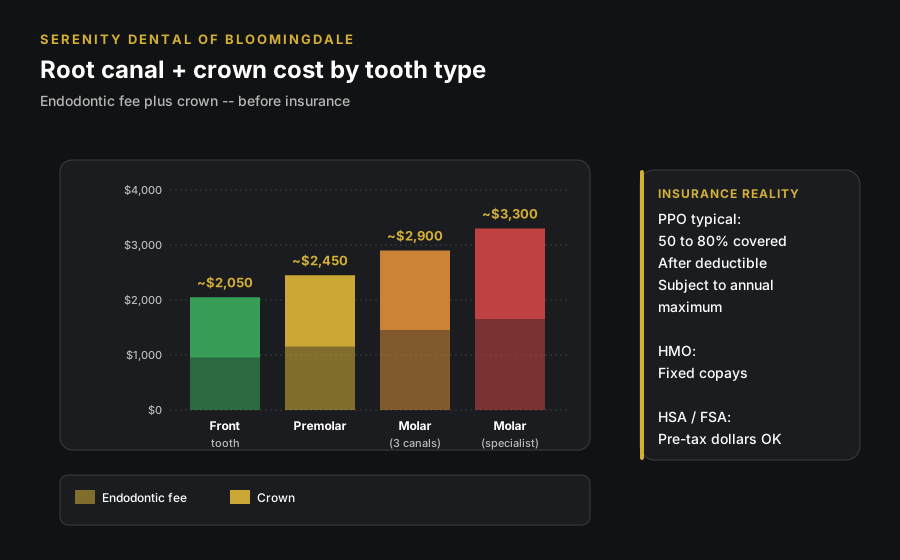
The biggest factor in pricing is which tooth is treated. The number of canals roughly triples between a front tooth (1 canal) and a molar (3 to 4 canals), and so does the chair time required for the procedure.
Front tooth
$700–$1,100
Incisors and canines. Single canal. 45 to 60 minute appointment. Often restored with a filling instead of a crown.
Premolar
$800–$1,500
Bicuspids. One to two canals. 60 to 90 minute appointment. Crown almost always recommended.
Molar
$1,000–$1,600
Back teeth. Three to four canals. 90 minute to 2 hour appointment. Crown required.
Ranges reflect 2026 averages in the greater Chicago area. Individual cost varies by complexity.
Why molars cost more: they have multiple roots, variable canal anatomy that sometimes requires 3D CBCT imaging to map, and they handle the heaviest chewing forces (which makes the crown afterward both mandatory and more expensive).
The crown cost you shouldn’t forget
Most root canal patients arrive thinking about the root canal cost alone. The honest framing is that for 80 to 90 percent of cases, the crown afterward is not optional — and it’s often more expensive than the root canal itself.
What a crown runs
| Crown type | Typical cost |
|---|---|
| Porcelain-fused-to-metal (PFM) | $900 to $2,000 |
| All-ceramic / all-porcelain | $1,000 to $2,500 |
| Zirconia | $1,000 to $2,500 |
| Gold | $1,200 to $3,000 |
Why the crown is usually necessary
A root-canal-treated tooth loses its pulp, which is the early-warning system for biting on something too hard. The access opening also removes a meaningful amount of natural tooth structure. Without a crown:
- Molars and premolars typically fracture within 6 months to 5 years under normal chewing force
- Front teeth fare better because they handle less force, but still benefit from crown protection when significant structure has been lost
- Cracks that extend below the bone level make the tooth non-restorable, forcing extraction and replacement at much higher total cost
Placing the crown promptly protects the tooth: in an eight-year study in the Journal of Endodontics, teeth crowned more than four months after the root canal were about three times as likely to be lost as teeth crowned within four months, and we schedule the crown within 30 days. Delaying the crown is usually a bad financial decision even though it looks like savings short-term.
Total cost: root canal plus crown
The number patients actually pay, all-in:
| Scenario | Typical combined range |
|---|---|
| Front tooth + filling (no crown) | $900 to $1,500 |
| Front tooth + crown | $1,700 to $3,600 |
| Premolar + crown | $1,800 to $4,000 |
| Molar + crown | $2,000 to $4,100 |
Compared to the alternative (extraction, a socket preservation graft, and an implant with its crown, which together run $4,000 to $7,000 over 6 to 9 months), the root canal is almost always the cheaper path when the tooth is restorable.
What insurance typically covers
Root canal treatment is widely covered by dental insurance because it’s considered restorative care. Three patterns are consistent across major plans.
Major PPO dental plans typically cover 50 to 80 percent of endodontic treatment after the deductible. Front teeth are often covered at 80 percent. Molars are commonly covered at 50 to 60 percent. The crown afterward has separate coverage, usually 50 percent. Annual maximum benefits (typically $1,000 to $2,500) apply to the combined total.
Medicaid and Medicare Advantage dental plans vary significantly by state and plan. Many cover medically necessary root canals on front teeth but limit or exclude molars for adults. Prior authorization is often required for surgical endodontics or retreatment cases.
Waiting periods and exclusions apply to new plans. Most plans require 6 to 12 months before covering major services, including root canals and crowns. Some plans cover the root canal but classify the crown as a “major” procedure with longer waiting periods and lower reimbursement.
The American Dental Association procedure codes for endodontic treatment (D3310 anterior, D3320 premolar, D3330 molar) are recognized by all major dental insurers. Reimbursement levels vary substantially, and maximum benefits often run out when root canal plus crown treatment is combined with other dental work in the same calendar year.
Serenity Dental verifies your specific benefits before treatment so the written estimate reflects your actual out-of-pocket cost, not just a ballpark.
The $99 trap
Heavily discounted root canal pricing is a common marketing tactic. The advertised price is often genuine for a narrow scenario but excludes most of what patients actually need.
What typically isn’t included at the advertised price:
- The exam and X-rays ($75 to $250) needed to plan treatment
- CBCT imaging ($200 to $400) if complex anatomy is present
- Molar pricing (the ad usually applies to front teeth only)
- The crown afterward ($1,000 to $2,500)
- Retreatment if the tooth has been previously worked on
- Post-op visits if complications develop
- Sedation for anxious patients or complex cases
A patient quoted $99 for a root canal typically leaves having paid $1,500 to $3,000 once the actual case is assessed and the crown is included. That’s not dishonesty on the clinic’s part — the fine print usually says so — but it’s misleading pricing.
The “cheapest root canal” search problem. Searches for “cheapest root canal near me” frequently lead to clinics practicing this bait pricing. A clinic that provides a complete written estimate before treatment begins — covering the root canal, any imaging, the temporary restoration, and the crown — is being honest about what your situation actually requires.
The honest ask
Request a written estimate that includes the exam, imaging, the root canal itself, the temporary filling, and the permanent crown. Ask specifically what happens if the case becomes more complex than expected. A practice unwilling to provide these numbers before treatment is one worth thinking twice about.
Additional cost factors
Several add-ons affect the final bill beyond the base root canal.
CBCT imaging ($200 to $400)
A 3D CBCT scan is recommended for molars with complex root anatomy, retreatment cases, or any situation where standard X-rays don’t clearly show the canals. Some practices include the CBCT in the procedure cost; others bill separately. Always ask which model applies to your quote.
Retreatment ($900 to $2,200)
A second root canal on the same tooth (when the first one failed) costs more than a first-time treatment. The existing filling material must be removed before re-cleaning, which adds chair time and complexity. Success rates are also lower (70 to 85 percent vs 86 to 93 percent for first-time cases).
Apicoectomy ($900 to $1,600)
Surgical retreatment accessing the root tip through the gum, used when standard retreatment isn’t possible or has failed. Usually performed by an endodontist.
Sedation ($50 to $400)
Local anesthesia is included in standard pricing. Optional sedation adds cost: nitrous oxide (laughing gas) typically adds $50 to $125 and oral sedation adds $200 to $400. IV sedation, when a case calls for it, is provided by referral and billed by that office. Anxious patients and complex cases are the most common indications.
Antibiotics
When infection is present, antibiotics may be prescribed. Generic amoxicillin costs $4 to $20 with insurance. Not routinely needed for uncomplicated cases per current American Dental Association guidelines.
Financing when insurance doesn’t cover everything
Root canal costs often need to be spread over time, especially when followed by the crown. Three financing paths cover most situations.
Cherry financing offers monthly payment plans with a soft credit check, often at 0% interest within a 6 to 24 month promotional period. Approval typically takes minutes.
CareCredit offers similar structure with longer promotional periods available and a broader provider network. Requires a hard credit check but is more established.
FSA and HSA funds apply to root canals as qualified medical expenses. Pre-tax dollars effectively reduce the cost by your marginal tax rate. Many patients combine FSA funds with insurance coverage and Cherry financing for the remainder.
Most patients combine partial insurance coverage with monthly financing. Combined monthly payments typically run $50 to $150 during the financing period.
What to ask at the cost consultation
Three questions clarify exactly what you’re committing to before signing.
-
Is the exam, X-ray, and CBCT imaging included or billed separately? 3D imaging adds $200 to $400 if separate. Some practices bundle it; others don’t.
-
What does the crown cost, and can it be priced as a combined estimate with the root canal? Seeing both numbers together prevents sticker shock at the crown appointment. Combined estimates help with financing planning.
-
What’s the cost if the case becomes more complex — for example, a needed retreatment mid-procedure, or a missed canal discovered on imaging? Contingency pricing matters. Vague answers or “we’ll see when we get in there” is a flag.
A good provider answers these directly and provides the written estimate covering each scenario.
Bloomingdale-area pricing
Practices in DuPage County and the broader Chicago metro price root canals within the ranges above. Variation across the area is less about location and more about what’s included in the base quote. Some practices quote the root canal alone and present the crown estimate later; others price both together from the start. Ask which model you’re looking at.
In our Bloomingdale office, the written estimate for a root canal lists the endodontic fee, the core buildup, and the crown on one page, with the plan’s share and your share shown side by side after we verify benefits. The second number should never arrive as a surprise at the crown appointment. We see one pattern often enough to name it: a patient arrives with a low quote from elsewhere, and once the molar is actually imaged, the quote grows by the crown, the buildup, and the scan. Ask for the whole picture first.
How to read a root canal quote
Count the line items. A quote that fits on one line is quoting one thing, usually the endodontic fee for the easiest tooth, while a quote that runs to five or six lines (exam, imaging, the root canal by tooth type, the buildup, the crown, and a contingency note for retreatment or a missed canal) is describing the treatment you will actually receive, which is why the longer estimate is so often the cheaper one by the time the crown is seated. Then check the tooth. A molar fee sitting at the front-tooth price is a flag, not a bargain, because three or four canals cannot be cleaned and sealed in the time a single canal takes, and the practice that quotes it either plans to revise the number later or plans to rush the work.
Cost figures in this article are Chicago-area reference ranges compiled from regional fee data, not quotes from Serenity Dental of Bloomingdale. Every dental insurance carrier negotiates its own fee schedule, and Medicaid and Medicare Advantage plans set separate schedules of their own, so the amount a plan allows can sit above or below these ranges. Your actual fee depends on exam findings, materials, and benefits, and we provide a written, itemized estimate before any treatment begins.
When to call rather than wait
A common scenario: cost is a barrier, so treatment gets postponed. For a pulp that’s acutely infected, delay is risky. Untreated pulpal infection progresses to periapical abscess, which can cause facial swelling, fever, and in rare cases spreading infection that requires emergency room care. If pain is severe, swelling is expanding, or difficulty swallowing or breathing develops, seek emergency room evaluation the same day. The cost of managing a facial space infection in the ER far exceeds the cost of a timely root canal.
Call right away at (630) 359-0105 for a toothache that wakes you at night, a pimple on the gum, a bad taste from one spot, or a face that looks fuller on one side. Those are signs of an abscess, and they need an exam within a day, not a better price quote. Pain that comes and goes still counts.
For cases where cost is the only reason to delay, discuss it openly at the consultation. Payment plans, dental savings plans, and phased treatment (root canal now, crown in 30 days) are standard options. Individual cases vary, and Dr. Husna Khan presents the risk profile of any delay so the decision is informed rather than financial-default.
Schedule a root canal consultation at Serenity Dental for a written estimate based on your specific tooth and case. Call (630) 359-0105. Dr. Husna Khan reviews every treatment plan in person and walks through the full cost picture — root canal, crown, imaging, and insurance application — before any appointment is booked. Related: root canal service page · the root canal procedure · root canal vs extraction.
Clinical references and sourcing
Clinical guidance in this article reflects current standards from the American Association of Endodontists (AAE) treatment standards and position statements; American Dental Association (ADA) procedure coding and its 2019 antibiotic guideline; American Association of Oral and Maxillofacial Surgeons (AAOMS) parameters of care for adjacent surgical decisions; the Cochrane review of single-visit versus multiple-visit treatment; and outcome studies in the Journal of Endodontics (JOE). Cited timelines and survival rates are drawn from these primary sources, listed with links under Sources below.
Root canal cost - questions answered
How much does a root canal cost?
How much is a root canal without insurance?
Does insurance cover root canals?
Why are molar root canals so much more expensive?
Is a $99 root canal legitimate?
Can I finance a root canal?
How much does a root canal and crown cost together?
Is a root canal cheaper than an extraction and implant?
Educational content only. Recommendations are personalized after an exam and any needed imaging.
About this article
Reviewed by Dr. Husna Khan, DDS, of Serenity Dental of Bloomingdale. Dr. Husna Khan performs endodontic treatment in-house at our office using rubber-dam isolation, rotary nickel-titanium instrumentation, electronic apex location, and CBCT imaging when canal anatomy warrants it.
This article is for general educational and informational purposes and is not a substitute for an in-person dental evaluation. Individual cases vary — a specific treatment plan is determined after clinical examination and imaging. If you have ongoing tooth pain, swelling, or a tooth you are unsure about, please call our office or schedule an evaluation so we can examine the tooth and review your imaging with you.
Cited sources: AAE clinical guidelines, ADA procedure coding and clinical guidance, AAOMS parameters of care, Cochrane systematic reviews of endodontic outcomes, and Journal of Endodontics (JOE) outcome studies.
Sources
- American Association of Endodontists, Treatment Standards: Executive Summary (2019). Minimum standards for nonsurgical root canal treatment; the final restoration plays a major role in long-term prognosis
- American Association of Endodontists, Guidance on the Use of Systemic Antibiotics in Endodontics (2017). Antibiotics only as an adjunct when there is systemic involvement or a spreading infection, not for a localized infection once the tooth is treated
- Lockhart PB et al. Evidence-based clinical practice guideline on antibiotic use for the urgent management of pulpal- and periapical-related dental pain and intraoral swelling: a report from the American Dental Association. J Am Dent Assoc 2019;150(11):906-921. Recommends against antibiotics in most cases of dental pain and swelling; reserve them for fever, malaise or a spreading infection
- Pratt I, Aminoshariae A, Montagnese TA, Williams KA, Khalighinejad N, Mickel A. Eight-year retrospective study of the critical time lapse between root canal completion and crown placement: its influence on the survival of endodontically treated teeth. J Endod 2016;42(11):1598-1603. Teeth crowned more than 4 months after the root canal were about 3 times as likely to be extracted (hazard ratio 3.38)
- Salehrabi R, Rotstein I. Endodontic treatment outcomes in a large patient population in the USA: an epidemiological study. J Endod 2004;30(12):846-850. 1.46 million root canals in 1.1 million patients; 97 percent of teeth were still in place 8 years later
- Manfredi M et al. Single versus multiple visits for endodontic treatment of permanent teeth. Cochrane Database Syst Rev 2022;12:CD005296. No evidence of a difference in outcomes between root canals finished in one visit and in several
- American Dental Association, Code on Dental Procedures and Nomenclature (CDT)
- AAOMS Parameters of Care: Clinical Practice Guidelines for Oral and Maxillofacial Surgery (ParCare), 7th edition. Practice guidelines covering dentoalveolar and implant surgery
Need help with this in real life?
Reading helps. Talking to someone who can look at your actual teeth and symptoms helps more. If you want a clear next step, we’re here.
Related articles
Root Canal Recovery Time: Day-by-Day What to Expect
Root canal recovery timeline -- when pain resolves, what to eat, when to return to work, chewing restrictions, and the crown appointment timing.
Read article →Tooth Extraction Cost in 2026: What You Actually Pay
Real tooth extraction costs by procedure type -- simple, surgical, broken, and impacted. What insurance covers, what drives the price, and financing options.
Read article →Are Root Canals Safe? The Evidence Behind the Online Myths
A clinical review of social-media claims that root canals cause cancer or chronic disease, with the real evidence and the AAE, ADA, and Cochrane positions.
Read article →