
Cosmetic Dentistry
How Much Do Dental Veneers Cost? A Plain-English Breakdown
What dental veneers really cost in 2026, what drives the price up or down, and how a Bloomingdale, IL dentist builds a written estimate before any treatment.

How much will this cost. Dr. Husna Khan hears some version of that question at nearly every veneer consultation. An honest answer starts with a range, then narrows once we look at how many teeth, which material, and what the bite is doing.
This article walks through the cost framework the way we walk through it at the consultation, including what drives the price up, what brings it down, and what an actual written estimate covers.
A realistic price range in 2026
Veneer cost by type
| Veneer type | Visits | Lifespan | Typical range per tooth |
|---|---|---|---|
| Composite (chairside) | 1 | 5-7 years | Roughly half the porcelain fee |
| Porcelain (lab) | 2-3 | 10-15 years | Roughly $900 to $2,500 |
| Minimal-prep porcelain | 2-3 | 10-20 years | Similar to conventional porcelain |
| Removable snap-in appliance | 1-2 | 1-3 years | Quoted per arch, not per tooth |
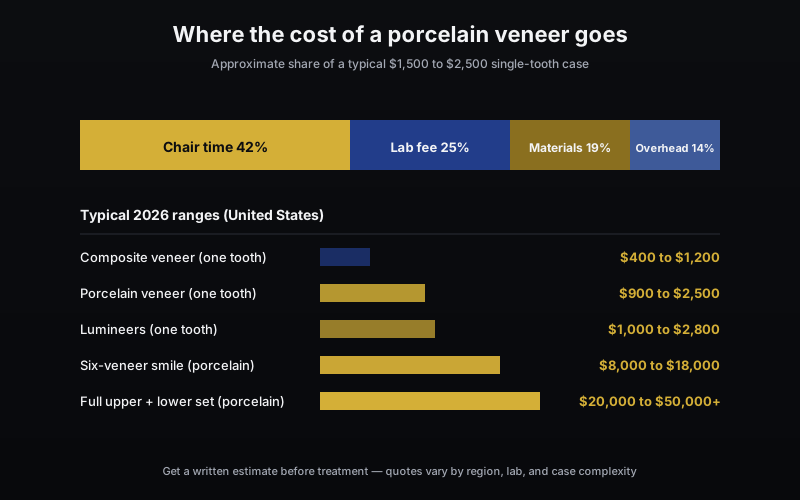
Porcelain veneers in the United States typically fall within a range of roughly nine hundred to twenty-five hundred dollars per tooth, though regional and case-specific factors push above and below that range. Composite usually runs about half as much per tooth.
Survey data on average dental fees by procedure code is published periodically by the American Dental Association. Veneer fees vary widely by region, by lab, and by the complexity of the case, so any flat number you see online should be treated as a starting reference rather than a quote.
Geography moves the number more than most people expect. Metropolitan practices generally price above suburban ones, and the gap between the coasts and the Midwest on a single porcelain unit can reach several hundred dollars for identical work.
In our Bloomingdale practice, we provide a written, itemized estimate before any treatment begins so that patients know what is included and what is not.
What drives the price up
Three factors do most of the work in pushing the cost of a veneer case higher.
Material is the first. Porcelain costs more than composite because a dental lab fabricates it from premium ceramic, often pressed lithium disilicate or layered feldspathic porcelain. Lab fees per tooth are a real number that gets passed through.
Number of teeth is the second. Six veneers cost more than two. Most full-set cases involve eight to ten upper veneers, and sometimes a matched set of lowers.
Case complexity is the third. A bite that needs equilibration, a gum line that needs reshaping, or a tooth that needs root canal treatment before a veneer can go on top all add cost. The Journal of Prosthetic Dentistry has documented how multidisciplinary cases require longer treatment plans, which translates to more chair time and more lab work.
What brings it down
A few things shrink the per-tooth price in real cases.
Targeted plans that treat only the teeth that need it, often two to four upper teeth rather than a full set, cost considerably less than a full smile makeover.
Composite material instead of porcelain typically halves the per-tooth fee.
Same-day chairside placement removes the lab fee entirely.
Financing can spread the total over months without changing the underlying price; the options are covered further down.
What a written estimate usually includes
When we hand a patient an estimate, the document covers more than the veneer fee alone. Most written estimates break out:
- Diagnostic workup, including a comprehensive exam, radiographs, photos, and a smile design preview
- Temporary veneers worn between the prep and seating appointments
- Lab fee per tooth
- Seating appointment, including try-in, adjustment, and bonding
- A post-op visit at one or two weeks to check the bite and the gums
- A custom night guard if grinding is part of the picture
Itemizing this way matters. It shows where each dollar is going and lets you compare estimates from different practices on the same line items.
The hidden line items
Four costs sit outside the veneer fee often enough to be worth planning for.
Preparatory work comes first. Decay under an old filling, a gum graft at a receded margin, or orthodontic movement before veneers are placed all get billed separately from the cosmetic work. Only the exam surfaces these. That is why a phone quote cannot be accurate.
Night guards are the second. The American Dental Association recognizes occlusal guards as standard care for bruxism, and for a patient who grinds, a custom guard is not optional if the case is going to survive a decade.
Whitening the untreated teeth is third. Porcelain does not respond to bleaching agents, so any whitening has to happen before the shade is selected, and patients who skip that step sometimes find their natural teeth drifting visibly darker than the porcelain a few years on.
Replacement is the fourth, and the one most cost comparisons ignore. Composite priced at half the porcelain fee may need redoing twice in the time a porcelain case needs redoing once. Comparing lifetime cost rather than the sticker price changes which option looks cheaper.
Running that arithmetic is worth the ten minutes it takes. Porcelain veneer survival runs above 90 percent at ten years in well-selected cases, per the Journal of Esthetic and Restorative Dentistry, while composite typically reaches five to seven years before it needs refurbishing. Two composite cycles at half price arrive at roughly the same total as one porcelain cycle, except the patient has sat through twice the chair time. That comparison rarely appears on a quote sheet, and it is worth running before choosing, because the cheaper option on paper is not always the cheaper option over fifteen years.
The full mouth question
Patients ask about full mouth veneers more often than they used to, partly because of social media. Full upper and lower sets of porcelain veneers in the United States can run from twenty thousand to over fifty thousand dollars depending on the practice, the material, and the design work involved.
Two cautions come up in our consultations. First, very few patients actually need that many veneers. Most cosmetic concerns concentrate in the upper front six to eight teeth. Second, the more teeth involved, the more it matters that a cosmetic dentist who has done the diagnostic workup has planned the case.
Dental tourism enters this conversation regularly. Treatment abroad can cut the sticker price substantially. Some overseas clinics do excellent work. Follow-up is the practical difficulty: if a margin leaks or a unit fractures at month eight, the remake and the travel both fall on the patient, and local practices are often reluctant to take over another clinic’s case.
Insurance and what it usually covers
Most major dental insurance plans, both PPO and HMO, classify veneers as cosmetic and provide no coverage. Exceptions exist, mostly when a veneer restores a fractured or congenitally malformed tooth and the case can be coded as restorative. Those exceptions are decided case by case and depend on plan language.
Medicaid and Medicare Advantage dental benefits in Illinois do not cover cosmetic veneers. Coverage varies by plan and by year, so verify with your specific carrier before counting on benefits. Our companion guide on whether insurance covers veneers walks through pre-treatment estimates and CDT codes in detail.
Budgeting for a case
Start with the number of teeth. It moves the total more than any other choice, and since cosmetic concerns concentrate in the teeth that show when you smile, a two-tooth case is a very different budget conversation than an eight-tooth one.
Then think about timing. At our Bloomingdale office, self-pay veneer cases are collected in three parts, with a deposit at the design visit, a payment at the prep appointment when the case goes to the lab, and the balance at seating, which spreads the total across the weeks the case itself takes. Financed cases run on the provider’s schedule instead. Other offices structure this differently, so when you compare estimates, ask how the payment is scheduled and what happens to a deposit if you pause between design and prep. Neither question is awkward. Both belong in the same conversation as the price itself.
In our Bloomingdale office the financing options are Cherry, CareCredit, and Sunbit; approval and terms sit with each provider rather than with the practice, and the three get walked through side by side at the consultation.
Comparing quotes
If you have gathered estimates from a few practices, three things help you compare like with like.
Look at material and lab choice first. Composite estimates will always come in below porcelain estimates, and an unnamed lab will always undercut a premium domestic one. Lower is not automatically better.
Check what is included next. Some estimates exclude the temporary veneers, the night guard, or the post-op visits. Others bundle them in.
Weigh experience and case photos last. The Academy of General Dentistry has noted that cosmetic outcomes depend heavily on the dentist as much as on the material. Practices that can show real cases with concerns similar to yours are doing different work than those that cannot.
When to call rather than wait
Cost questions are rarely urgent, but a few situations warrant a same-day call rather than waiting for a scheduled visit.
Call the office if a temporary veneer comes off between the prep and seating appointments. Prepared teeth left uncovered are sensitive and can shift slightly, which affects the fit of the finished porcelain.
Call promptly if a finished veneer debonds or fractures. Save any pieces, keep them dry, and avoid household adhesives. Rebonding an intact veneer costs a fraction of remaking one.
Call if sensitivity to cold or sweetness develops at the margin of a veneer, or if the gum around it swells or bleeds. Both can signal a bond that is leaking, and cost climbs the longer that goes unaddressed.
Why this is general information only
Cost ranges in this article are educational and not a quote. Pricing depends on your specific exam, radiographs, and treatment plan, and the only way to reach a firm number is to be seen for a consultation. Nothing here is individualized medical or financial advice.
If you are weighing veneers and want a clear written estimate before deciding anything, contact our Bloomingdale office to schedule a cosmetic consultation with Dr. Husna Khan. You can also read our overview of what dental veneers are and how long veneers last.
FAQs
How much does a single porcelain veneer cost?
How much do composite veneers cost compared with porcelain?
Does insurance pay for veneers?
How much does a full set of veneers cost?
Are there payment plans for veneers?
Why do veneer prices vary so much between practices?
Is a cheaper veneer quote a bad sign?
Do veneers cost more than crowns?
Can an HSA or FSA be used to pay for veneers?
Educational content only. Recommendations are personalized after an exam and any needed imaging.
Need help with this in real life?
Reading helps. Talking to someone who can look at your actual teeth and symptoms helps more. If you want a clear next step, we’re here.
Related articles
Does Insurance Cover Dental Veneers? Coverage and Payment Options
Plain answers about veneer insurance coverage, what counts as cosmetic, and what payment plans actually work for patients in Bloomingdale, IL.
Read article →How Long Do Dental Veneers Last? Lifespan, Wear, and Replacement
Real numbers on how long porcelain and composite veneers last, what wears them down, and how to make them last longer, from a Bloomingdale, IL dentist.
Read article →Porcelain vs Composite Veneers: An Honest Comparison
Porcelain or composite veneers? A Bloomingdale, IL dentist breaks down cost, lifespan, appearance, and which option fits which kind of patient.
Read article →