Cosmetic Dentistry
Veneers vs Crowns: When You Need Each One
Veneers and crowns are not the same. A Bloomingdale, IL dentist explains when each one is the right choice and what insurance usually pays for.

Veneers and crowns get used interchangeably in conversation, but they are not the same restoration and they are not interchangeable in the chair. The short version: a veneer covers only the front of a tooth and is mainly cosmetic, while a crown wraps the entire tooth and is structural. Choosing between them comes down to one question: does the tooth need cosmetic improvement, structural support, or both, and everything else in this comparison is really just that question wearing different clothes. If you want the mechanics first, start with what dental veneers are and how they work.
This article walks through the comparison the way Dr. Husna Khan walks through it at our Bloomingdale practice, with the points that decide which one is right for which tooth.
What each restoration actually covers
Veneers vs crowns
| Factor | Veneers | Crowns |
|---|---|---|
| Coverage | Front surface only | Entire tooth (full coverage) |
| Tooth removal | Light enamel reduction | Significant tooth reduction |
| Best for | Cosmetic changes on healthy teeth | Damaged, weak, post-root canal teeth |
| Lifespan | 10-15 years (porcelain) | 10-20 years |
| Cost (per tooth) | Roughly $900-$2,500 | Roughly $1,000-$3,500 |
| Insurance | Cosmetic veneers rarely covered | Often partially covered when restorative |
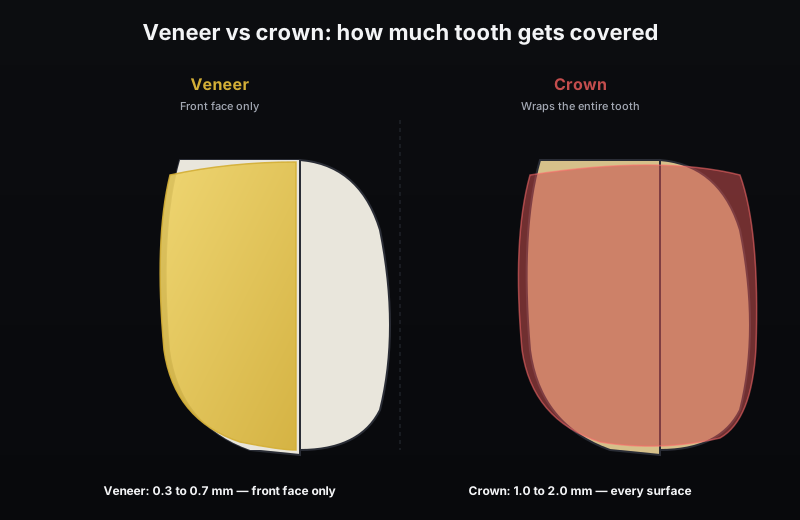
Veneers are thin shells, usually porcelain or composite, bonded to the front of a tooth and nowhere else. Coverage stops at the front. Behind it, the tooth and most of its structure remain untouched.
Crowns wrap. A tooth-shaped cap covers the entire tooth above the gum line, replacing the outer surface on every side rather than facing only the front. It covers the front, the back, both sides, and the biting surface. Crown materials run wider: porcelain, porcelain fused to metal, zirconia, full metal. The American Dental Association classifies crowns as restorative restorations because they replace lost tooth structure rather than just changing appearance.
Covering one surface versus covering all five is the difference between a cosmetic restoration and a structural one.
When a veneer is the right call
Structurally healthy, cosmetically imperfect: that is veneer territory. Common scenarios in our chair include:
Discoloration that has not responded to whitening. Here the veneer changes the color of the visible surface, and it does so without removing any more tooth structure than the case strictly needs, which for a whitening-resistant but structurally sound tooth is the entire argument.
Chipped or worn edges on an otherwise solid tooth. Either material rebuilds the edge cosmetically.
Small gaps between front teeth that the patient wants closed without orthodontics. Two veneers do both jobs at once.
Worn or slightly off-shape front teeth that are otherwise sound. Lengthening, widening, or rebalancing all happen without touching the back surface.
A common reason patients book a consultation in our Bloomingdale practice is one or two front teeth that need cosmetic improvement, and in many of those cases a veneer is the conservative answer.
When a crown is the right call
Crowns take over when a tooth needs structural support and not merely cosmetic improvement, because wrapping the whole tooth lets the restoration absorb biting force that a front-surface shell was never engineered to carry. Common scenarios include:
Teeth carrying large old fillings sit here too, because once the remaining natural structure can no longer reliably support what has been patched into it, every additional year of chewing raises the odds of the kind of fracture that turns a restorable tooth into an extraction. The Journal of Prosthetic Dentistry has documented that teeth with large multi-surface fillings have a higher fracture risk and benefit from full coverage.
Root canal teeth. After a root canal, the back teeth in particular need a crown to protect against fracture, because the tooth has been hollowed out and is more brittle. Front teeth after a root canal sometimes need a crown and sometimes can be restored with a different approach, depending on how much tooth structure remains.
Cracked teeth. Below the gum line, cracks usually mean a crown. Sometimes more.
Implants. What you see on top of an implant is a crown, attached to the fixture below the gum.
Severe grinding wear. When wear has shortened the tooth significantly, a crown can rebuild both the height and the function of the tooth.
The Cochrane group has reviewed published evidence on crown placement for compromised teeth, and the consensus is that full coverage is the more durable option when significant tooth structure has been lost.
Where the choice gets harder
Some cases sit in the gray area between veneer and crown. A few patterns repeat:
Front teeth carrying both a moderate filling and a cosmetic concern sit right on the line, and this is exactly the case where two dentists can reasonably disagree about which restoration serves the tooth better over the next fifteen years. Appearance says veneer. Strength might still say crown, because a tooth can need full coverage for reasons the mirror never shows. We sometimes do a full crown that is designed and shaded to look like a veneer from the front.
Smaller cracks that have not yet split. Veneers might not hold the tooth together over time. Crowning it is usually the safer call.
Heavy grinders who want veneers on multiple front teeth. Sometimes crowns provide better long-term durability for grinders, even when the front teeth are otherwise structurally sound. The American Academy of Cosmetic Dentistry has discussed how heavy bite forces influence material choice in cosmetic cases.
In gray-area cases, Dr. Husna Khan walks through the tradeoff explicitly so the patient understands what they are choosing.
How insurance treats each one
Insurance usually treats veneers and crowns very differently.
Veneers are classified as cosmetic by most major dental insurance plans. Coverage is typically zero. There are exceptions when a veneer is being used to restore a fractured or congenitally malformed tooth, but those are rare and case-by-case.
Restorative classification applies to crowns placed for a structurally compromised tooth, and that single word on the claim form is frequently the entire difference between a benefit paying out and a benefit denied. Most major dental insurance plans cover a percentage of the crown fee, often around fifty percent after the deductible has been met. Coverage rules vary by plan and depend on documentation of the structural need, so a pre-treatment estimate is the most reliable way to know.
This insurance difference sometimes pushes a borderline case toward a crown rather than a veneer, particularly when the tooth has structural issues that would justify the crown coding.
How preparation differs
Enamel reduction for a veneer stays small and front-only, typically between three-tenths and seven-tenths of a millimeter, which usually stays inside the enamel layer.
A crown requires reduction from all surfaces of the tooth, typically between one and one and a half millimeters per surface. That is significantly more reduction than a veneer, and it is part of why a crown is reserved for cases where the structural need is clear.
The Academy of General Dentistry has published on conservative restoration principles, and the consistent message is to remove only what the case actually requires.
How long each one lasts
Ten to fifteen years is the average porcelain-veneer run, and many cases go longer when home care and grinding are well managed.
Fifteen to twenty years is a typical crown lifespan. Some run much longer. Crowns made from zirconia or porcelain fused to metal tend to be the most durable, while all-ceramic crowns offer the most natural appearance for front teeth.
The Cochrane group has reviewed long-term crown survival data and reported that crown longevity correlates strongly with the underlying tooth health and with how well the original case was executed.
A note on this article
This is general information for patients weighing restorative options. It does not replace an in-person exam. The right answer for your tooth depends on a clinical exam, x-rays, and the structural condition of the tooth itself.
If you are weighing whether a tooth needs a veneer, a crown, or something else, reach our Bloomingdale office for an exam with Dr. Husna Khan. We will review the actual condition of the tooth and walk through the options before any treatment is planned.
When to call rather than wait
Choosing between the two restorations is consultation material. These situations are not.
Same-day call: a crown that has come off. Keep it, bring it in, and avoid chewing on that side, because an exposed prepared tooth is both sensitive and vulnerable to fracture, and rebonding an intact crown is fast and inexpensive when the tooth underneath is sound.
Call promptly for a cracked tooth that zings on release when you bite. Pain on letting go, more than on biting down, is the classic sign of a crack, and cracked teeth that get crowned early keep their pulp far more often than ones that wait.
Call about any front tooth, crowned or veneered, that darkens at the gum line over a short stretch of weeks. Fast change points to a leaking margin or a pulp problem, and both are cheaper conversations early.
Cost figures in this article are typical ranges for the Chicago area, compiled from regional fee data. They are not quotes from Serenity Dental of Bloomingdale; your fee depends on exam findings, materials, and insurance benefits, and we provide a written, itemized estimate before any treatment begins.
FAQs
What is the difference between a veneer and a crown?
Do crowns or veneers last longer?
Does insurance cover crowns and veneers the same way?
Do crowns require more tooth reduction than veneers?
Can a tooth have both a veneer and a crown?
When is a crown the better choice than a veneer?
Can you put a veneer on a tooth that already has a crown?
Is a root canal tooth better with a crown or a veneer?
Do crowns feel different from veneers in the mouth?
Educational content only. Recommendations are personalized after an exam and any needed imaging.
Need help with this in real life?
Reading helps. Talking to someone who can look at your actual teeth and symptoms helps more. If you want a clear next step, we’re here.
Related articles
Does Insurance Cover Dental Veneers? Coverage and Payment Options
Plain answers about veneer insurance coverage, what counts as cosmetic, and what payment plans actually work for patients in Bloomingdale, IL.
Read article →How Long Do Dental Veneers Last? Lifespan, Wear, and Replacement
Real numbers on how long porcelain and composite veneers last, what wears them down, and how to make them last longer, from a Bloomingdale, IL dentist.
Read article →Porcelain vs Composite Veneers: An Honest Comparison
Porcelain or composite veneers? A Bloomingdale, IL dentist breaks down cost, lifespan, appearance, and which option fits which kind of patient.
Read article →