Cosmetic Dentistry
Veneers vs Lumineers: What Is the Difference, Really?
Lumineers are a brand of no-prep veneer. A Bloomingdale, IL dentist explains what is the same, what is different, and which one fits which patient.

Lumineers are a brand name, nothing more and nothing less: a thin, no-prep porcelain veneer made from a specific leucite-reinforced ceramic called Cerinate and fabricated through one company’s lab network. Still veneers. Still porcelain, still bonded to the tooth in the same general way, and still subject to the same physics of thin ceramic living on the front of a working tooth. Marketing has positioned them as a separate category. Clinically they belong inside the larger no-prep veneer family. Both options build on the same foundation, explained in how dental veneers work.
This article walks through what is actually the same and what is genuinely different, so the choice at your consultation in our Bloomingdale practice rests on the case rather than on the brand name.
What Lumineers actually are
Veneers vs Lumineers
| Factor | Traditional veneers | Lumineers (brand) |
|---|---|---|
| Thickness | 0.5-0.7 mm | 0.2-0.3 mm (ultra-thin) |
| Tooth prep | Light enamel reduction | Minimal to no prep |
| Reversibility | Generally not reversible | Sometimes removable |
| Visits | 2-3 | 2-3 |
| Material | Various porcelain (e.max, feldspathic, zirconia) | Cerinate porcelain only |
| Lifespan | 10-15 years | 10-20 years (claim); real-world similar |
| Cost (per tooth) | Roughly $900-$2,500 | Roughly $800-$2,000, plus any brand fees |
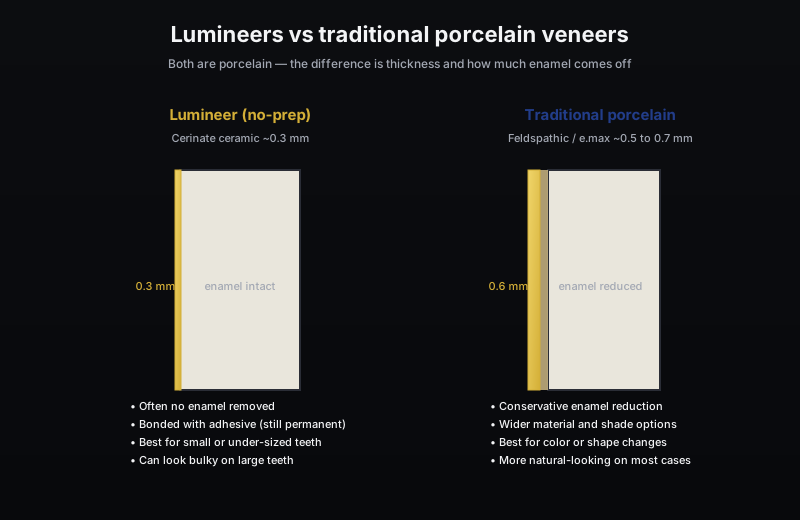
Lumineers are a registered trademark of DenMat, a dental products company. Specifically, the brand refers to thin porcelain veneers made of a leucite-reinforced ceramic called Cerinate, fabricated at the DenMat lab in California.
Thinness is the signature feature. Lumineers can be milled as thin as two-tenths to three-tenths of a millimeter, which is roughly the thickness of a contact lens. That thinness is what allows the no-prep design in some cases.
Within the American Academy of Cosmetic Dentistry’s classification they sit inside the broader porcelain veneer category, which matters because everything the research literature says about thin porcelain applies to them whether or not the marketing acknowledges it. No-prep designs suit specific clinical situations rather than for every cosmetic case.
What is the same as a regular veneer
Lumineers and traditional porcelain veneers share more than they differ.
Both are made of porcelain. Cerinate sits alongside e.max lithium disilicate and feldspathic porcelain. None wins universally.
Both are bonded with dental adhesive resin. Bonding chemistry does not differ.
Color-matching does not differ either: shade guides, digital photography, lab.
Both need a scan or impression.
Both last in a similar long-term range when the case is well placed and well maintained, typically ten to fifteen years on average.
What is genuinely different
A few things distinguish Lumineers from a typical custom porcelain veneer case.
Lab. Lumineers are made only at the DenMat Cerinate lab. A traditional porcelain veneer can be made by any dental lab the dentist trusts, which gives more flexibility in lab choice and turnaround time.
Material. Cerinate is a specific leucite-reinforced ceramic. e.max lithium disilicate, used in most modern non-Lumineer porcelain veneers, is generally stronger and is the more common material in current cosmetic practice.
Preparation. Marketed as no-prep, and in suitable cases genuinely placed that way, Lumineers can be bonded onto the tooth without removing enamel. Traditional veneers usually involve a thin layer of enamel reduction. Both can be done with minimal preparation when the case fits.
Marketing. Lumineers have been heavily marketed direct to patients for many years. Brand recognition is real: its name is familiar to many people who have never heard of e.max or feldspathic porcelain, even though those are the more common materials in custom cosmetic cases today.
When no-prep designs work well
Lumineers and other no-prep porcelain veneers work best when three things are true:
Smaller-than-average teeth. Teeth tipped slightly inward. Worn edges that need lengthening forward. In these cases, adding the thin porcelain on top of the existing tooth produces a natural-looking result without crowding the lip.
Mild to moderate cosmetic concerns. Small differences in shape, color, and edge length: this is where no-prep designs earn their keep, evening out minor asymmetries across the smile line without asking the patient to give up any enamel in exchange. Dark teeth expose their limits.
Patients who value keeping every bit of natural enamel intact. Some patients are clear from the start that they do not want any tooth structure removed, and a no-prep design is a reasonable response when the case fits.
Dr. Husna Khan reviews these factors at every consultation in our Bloomingdale practice, often with diagnostic photos and a wax-up before deciding between no-prep and minimal-prep designs.
When no-prep is not the right answer
Sometimes the no-prep result disappoints. The most common patterns:
Patients with larger or more prominent front teeth. Adding a no-prep veneer on top of an already prominent tooth pushes the tooth forward and can make the smile look bulky.
Patients with significant discoloration. Thin no-prep porcelain does not reliably mask what sits underneath it, and tetracycline staining in particular tends to ghost through a shell that measures a fraction of a millimeter, no matter how skilled the ceramist. Slightly thicker minimal-prep designs with masking porcelain color-correct better.
Patients with rotated or crowded teeth. When a tooth needs to be brought back into alignment with the rest of the smile, a small amount of preparation is usually needed to create the space. Skipping that step leaves the tooth still rotated, just covered with porcelain.
The Journal of Esthetic and Restorative Dentistry has published on case selection for no-prep designs, and the consistent finding is that the right cases produce excellent results, while the wrong cases produce bulky-looking smiles.
How cost compares
Lumineers and traditional porcelain veneers fall in a similar price range. Licensing fees for the dentist and the lab ride along with the brand, which sometimes makes Lumineers slightly more expensive per tooth than a comparable e.max veneer from a different lab.
Cost should not be the primary factor in the choice. Material and preparation suitability matter more for the long-term result. A no-prep veneer that is the wrong design for the tooth will look wrong even at a higher price point.
A common misconception
The most common misconception we hear in our chair is that Lumineers are reversible because they involve no preparation. True, technically. Where no enamel is removed the underlying tooth really is unchanged, and if a patient asked only about the day of placement the reversibility claim would hold up fine.
Removal after years of bonding is rarely straightforward. Removing them is another matter: the bonded resin layer adheres tightly to enamel, and the tooth often shows small surface changes after the porcelain is removed. Plan on permanence.
Snap-on or pop-on veneer products marketed online are a different category entirely. Those are not bonded; they are removable trays worn over the teeth. We address those in a separate article.
What we recommend reviewing at the consultation
Three things are worth reviewing before choosing between Lumineers, a different brand of no-prep veneer, and a traditional or minimal-prep porcelain veneer:
Diagnostic photos and a wax-up showing each scenario. The American Dental Association has noted that diagnostic previews improve patient satisfaction with cosmetic outcomes.
A frank conversation about whether the case fits the no-prep profile or whether a minimal-prep design would produce a better long-term result.
A written estimate that compares the line items between options.
General information only here, not individualized medical advice. Choosing correctly for your teeth takes an exam, photographs, and a plan built by a dentist who has actually examined the case.
To talk through whether Lumineers, no-prep veneers, or traditional porcelain veneers are the right fit for your goals, contact our Bloomingdale office to schedule a consultation with Dr. Husna Khan.
When to call rather than wait
Brand comparisons can wait for the consultation chair. A few things cannot.
Same-day call: a no-prep veneer that has popped off. Thin porcelain is fragile off the tooth, so store it in a rigid container rather than a pocket, and skip every household adhesive, because rebonding only works on an uncontaminated fitting surface.
Call promptly about a rough or sharp edge where thin veneer meets tooth, because thin porcelain margins chip in ways that catch floss and cut soft tissue, and polishing a chipped margin early can stop the crack from running. Thin margins chip in ways that catch floss and cut soft tissue, and polishing a chipped margin early can prevent the crack from running.
Contact your dentist if the gum along a no-prep veneer stays puffy or bleeds past the first few weeks. Bulk at the gum line traps plaque, and persistent inflammation there is a hygiene-access problem worth solving before it becomes recession.
Cost figures in this article are typical ranges for the Chicago area, compiled from regional fee data. They are not quotes from Serenity Dental of Bloomingdale; your fee depends on exam findings, materials, and insurance benefits, and we provide a written, itemized estimate before any treatment begins.
FAQs
What are Lumineers?
Are Lumineers better than regular veneers?
How much do Lumineers cost?
Are Lumineers reversible?
Do Lumineers last as long as regular porcelain veneers?
Are Lumineers a brand or a type of veneer?
Can Lumineers be whitened if they discolor?
Do Lumineers work on dark or tetracycline-stained teeth?
Do Lumineers feel bulky compared with prepped veneers?
Educational content only. Recommendations are personalized after an exam and any needed imaging.
Need help with this in real life?
Reading helps. Talking to someone who can look at your actual teeth and symptoms helps more. If you want a clear next step, we’re here.
Related articles
Does Insurance Cover Dental Veneers? Coverage and Payment Options
Plain answers about veneer insurance coverage, what counts as cosmetic, and what payment plans actually work for patients in Bloomingdale, IL.
Read article →How Long Do Dental Veneers Last? Lifespan, Wear, and Replacement
Real numbers on how long porcelain and composite veneers last, what wears them down, and how to make them last longer, from a Bloomingdale, IL dentist.
Read article →Porcelain vs Composite Veneers: An Honest Comparison
Porcelain or composite veneers? A Bloomingdale, IL dentist breaks down cost, lifespan, appearance, and which option fits which kind of patient.
Read article →