
Dentures
Flexible Dentures: Cost, Lifespan, Pros and Cons
Flexible nylon partial dentures explained: materials, how they compare with cast-metal and acrylic partials, lifespan, cleaning, and who should skip them.
Flexible dentures are partial dentures with a base made of thin, slightly bendable nylon instead of rigid acrylic or a cast-metal frame. Pink extensions of the base grip the remaining teeth and disappear against the gums, so there are no metal clasps to show when you smile. That single advantage sells most of them. Real trade-offs come with it, though: a flexible partial wears out sooner, it cannot be relined the way an acrylic partial can, and the clinical literature treats it as an interim or special-case appliance rather than a lifelong one. This guide covers what the material is, how it compares with the alternatives, what it costs in the Chicago area, how to care for it, and when Dr. Husna Khan, DDS recommends one at Serenity Dental of Bloomingdale.
Most people who need a partial are missing a few teeth, not all of them
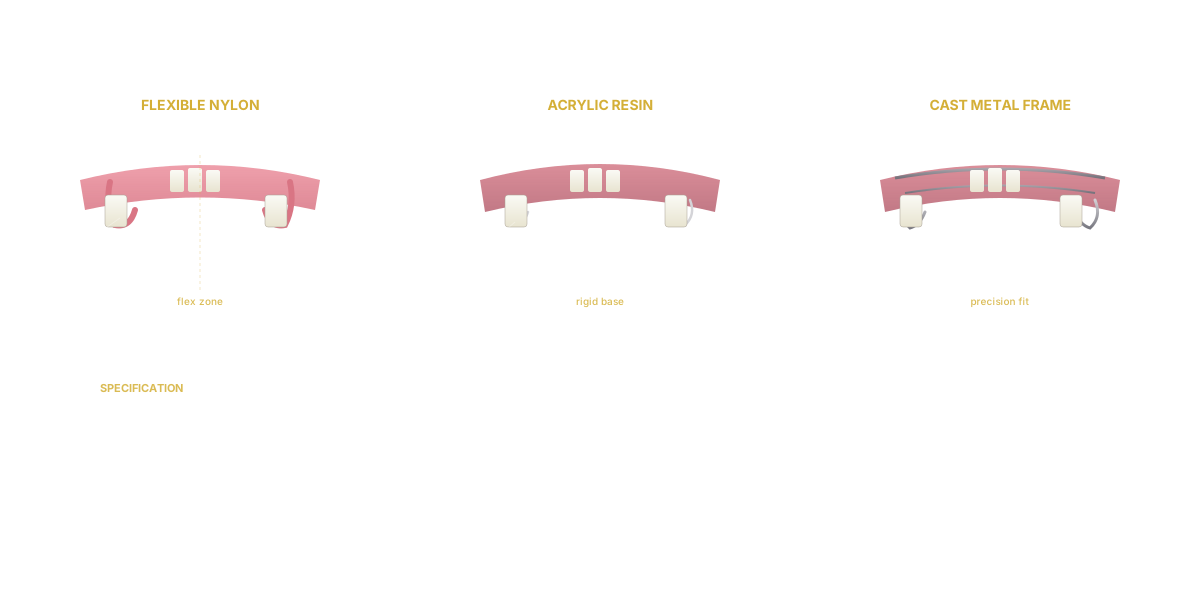
Tooth loss in working-age adults is usually partial. NIH’s National Institute of Dental and Craniofacial Research reports that adults aged 20 to 64 keep about 26 of their 32 teeth on average, and only about 2 percent have none left. That is the partial-denture population. One to several gaps, healthy teeth on either side, and a wish to fill the space without surgery. Three removable appliances can do it: a flexible partial, an acrylic partial with wire clasps and a cast-metal partial, and the rest of this guide compares all three.
What flexible dentures are made of
Thermoplastic polyamide, the same family of polymers as nylon fishing line, makes up the base; it is heated and injected into a mold rather than mixed and cured like acrylic. Replacement teeth, usually acrylic, are set into the pink base before it is finished and polished. Nothing else holds the denture in. There is no metal framework underneath and no cast clasps; thin wings of the same pink material reach just past the widest part of each neighboring tooth, flex over it as the denture seats, and spring back to grip it.
Several brands are licensed for dental use. Valplast is the original, introduced in the 1950s. TCS, Duraflex and Sunflex are the other names you will hear from labs in the Chicago area. These products are not interchangeable: the Japan Prosthodontic Society’s position paper on non-metal clasp dentures in the Journal of Prosthodontic Research (Fueki and colleagues, 2014) found that the thermoplastic resins on the market vary considerably in their physical and mechanical properties, and it asked clinicians to use each one with its specific properties in mind. Your lab’s material choice matters as much as the brand name on the box. Ask which resin your lab uses, and ask what its reline and repair policy is before you commit.
Two material facts drive most of what follows. Polyamide absorbs more water than the other thermoplastic classes, and Dental Materials Journal testing of six thermoplastic denture resins (Takabayashi, 2010) found that clinically noticeable staining can occur on it. The same low stiffness that lets the base flex over undercuts is also why it cannot carry a bite the way a rigid frame can.
How flexible partials compare with acrylic and cast-metal partials
Each material trades off a different set of properties. None of the three is better across the board.
| Feature | Flexible nylon partial | Acrylic partial with wire clasps | Cast-metal partial |
|---|---|---|---|
| Chicago-area cost | $1,200 to $2,500 | $700 to $1,800 | $1,200 to $3,000 |
| Typical lifespan | 3 to 7 years | 3 to 6 years | 5 to 8 years |
| Visible metal | None | Wire clasps often show | Clasps can show on canines and premolars |
| Can be relined | Rarely, and only by lab rebase | Yes, chairside or lab | Yes |
| Repairs and added teeth | Limited, lab only | Yes | Yes |
| Rigidity and bite support | Low, tissue-borne | Moderate | High, rests on the teeth |
| Adjustment period | About 2 to 3 weeks | 3 to 5 weeks | 4 to 6 weeks |
That reline row matters more than most patients expect. Bone under any removable denture slowly remodels, so the fit loosens over time. An acrylic or cast-metal partial can be relined every few years to restore the fit, and a reline in the Chicago area runs about $300 to $700, far less than a new appliance. Fresh acrylic does not bond to cured nylon. Chairside hard relines are therefore off the table for a flexible partial; a few labs will rebase one by remaking the fitting surface, and once the fit is well and truly gone the fix is a new denture.
Clinical literature draws the line clearly. The Japan Prosthodontic Society panel, writing in the Journal of Prosthodontic Research, concluded that a flexible non-metal clasp denture without a metal framework is not recommended as a definitive denture under current prosthetic principles, except in limited cases such as a metal allergy. When a patient refuses visible metal clasps for cosmetic reasons, the panel recommends a rigid design instead: a cast-metal framework inside, with tooth-colored or pink flexible clasps only where they would show. We agree. That hybrid is what we suggest for most cases that need to last.
When we recommend a flexible partial
In our Bloomingdale office, a flexible partial comes up in four situations.
One to three missing front teeth. Missing a lateral incisor and the tooth beside it is the textbook case. Any metal clasp on the canine would show with every smile, while the pink nylon wing disappears against the gum. Small gap, big cosmetic payoff.
A documented metal allergy. Nickel is the most common metal allergen on patch testing, and a few dental casting alloys contain it. A nylon base contains no metal at all, which is the one indication the position paper above accepts without reservation.
A bridge to implants. Someone saving for an implant, or waiting out a bone graft, needs teeth for a year or two and does not want to invest in a cast framework that an implant will make redundant. A flexible partial fills the gap during the wait, and we plan the implant timeline at the same visit so the two treatments line up.
Healthy neighboring teeth and good home care. The wings grip teeth, so those teeth need sound enamel and healthy gums, and the owner needs to be someone who will take the partial out at night and clean it daily. Nylon rewards good habits and punishes neglect faster than acrylic does.
When a flexible partial is the wrong choice
Grinding or clenching. Soft bases do not spread grinding forces the way a rigid frame does. It concentrates them on the teeth it clasps and on the ridge beneath it, and heavy grinders chew through the lifespan of a flexible partial quickly. A cast-metal partial, often paired with a night guard, holds up better.
The first year after extractions. Ridges keep changing shape for roughly 6 to 12 months after teeth come out. A flexible partial made in that window loosens as the bone settles, and it cannot be relined to catch up. We use an interim acrylic partial for that period and make the definitive appliance once the ridge is stable.
A partial you expect to wear for ten years or more. The arithmetic favors metal. Two or three flexible partials over a decade cost more than one cast-metal partial plus a couple of relines, and each replacement means another round of impressions, try-in and adjustment visits.
Several missing back teeth on one side. A nylon base is tissue-borne, so under chewing load it sinks slightly and pushes sideways on the teeth it clasps. That is a minor issue for two incisors and a real one for a span of molars. The position paper’s advice applies here: the same design principles that govern a conventional partial, including rests on the teeth and a rigid connector, still apply, and a framework-free flexible base cannot meet them for a long free-end span.
What fabrication looks like
Expect 3 to 4 visits spread over 3 to 5 weeks.
- Impressions and bite record. Impressions of both arches and a bite registration go to the lab, which designs the partial around the teeth that will carry the wings.
- Try-in. The replacement teeth are set in a wax base so you can preview the shade, the shape and the bite before the nylon is injected. Changes are easy at this stage and hard afterward.
- Delivery. The finished partial is seated, the path of insertion is checked, the bite is adjusted, and you practice putting it in and taking it out before you leave.
- Adjustment. Most patients come back within 7 to 10 days for sore spots. Nylon smears under the burs used on acrylic, so we relieve pressure points with a bur made for the material and repolish the surface.
What flexible dentures cost in the Chicago area
A flexible partial runs about $1,200 to $2,500 in the Chicago area, the range on our dentures in Bloomingdale, IL page, and a premium-brand partial replacing several teeth can reach about $2,800. That fee covers the exam, impressions, the try-in, delivery and the first adjustment visits. Cast-metal partials run $1,200 to $3,000, and acrylic interim partials $700 to $1,800. Adding a tooth to an existing flexible partial is lab work that usually falls in the $100 to $400 repair range, when the lab will take it at all.
Most PPO plans classify partials as a major service and pay around 50 percent of the allowed fee after the deductible, subject to an annual maximum that is commonly $1,000 to $2,500. Many plans also carry a replacement clause and pay for a new partial only once every five to seven years, which is worth knowing for an appliance that may need replacing in three to seven. Cherry, CareCredit and Sunbit offer monthly payment plans for the balance; the application takes a few minutes at the front desk or from home.
Compare the numbers against an implant before choosing any partial for a single back tooth with sound neighbors. A single dental implant in Bloomingdale restored with a crown runs $3,500 to $6,000 in the Chicago area, and our single-implant package, which includes the implant post, abutment and crown, is $2,999 with no insurance for a routine case. It costs more up front than a partial. It is also fixed, it does not clasp the neighboring teeth, and it does not need replacing every few years.
Cleaning and care
Scrubbing a flexible partial with toothpaste is the most common mistake we see. Abrasive paste scratches the polished nylon, and a scratched surface absorbs stain and odor far faster than a smooth one. The American Dental Association’s MouthHealthy guidance for partial dentures is to brush daily with a denture brush or a soft toothbrush and a denture cleanser, hand soap or mild dish liquid rather than toothpaste, to clean over a folded towel or a sink of water in case the partial slips, to keep it moist, and to soak it overnight.
Night-time removal is the rule that matters most. The American College of Prosthodontists guideline on denture care, published in JADA and the Journal of Prosthodontics in 2011, states that dentures should not be worn continuously, 24 hours a day, because continuous wear raises the risk of denture stomatitis, and the international expert panel behind the Oral Health Foundation’s denture guidelines reached the same conclusion. Denture stomatitis is the chronic redness of the tissue under a denture base. Published prevalence estimates range from roughly 15 percent to about two-thirds of denture wearers depending on the group studied (Gendreau and Loewy, Journal of Prosthodontics, 2011), and continuous wear and poor denture hygiene are the two factors that come up again and again.
Nylon has three rules of its own:
- Keep it cool. Hot water and the dishwasher can warp the base, and the ACP guideline says no denture should ever go in boiling water.
- Skip bleach-based cleansers. Manufacturers advise against them because bleach can discolor nylon over time; use the cleanser your lab or the material’s manufacturer recommends, and use it outside the mouth.
- Keep it wet. A nylon base that dries out overnight can change shape; store it in cool water or cleanser.
Bring the partial to every check-up. Annual professional checks of fit and tissues are part of the ACP guideline, and we find that the stain and odor problems that make patients give up on a flexible partial are usually caught early at those visits with a professional clean and polish.
What this looks like at our practice
At Serenity Dental of Bloomingdale we treat a flexible partial as a cosmetic, interim or special-case appliance, and we say so at the consultation. In our Bloomingdale office that visit covers four things: how many teeth are missing and where, whether the neighboring teeth are sound enough to carry the wings, the bite and any history of grinding, and what the plan is for the next five years. Patients who want the cosmetic benefit for a long-term back-tooth partial usually leave with a different recommendation, a cast-metal framework with flexible clasps where they show.
At delivery we check the path of insertion, how the wings seat on the teeth, the occlusion, and the tissue contact under the base; at the one-week visit we relieve sore spots and recheck the bite. We also go over a cleaning routine that fits the material the patient was given, because the routine for nylon is not the routine for acrylic.
When to call rather than wait
Adjustment-period soreness usually settles with one or two visits. Call the office at (630) 359-0105 rather than waiting it out if you notice any of the following:
- Soreness at one spot that is still there after 5 days, or an ulcer under the base.
- Cracks or tears in a wing, or a tooth that has come loose from the base.
- Rocking when you bite, or a partial that no longer seats fully.
- Swelling, redness or white patches on the tissue under the denture.
- Bad taste or odor that cleaning does not fix.
Each of these has a fix, from a simple adjustment to a lab rebase to a different appliance. Wearing a partial that no longer fits damages the teeth that hold it. Do not try home repairs or over-the-counter glues on a nylon base; the ADA advises against them for any denture, and on nylon they almost always make a professional repair impossible.
Clinical context and evidence
The recommendations in this guide rest on the Japan Prosthodontic Society’s two-part position paper on non-metal clasp dentures in the Journal of Prosthodontic Research (2014), the Dental Materials Journal study comparing thermoplastic denture resins with acrylic (2010), the American College of Prosthodontists denture-care guideline in JADA (2011), the Journal of Prosthodontics review of denture stomatitis (2011), the American Dental Association’s MouthHealthy guidance on partial dentures, and NIH tooth-loss data. Where the literature is thin, and for a material this new to long-term study it often is, we have said so and given you our clinical judgment instead.
Medical disclaimer
This article is general information for patients and is not a substitute for an examination or for personalized dental advice. Whether a flexible partial, a cast-metal partial, a bridge or an implant is right for you depends on your teeth, your gums, your bite and your medical history. Schedule a consultation with Dr. Husna Khan, DDS at Serenity Dental of Bloomingdale to review your options.
Cost figures in this article are Chicago-area reference ranges compiled from regional fee data, not quotes from Serenity Dental of Bloomingdale. Every dental insurance carrier negotiates its own fee schedule, and Medicaid and Medicare Advantage plans set separate schedules of their own, so the amount a plan allows can sit above or below these ranges. Your actual fee depends on exam findings, materials, and benefits, and we provide a written, itemized estimate before any treatment begins.
Flexible dentures: questions answered
What are flexible dentures?
How long do flexible dentures last?
Are flexible dentures better than metal partials?
What is the disadvantage of flexible dentures?
Can you sleep with flexible dentures?
Can flexible dentures be repaired or relined?
How much do flexible dentures cost?
Are flexible dentures comfortable?
Can a flexible partial replace back teeth?
Educational content only. Recommendations are personalized after an exam and any needed imaging.
Sources
- Fueki K, Ohkubo C, Yatabe M, et al. Clinical application of removable partial dentures using thermoplastic resin. Part I: Definition and indication of non-metal clasp dentures. Journal of Prosthodontic Research 2014;58(1):3-10. Japan Prosthodontic Society position paper: a flexible non-metal clasp denture without a metal framework is not recommended as a definitive denture except in limited cases such as metal allergy; a rigid design with a metal framework is recommended when patients refuse metal clasps for cosmetic reasons
- Fueki K, Ohkubo C, Yatabe M, et al. Clinical application of removable partial dentures using thermoplastic resin. Part II: Material properties and clinical features of non-metal clasp dentures. Journal of Prosthodontic Research 2014;58(2):71-84. Thermoplastic denture resins vary considerably in physical and mechanical properties; they generally have lower color stability, a higher fracture risk and a surface that roughens more easily than conventional acrylic
- Takabayashi Y. Characteristics of denture thermoplastic resins for non-metal clasp dentures. Dental Materials Journal 2010;29(4):353-361. Six thermoplastic denture resins tested against conventional acrylic: the low elastic modulus allows larger retentive undercuts, and clinically noticeable staining may occur on polyamide (nylon) resins
- Procter and Gamble dentalcare.com continuing education course 650, Non-Metal Clasp Dentures: types of thermoplastic resins. Polyamide has the highest water sorption of the thermoplastic resin classes; the nylon product Valplast is difficult to reline, repair, grind and polish and has color stability problems
- Felton D, Cooper L, Duqum I, et al. Evidence-based guidelines for the care and maintenance of complete dentures: a publication of the American College of Prosthodontists. JADA 2011;142(Suppl 1):1S-20S; Journal of Prosthodontics 2011;20(Suppl 1):S1-S12. Dentures should not be worn continuously (24 hours a day) to reduce denture stomatitis; clean daily by soaking and brushing with a nonabrasive denture cleanser used outside the mouth; never place dentures in boiling water; annual professional check of fit and tissues
- Gendreau L, Loewy ZG. Epidemiology and etiology of denture stomatitis. Journal of Prosthodontics 2011;20(4):251-260. Prevalence estimates for denture stomatitis range from about 15 percent up to about two-thirds of denture wearers across studies; continuous denture wear and poor denture hygiene are leading risk factors, with Candida strongly associated
- American Dental Association, MouthHealthy: Dentures, partial. Brush a partial daily with a denture brush or soft toothbrush and a denture cleanser, hand soap or mild dish liquid rather than toothpaste; keep it moist and soak it overnight; see the dentist for sore spots or a loose fit; never attempt home repairs or over-the-counter glues
- National Institute of Dental and Craniofacial Research (NIH), Tooth loss in adults (age 20 to 64). Adults aged 20 to 64 keep about 26 of 32 teeth on average (25.5 in the 2017 to March 2020 NHANES cycle; 23.3 at ages 50 to 64), and about 2 percent have no remaining natural teeth
- Oral Health Foundation, Denture care guidelines from an international expert panel (2017, updated 2019). Clean dentures daily by brushing with a non-abrasive cleanser rather than toothpaste, soak them daily in a denture-cleansing solution used outside the mouth, do not keep dentures in the mouth overnight, and stay in a regular recall programme
Need help with this in real life?
Reading helps. Talking to someone who can look at your actual teeth and symptoms helps more. If you want a clear next step, we’re here.
Related articles
Permanent Dentures: Fixed Implant Teeth vs Finished Denture
What permanent dentures means: a fixed implant bridge on All-on-4 or All-on-6, or the finished denture after an immediate one. Candidacy, timeline, care, costs.
Read article →Dentures cost and insurance: 2026 guide
How much do dentures cost? Cash prices by type, PPO insurance coverage, Medicaid, financing, and how to phase larger plans across years.
Read article →Palateless (horseshoe) upper dentures: when to choose them
Palateless upper dentures eliminate roof coverage to restore taste and reduce gag reflex. They require 4 or more implants for support.
Read article →