Dental Implants
Same-Day Tooth Extraction and Implant: Is It Right for You?
Same-day tooth extraction and implant placement explained: who qualifies, what the visit involves, what the research shows, and when waiting is the better call.
Bottom line
Same-day implants are not for every socket. Only a short, firm list of conditions makes an extraction site suitable for immediate placement: intact bone walls, a facial wall at least 1 millimeter thick, no active infection, and enough bone beyond the root tip for the implant to sit tight on the day. A CBCT scan and a clinical exam tell us within minutes whether a given tooth qualifies. Staged works too. Both paths end at the same crown, and the research puts their long-term results close together as long as the cases are chosen well.
A note from our practice
We always show the scan. In our Bloomingdale office, before any same-day extraction and implant case is scheduled, we walk the patient through their CBCT images on the screen, point out the facial wall, the bone density, and the nerve or sinus nearby, and explain the specific reasons the site is or is not a candidate for immediate placement, because the conversation lands far better when the patient can see what we are looking at. Trust grows from clarity. Pictures carry the explanation.
Same-day extraction and implant placement, formally called immediate implant placement, combines two procedures into one surgical visit when specific clinical conditions are met. Applied to the right socket, it removes one surgery and 8 to 16 weeks of waiting from the treatment plan. Applied to the wrong one, it fails more often than a staged implant would have. Case selection decides it, not patient preference alone.
This guide covers which conditions favor immediate placement, the survival and esthetic figures from peer-reviewed research, what the visit involves, what the combined procedure costs in the Chicago area, and the situations where the better answer is “wait.”
What “same-day” actually means
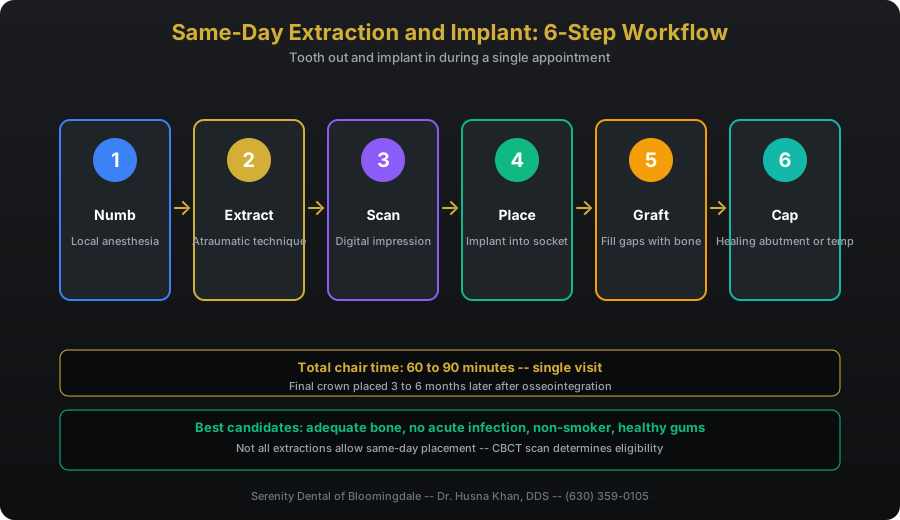
Two different ideas live under the “same-day implant” label, and they get confused constantly. Same-day extraction and implant placement means the tooth comes out and the implant goes in during one visit. Same-day implant with a tooth on top adds an immediate temporary crown to that implant on the same day, which is a separate decision that depends on how firmly the implant seated and where it sits in the bite, not on bone health alone.
At our Bloomingdale practice the temporary-crown question is answered separately from the implant question. For back teeth we let the implant heal under a healing cap for 3 to 6 months and place the final crown at a later visit, because chewing forces on a fresh implant are the quickest way to lose it. Same-day temporaries are reserved for select front-tooth cases where an empty space during healing would be hard to live with, and even then the temporary is shaped so that nothing touches it when the patient bites.
Terminology matters because the protocols and the risks differ. “Teeth in a day” marketing blurs the two, and patients arrive expecting a finished tooth by dinner. We walk through the distinction at every consultation.
Who qualifies for same-day extraction and implant
Consensus statements from the International Team for Implantology (ITI) on implants in the esthetic zone set out the preconditions for immediate placement: intact socket walls, a facial bone wall at least 1 millimeter thick, thick soft tissue, no acute infection, and bone beyond and behind the socket to anchor the implant. That same statement adds a sobering line: those preconditions are rarely all present, and early placement a few weeks after extraction is the option of choice in most instances. Four checks at the consultation sort one from the other.
Bone wall integrity. All four walls around the socket must be intact. Of the four, the facial (cheek-side) wall is the thinnest and the one most often damaged by long-standing infection or a fractured root. In a study of 93 upper front and premolar sockets published in Clinical Oral Implants Research, the facial wall of front teeth averaged 0.8 millimeters, 87 percent measured 1 millimeter or thinner, and only 3 percent reached 2 millimeters. CBCT shows us the wall before we commit.
Absence of acute infection. A draining abscess or severe periapical infection means the bacterial load at the site is too high for predictable healing around an implant. Those sockets are cleaned out, allowed to heal for 4 to 12 weeks, and treated with antibiotics when indicated, before an implant is placed. Chronic low-grade inflammation without acute symptoms is generally compatible with immediate placement.
Bone beyond the socket. Primary stability comes from healthy bone past the natural root tip, typically 3 to 4 millimeters of it, that the implant can engage. Lower back teeth need a careful look at the inferior alveolar nerve. Upper back teeth need a careful look at the sinus floor.
Patient health factors. Smokers, patients with poorly controlled diabetes, and patients taking bisphosphonates can still have implants, but the evidence pushes them toward a staged protocol. A meta-analysis in the Journal of Dentistry covering 107 studies found implant failure in 6.35 percent of smokers against 3.18 percent of non-smokers. A one-year study in the Journal of the American Dental Association found that elevated HbA1c did not change implant survival, but that implants in poorly controlled patients took longer to stabilize, which argues against loading them early. For bisphosphonates, the AAOMS position paper on medication-related osteonecrosis puts the risk after an extraction in osteoporosis patients on bisphosphonates at 0 to 0.15 percent and asks for informed consent and long-term recall when implants are placed, so we talk it through rather than rush it.
What the same-day visit involves
A typical same-day extraction and implant visit runs 2 to 3 hours. Nitrous oxide or oral sedation is available for the visit, and IV sedation can be arranged by referral for patients who want deeper relaxation. Local anesthesia is given either way.
Confirmation imaging starts the visit. Atraumatic extraction follows: the tooth is removed with periotomes, vertical luxators, and gentle rotation rather than levering force, because the bone walls that come through the extraction intact are the bone walls the implant will depend on. Our tooth extractions in Bloomingdale page describes the simple and surgical techniques in more detail. A tooth that has to be sectioned and removed in pieces is still a candidate, but the walls are inspected even more carefully afterward.
Once the tooth is out, the socket is debrided of granulation tissue and fragments, then measured. If the walls are intact and the plan still holds, the surgical guide made from the CBCT scan is seated and the implant site is prepared, angled slightly toward the palate and placed a little deeper than the old root so that the implant platform sits at least 2 millimeters inside the facial wall, the distance the ITI consensus recommends. Insertion torque is read on a wrench; the ITI consensus on loading protocols lists 20 to 45 Ncm as the usual threshold for immediate or early loading, and a reading at the low end of that range means the implant heals quietly under a cover screw rather than carrying a temporary.
Bone graft particles are packed into the gap between the implant and the socket walls. That gap exists because implants are round or tapered while roots are not, and the ITI statement recommends filling it with a slowly resorbing material to compensate for the shrinkage that follows every extraction. A collagen membrane may cover the site. Our bone grafting in Bloomingdale, IL page covers the materials.
Closure finishes the surgical phase. If a same-day temporary is planned, it is fabricated chairside and attached out of bite contact. Otherwise a healing cap is placed, and a removable flipper can fill a visible gap during healing.
Success rates and what the research says
Our best current summary is a 2019 systematic review and meta-analysis in the Journal of Clinical Periodontology by Cosyn and colleagues. Across eight studies and 473 single implants, survival was 94.9 percent after immediate placement and 98.9 percent after delayed placement, and every failure was an early one, before the final crown went on. Probing depths and pink esthetic scores were the same in both groups. In plain terms: an immediate implant that integrates does as well as any other, but a few more of them fail to integrate in the first months.
Cochrane’s review of implants in fresh extraction sockets reached a more cautious version of the same conclusion. Its trials were few and underpowered, there was a suggestion that immediate and immediate-delayed implants carried a higher failure risk, and esthetics looked slightly better when implants went in soon after extraction.
In the smile zone the gum line is the second variable. Chen and Buser’s systematic review for the ITI pooled 50 studies of single implants in the upper front and premolar region and found midfacial recession of more than 1 millimeter at 9 to 41 percent of immediately placed implants (median 26 percent) within 1 to 3 years. Studies of early placement a few weeks after extraction reported none. Risk factors for that recession were a thin or missing facial bone plate, thin soft tissue, and an implant angled too far toward the lip, which is why the consultation spends so long on exactly those three things.
What this means practically is that a same-day extraction and implant offered to every patient who walks in is a marketing protocol, not a clinical one. When the socket favors staging, we say so at our Bloomingdale practice and show the reason on the scan, because a patient who hoped for same-day placement and hears no deserves the reasoning, and the staged result is what protects their final outcome.
Does an immediate implant save the bone?
Patients are often told that placing the implant right away preserves the socket. Research says otherwise. Bundle bone, the thin layer that lines a socket, resorbs after extraction whether or not an implant is sitting in it, and the human review by Tan and colleagues in Clinical Oral Implants Research found that a healing ridge loses 29 to 63 percent of its width and 11 to 22 percent of its height within 6 months, most of it in the first 3 to 6 months.
An implant does not stop that process. What protects the contour is the gap graft, a facial wall that was thick to begin with, and an implant positioned toward the palate rather than against the thin front wall. Immediate placement saves time and a surgery. It does not save bone on its own, and anyone who claims otherwise is selling.
Same-day vs staged: how to think about the choice
Beyond the candidacy criteria, several practical factors come into play. Same-day placement means one surgical appointment instead of two and one recovery instead of two. Total treatment time from extraction to final crown is usually 4 to 6 months, against 6 to 9 months for a staged plan, because the 8 to 16 weeks of socket healing drop out of the schedule.
Staged placement offers its own advantages. Because the site heals fully before any implant work begins, we start from a clean, closed foundation. Grafting a socket by itself is technically simpler than grafting around an implant and can produce a wider ridge for ideal positioning. Patients with any candidacy concern get time to optimize them, whether that is finishing a course of smoking cessation or bringing blood sugar under control, before the implant is placed.
Cost differences are small in either direction. A same-day visit saves the second surgical appointment but often uses more graft material. A staged plan involves two visits but usually less grafting at the implant appointment.
Our framing for patients is simple. Same-day is the right answer when the clinical conditions cooperate, and staged is the right answer when they do not. A CBCT scan and an exam tell us which case we are looking at. Marketing that advertises same-day implants for everyone, without a site-specific assessment, should be treated as a red flag.
What the combined procedure costs
Plan on roughly $3,900 to $7,400 in the Chicago area for a same-day extraction and implant. An implant by itself (post, abutment, and crown) runs $3,500 to $6,000, the same as a staged implant. Extraction adds $75 to $300 for a simple removal or $225 to $600 for a surgical one. A gap graft, when needed, adds $300 to $800. Nitrous oxide adds $50 to $125 and oral sedation $200 to $400. Many PPO plans pay toward the extraction and sometimes the graft; implant coverage varies by plan, and we verify benefits before the visit.
At Serenity Dental of Bloomingdale a standard single-implant case (implant, abutment, and crown) is offered as a $2,999 package for patients without insurance, with the extraction, any grafting, and sedation quoted separately in a written estimate before anything is scheduled. Our dental implants in Bloomingdale, IL page lists the package details, and the dental implant cost guide itemizes every line. Patients who want to spread the cost can apply through Cherry, CareCredit, or Sunbit, each of which offers promotional 0% APR plans to qualified applicants.
Cost figures in this article are Chicago-area reference ranges compiled from regional fee data, not quotes from Serenity Dental of Bloomingdale. Every dental insurance carrier negotiates its own fee schedule, and Medicaid and Medicare Advantage plans set separate schedules of their own, so the amount a plan allows can sit above or below these ranges. Your actual fee depends on exam findings, materials, and benefits, and we provide a written, itemized estimate before any treatment begins.
What we tell patients about same-day implants
We see the same three questions at same-day consultations. First, the same-day decision is made at the consultation, after the CBCT, and never advertised before we have seen the socket, because there is no way to know whether the bone will cooperate until the scan is on the screen. Patients who arrive expecting same-day placement and need staging are walked through why, with the images in front of them.
Second, even when immediate placement is appropriate, the temporary tooth is a separate question. Back-tooth implants do not get a same-day crown, because chewing forces would compromise integration. Front-tooth implants may, provided the insertion torque is high enough, and even then the temporary is a placeholder kept out of the bite, not a working tooth.
Third, healing after same-day placement takes the same 3 to 6 months as a staged implant. That “same-day” label describes combining the extraction and the implant placement into one visit, not finishing the whole restoration in a day. Our implant healing stages guide walks through what those months look like week by week.
When to call rather than wait
After same-day extraction and implant placement, specific symptoms deserve a same-day phone call. Severe pain that worsens after day 3 rather than steadily improving can signal infection or a failing implant. Bleeding that continues past 24 hours, a foul taste, or visible pus need to be seen that day. Any sense that the implant has moved or loosened is uncommon but serious, and it should not wait for a scheduled check.
In the weeks that follow, increasing soreness instead of steady improvement, gum tissue pulling back to expose implant threads, or new swelling around the site all warrant an evaluation. For lower-jaw implants, numbness in the lip or chin that persists beyond 24 hours after surgery should be reported promptly. Most complications caught early are manageable. Call our office at (630) 359-0105; patients with active concerns are seen the same day or the next business day. For swelling that affects breathing or swallowing, call 911 or go to the nearest emergency room.
Related implant guides: dental implants in Bloomingdale · dental implant cost · implant healing stages · tooth extraction healing stages · dental implants and diabetesFrequently asked questions about same-day extraction and implant
Can a tooth extraction and dental implant be done the same day?
Who qualifies for same-day tooth extraction and implant?
How successful are same-day extraction and implant procedures?
Does the implant get a tooth on it the same day?
Is same-day implant placement riskier than waiting?
How much does same-day extraction and implant cost?
How long does the same-day extraction and implant procedure take?
When should I not do a same-day extraction and implant?
Educational content only. Recommendations are personalized after an exam and any needed imaging.
Clinical context and evidence
Survival figures in this article come from the 2019 Cosyn meta-analysis in the Journal of Clinical Periodontology (94.9 versus 98.9 percent, all failures early) and from the Cochrane review of implants in fresh extraction sockets, which found the evidence thin but pointing the same way. Candidacy criteria follow the ITI consensus statements from the fifth consensus conference: intact walls, a facial wall of at least 1 millimeter, thick soft tissue, no acute infection, bone for primary stability, and a 2 millimeter gap between the implant platform and the facial wall, with early placement recommended whenever those conditions are not met.
Recession figures (9 to 41 percent of immediate sites, median 26 percent) are from the Chen and Buser systematic review prepared for that conference. Facial-wall measurements (mean 0.8 millimeters, 87 percent at 1 millimeter or thinner) are from Huynh-Ba and colleagues in Clinical Oral Implants Research, and the ridge-shrinkage figures from the Tan systematic review in the same journal. A loading threshold of 20 to 45 Ncm is the figure in the ITI consensus on loading protocols. Smoking, diabetes, and bisphosphonate guidance come from the Chrcanovic meta-analysis in the Journal of Dentistry, the Oates cohort in the Journal of the American Dental Association, and the AAOMS 2022 position paper on medication-related osteonecrosis of the jaw. Every source is listed below.
Medical disclaimer
This article is general information for patients and is not a substitute for an examination, a CBCT scan, and personalized advice from a dentist who has seen your tooth and your medical history. Whether immediate placement is appropriate depends on findings that cannot be assessed from a description. If you have severe pain, swelling, fever, or bleeding that will not stop after an extraction or implant, contact your dentist the same day; for swelling that affects breathing or swallowing, call 911 or go to the nearest emergency room.
Reviewed by Dr. Husna Khan, DDS, Serenity Dental of Bloomingdale, 1 Tiffany Pointe, Suite 205, Bloomingdale, IL 60108. Telephone (630) 359-0105.
Sources
- Cosyn J et al. The effectiveness of immediate implant placement for single tooth replacement compared to delayed implant placement: a systematic review and meta-analysis. J Clin Periodontol 2019;46 Suppl 21:224-241. Eight studies, 473 single implants: survival 94.9 percent after immediate placement versus 98.9 percent after delayed placement, all failures early; probing depth and pink esthetic score similar
- Esposito M et al. Interventions for replacing missing teeth: dental implants in fresh extraction sockets (immediate, immediate-delayed and delayed implants). Cochrane Database Syst Rev 2010;9:CD005968. Few underpowered trials; a suggestion that immediate and immediate-delayed implants carry a higher failure risk, with possibly better esthetics when implants are placed soon after extraction
- Chen ST, Buser D. Esthetic outcomes following immediate and early implant placement in the anterior maxilla: a systematic review. Int J Oral Maxillofac Implants 2014;29 Suppl:186-215. Midfacial recession of more than 1 mm at 9 to 41 percent (median 26 percent) of immediately placed implants at 1 to 3 years; early placement showed none in the studies reviewed; thin or missing facial bone, thin tissue and facial malposition are the risk factors
- ITI Consensus Conference (5th, 2013): consensus statements on esthetic outcomes following immediate and early implant placement in the anterior maxilla. Immediate placement requires intact socket walls, a facial bone wall at least 1 mm thick, thick soft tissue, no acute infection and bone apical and palatal to the socket for primary stability; these preconditions are rarely present, and early placement is the option of choice in most instances
- ITI Consensus Conference (5th, 2013): consensus statements on loading protocols for single implants in partially edentulous patients. Immediate and early loading require primary stability, most often defined as an insertion torque of 20 to 45 Ncm or an implant stability quotient of 60 to 65; immediate loading in esthetic sites should be approached with caution
- Huynh-Ba G et al. Analysis of the socket bone wall dimensions in the upper maxilla in relation to immediate implant placement. Clin Oral Implants Res 2010;21:37-42. In 93 upper front and premolar sockets the facial wall averaged 0.8 mm at front teeth; 87 percent of front-tooth walls were 1 mm or thinner and only 3 percent were 2 mm or thicker
- Tan WL et al. A systematic review of post-extractional alveolar hard and soft tissue dimensional changes in humans. Clin Oral Implants Res 2012;23 Suppl 5:1-21 (Dental Elf summary). After an extraction the ridge loses 29 to 63 percent of its width (mean 3.79 mm) and 11 to 22 percent of its height within 6 months, most of it in the first 3 to 6 months
- Oates TW et al. The effects of elevated hemoglobin A1c in patients with type 2 diabetes mellitus on dental implants: survival and stability at one year. J Am Dent Assoc 2014;145:1218-1226. One-year survival was not altered by elevated HbA1c, but delays in implant stabilization tracked poor glycemic control
- Chrcanovic BR, Albrektsson T, Wennerberg A. Smoking and dental implants: a systematic review and meta-analysis. J Dent 2015;43:487-498. Implant failure 6.35 percent in smokers versus 3.18 percent in non-smokers across 107 studies, relative risk 2.23
- AAOMS position paper: Medication-Related Osteonecrosis of the Jaw, 2022 update. For osteoporosis patients on bisphosphonates the risk after extraction is 0 to 0.15 percent; implants are not contraindicated in osteoporosis, but informed consent and long-term recall are advised; implants are contraindicated during antiresorptive therapy for cancer
Need help with this in real life?
Reading helps. Talking to someone who can look at your actual teeth and symptoms helps more. If you want a clear next step, we’re here.
Related articles
All-on-4 Dental Implants Cost: With and Without Insurance
What All-on-4 costs per arch and for both arches, what a complete quote has to include, what dental insurance pays toward it, and how patients finance the rest.
Read article →Types of Dental Implants: Endosteal, Mini and Zygomatic
Endosteal, subperiosteal, mini and zygomatic dental implants compared, plus titanium versus zirconia and how implant brand, length and diameter are chosen.
Read article →Full Mouth Dental Implants Cost: Realistic Pricing for Every Treatment Option
Full mouth dental implants cost depends on the approach: snap-in overdentures, All-on-4, All-on-6, or an implant for every tooth. Realistic Chicago-area ranges, what a quote should include, and financing.
Read article →