
Dental Implants
Types of Dental Implants: Endosteal, Mini and Zygomatic
Endosteal, subperiosteal, mini and zygomatic dental implants compared, plus titanium versus zirconia and how implant brand, length and diameter are chosen.

Written by Dr. Husna Khan, DDS
Serenity Dental of Bloomingdale · November 2, 2026
Educational purposes only, not a substitute for clinical evaluation. Dr. Husna Khan recommends an implant type from CBCT imaging and an exam, so individual plans differ. Call (630) 359-0105 with questions.
Most patients who need a dental implant receive an endosteal titanium implant from an established manufacturer. Endosteal is the design the American Academy of Periodontology describes as the most common type, and the other designs exist for narrower situations: mini implants for thin ridges and denture stabilization, zygomatic implants for upper jaws with severe bone loss, and subperiosteal frames in rare, mostly historical, cases.
This guide explains each type, the clinical situation each one answers, the materials used (titanium versus zirconia), and how brand, length and diameter are chosen. Our dental implants in Bloomingdale, IL page covers the procedure itself, from the first CBCT scan to the final crown.
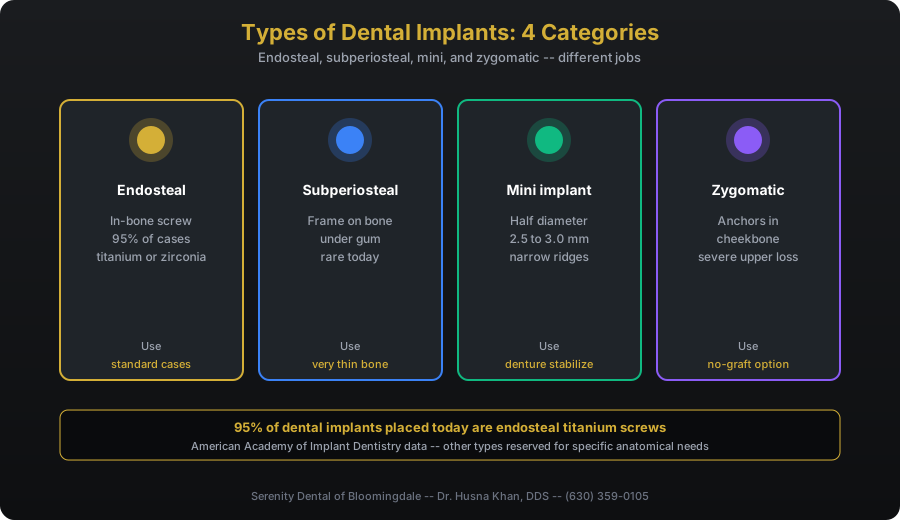
The four designs at a glance
| Implant type | Description | Best for |
|---|---|---|
| Endosteal | The standard design: a titanium (or zirconia) screw placed in the jawbone | Healthy adults with adequate bone, or bone rebuilt by grafting |
| Subperiosteal | Metal frame on top of the bone, under the gum | Historical use in jaws too thin for implants, before grafting became predictable |
| Zygomatic | Extra-long implant anchored in the cheekbone (zygoma) | Severe upper jaw bone loss when grafting is not possible or not wanted |
| Mini implants | One-piece posts under 3 mm in diameter | Lower denture stabilization, narrow ridges, non-load-bearing single teeth |
| All-on-4 (a technique, not an implant type) | Four endosteal implants supporting a full arch | Replacing all teeth in one jaw with a fixed bridge |
Endosteal implants: the standard of care
An endosteal implant is a screw-shaped or cylinder-shaped titanium post placed surgically into the jawbone. It works as the artificial tooth root, fusing with bone over 3 to 6 months through osseointegration, the biological lock between titanium and living bone that Per-Ingvar Branemark’s research group documented in the 1960s.
Endosteal implants replace single teeth, anchor multi-tooth bridges, and support full-arch prostheses such as All-on-4. Standard sizes run from 3.5 to 5.0 millimeters in diameter and 8 to 13 millimeters in length, and the specific size for each site is chosen from a CBCT scan of the available bone. In our Bloomingdale office, nearly every implant we place is an endosteal implant from an established manufacturer, planned on a CBCT scan taken in the office before the surgery date is set.
Surface treatment encourages bone integration. Current surface treatments include sandblasted-and-acid-etched (SLA), titanium plasma-sprayed, and laser-modified surfaces. Long-term records are strong. A 2021 cohort study published in Clinical Implant Dentistry and Related Research followed 10,871 implants in 4,247 patients for up to 22 years and found cumulative survival of 98.5 percent at 5 years, 96.8 percent at 10 years and 94 percent at 15 years, with cigarette smoking and diabetes correlated with the failures. A 2019 systematic review in the Journal of Dentistry pooled the published 10-year data and arrived at 96.4 percent survival. Across the wider literature, the AAOMS clinical paper on implant surgery puts reported success rates between 89 and 98 percent.
Subperiosteal implants: rarely used today
A subperiosteal implant is a custom metal framework that sits under the gum but on top of (not within) the jawbone. In the American Academy of Periodontology’s description, it is an implant placed on top of the jaw with posts that protrude through the gum to hold a prosthesis. Subperiosteal frames were developed in the 1940s and used for decades in patients whose jaws were too thin for implants placed into the bone, at a time when bone grafting was not predictable.
They are rarely placed today. Ridge augmentation and sinus lifts rebuild bone reliably enough that endosteal placement is feasible in nearly every patient willing to allow time for grafting, and a grafted site with a standard implant has the better long-term record. When a patient needs bone first, we plan the bone grafting in Bloomingdale, IL or the sinus lift in Bloomingdale as a staged step before the implant.
A patient considering implants in 2026 will almost certainly receive endosteal implants, with grafting if needed to create adequate volume. Subperiosteal frames survive mainly in textbooks and in the mouths of patients treated decades ago.
Mini dental implants: useful for specific applications
Mini dental implants are one-piece posts under 3.0 millimeters in diameter, where standard implants are mostly 3.5 to 5.0 millimeters. The ITI consensus review by Klein, Schiegnitz and Al-Nawas, published in the International Journal of Oral and Maxillofacial Implants in 2014, grouped narrow implants into three categories and placed mini implants in the smallest one, under 3.0 millimeters. Their most common job is to stabilize a lower complete denture, giving snap-in retention with a smaller surgery than standard implant placement.
Mini implants have real advantages in the right case. They fit narrow ridges where a standard implant would not. Surgery is less invasive, often without a gum flap, so soft-tissue healing is quicker. Cost is lower per fixture, often $500 to $1,500 per mini implant placed, against $1,800 to $2,800 for the surgical placement of a standard implant post. In selected denture cases they can be loaded the same day.
The trade-offs matter. The ITI review found mini implants documented for only two indications, the edentulous jaw under an overdenture and single teeth that do not carry chewing load, with reported survival between 90.9 and 100 percent. A 2023 meta-analysis of narrow implants (1.8 to 3.3 millimeters) under lower overdentures, summarized by the Dental Elf, reported mean survival of 94.9 percent against 99.0 percent for regular-diameter implants, a difference that did not reach significance in the short follow-up periods available. The thinner post is more exposed to fracture and bone loss under heavy forces, so mini implants are not used under molars or as the sole support for a fixed bridge. For a lower denture that will not stay put, they are a legitimate option; our dentures in Bloomingdale page covers the snap-in denture designs that sit on them.
Zygomatic implants: for severe upper jaw bone loss
A zygomatic implant is a long titanium implant, manufactured in lengths from 30 to 52.5 millimeters, that passes through or alongside the upper jaw and anchors in the dense bone of the cheekbone (zygoma). It is used in severely resorbed upper jaws where conventional implants cannot be placed even with grafting, most often in patients who have worn an upper denture for many years and lost most of the ridge.
Zygomatic surgery is technically demanding and is performed by oral and maxillofacial surgeons. A 2023 systematic review and meta-analysis in the International Journal of Implant Dentistry pooled 18 studies covering 1,349 zygomatic implants in 623 patients and reported 96.2 percent survival at 6 years, with an annual failure rate of 0.7 percent. Sinusitis was the most frequent complication, affecting 14.2 percent of patients, and it was also the problem most often linked to implant loss.
The advantage is time. Zygomatic implants allow a full-arch prosthesis to be attached the same day or within days, where conventional treatment would first need many months of grafting and healing. Against that stand the complexity of the surgery, the specialty referral, the sinus risk, and a fee the surgeon quotes case by case. For most patients with upper bone loss, All-on-4 dental implants in Bloomingdale, which tilt the back implants to use the bone that remains, or a sinus lift followed by standard implants, comes first. We refer patients we treat in our Bloomingdale practice with severely resorbed maxillae to specialty colleagues when zygomatic implants are appropriate.
Titanium versus zirconia: the material question
Most dental implants are titanium, either commercially pure titanium or the alloy Ti-6Al-4V. Titanium has been the implant material of record since the 1960s and carries about six decades of clinical follow-up on its biocompatibility, osseointegration, and mechanical reliability.
Zirconia implants, a white metal-free ceramic alternative, have been commercially available for roughly 20 years. Patients ask about them for two reasons: appearance, because a white post does not show through thin gum tissue the way grey titanium can, and the appeal of a metal-free option for patients concerned about metal sensitivity.
A 2018 meta-analysis of 18 clinical studies by Roehling and colleagues, published in Clinical Oral Implants Research, found 98.3 percent survival at 1 year and 97.2 percent at 2 years for commercially available zirconia implants, with marginal bone loss similar to published titanium data. Its authors also concluded that more long-term data are needed to confirm those early results. Titanium has decades of follow-up; zirconia has a little over one. For a patient with thin gums in the smile zone or a firm preference for a metal-free implant, zirconia can be a sound choice. For most patients, titanium remains the first-line material.
Implant brand selection: why it matters for decades
Implant brand is one of the more consequential decisions in implant treatment, and one patients rarely hear about. Established brands such as Straumann, Nobel Biocare, Zimmer Biomet, BioHorizons and Astra have decades of peer-reviewed follow-up, published survival data, and replacement parts available through any dentist. If a screw loosens or a crown needs remaking 10 years from now, a dentist anywhere in the United States can identify the connection and order the component.
Lesser-known systems may save money at placement, but they cannot be serviced by other dentists if the original provider closes or the system is discontinued. Years later, a replacement abutment for an obscure connection can be impossible to find. Patients we treat in our Bloomingdale practice receive implants from established manufacturers with documented long-term outcomes, and we record the brand, lot number and abutment specifications in the chart so the information is available to any future dentist.
The cost difference between an established brand and an off-brand implant is typically $500 to $1,500. For a device designed to last decades, that is a small share of the total and a meaningful protection against serviceability problems later.
How implant length and diameter are selected
Beyond type and brand, two specifications decide which exact implant goes into each site: length and diameter. Both come from CBCT measurements of the available bone and the restoration planned on top.
Length typically ranges from 8 to 13 millimeters. Longer implants engage more bone and gain more primary stability, but they need vertical bone height. Short implants (8 millimeters or less) are used when vertical bone is limited and the patient would rather avoid grafting or a sinus lift. A 2016 systematic review and meta-analysis in the Journal of Dentistry pooled 13 studies and 2,631 implants and found no significant difference in failure between short implants (3.9 percent) and standard-length implants (2.7 percent), while advising caution with the very shortest, 4 to 7 millimeter, designs.
Diameter typically ranges from 3.5 to 5.0 millimeters for standard implants. Wider implants spread chewing forces over more bone-to-implant contact, which helps in molar sites with high bite forces. Narrower implants fit tighter spaces but concentrate stress, so they are kept out of high-force back-tooth sites. Patients we treat at our Bloomingdale practice receive a size recommendation specific to each implant site, with the reasoning explained at the consultation.
What each type costs in the Chicago area
Cost follows the surgery involved and the parts that sit on the implant, not the label on the box. These are Chicago-area reference ranges for 2026.
| Implant type or procedure | Typical Chicago-area range |
|---|---|
| Standard endosteal implant, complete (post, abutment and crown) | $3,500 to $6,000 |
| Surgical placement of the post alone | $1,800 to $2,800 |
| Mini implant, per post, before the denture | $500 to $1,500 |
| Implant-retained snap-in denture, per arch | $6,000 to $15,000 |
| All-on-4, per arch | $15,000 to $30,000 |
| Bone graft, per site | $300 to $1,200 |
| Sinus lift, per side | $1,500 to $2,500 crestal; $2,500 to $5,000 or more lateral |
| Zygomatic implants | Quoted case by case by the oral surgeon |
At Serenity Dental of Bloomingdale, our standard single-implant package, which includes the implant post, the abutment and the crown, is $2,999 with no insurance required for a standard case. Cherry, CareCredit and Sunbit spread the cost over monthly payments for qualified applicants. Our dental implant cost guide breaks the figures down component by component.
Cost figures in this article are Chicago-area reference ranges compiled from regional fee data, not quotes from Serenity Dental of Bloomingdale. Every dental insurance carrier negotiates its own fee schedule, and Medicaid and Medicare Advantage plans set separate schedules of their own, so the amount a plan allows can sit above or below these ranges. Your actual fee depends on exam findings, materials, and benefits, and we provide a written, itemized estimate before any treatment begins.
When to call rather than wait
Specific symptoms after implant placement deserve prompt attention. Severe pain that worsens after day 3, bleeding that continues beyond 24 hours, a foul taste, or visible pus at any point during healing needs same-day evaluation. Fever above 100.4 F, a sudden feeling that the implant moves, or new numbness in the lip or chin should be reported right away.
Problems caught early are usually simple to manage. Problems that wait are not. Call our office at (630) 359-0105; patients with an active concern are seen the same day or the next business day.
Related implant guides: dental implants in Bloomingdale · Dental implants guide · Dental implant cost · Dental implant healing stages · What dental implants are made of · Full mouth dental implants cost · All-on-4 with bone loss
Types of dental implants: questions answered
What are the main types of dental implants?
What is an endosteal implant?
What is a subperiosteal implant?
What is a mini dental implant?
What is a zygomatic implant?
Are dental implants made of titanium or zirconia?
Which type of dental implant is best for me?
Do different implant brands matter?
How much do the different types of dental implants cost?
Educational content only. Recommendations are personalized after an exam and any needed imaging.
Medical disclaimer
This article is general information for patients and is not a substitute for an examination, CBCT imaging, and personalized advice from a licensed dentist. The right implant type, size and material depend on your bone, your medical history, and the teeth being replaced. If you have severe pain, swelling, fever or uncontrolled bleeding after any implant procedure, contact your dental provider or call our office at (630) 359-0105. For difficulty breathing or swallowing, call 911 or go to the nearest emergency department.
About this article
Reviewed by Dr. Husna Khan, DDS, who places dental implants at Serenity Dental of Bloomingdale, IL. Cited sources: the 2021 cohort study of 10,871 implants in Clinical Implant Dentistry and Related Research; the 2019 Journal of Dentistry meta-analysis of 10-year implant survival; the 2014 ITI consensus review of narrow-diameter implants; the 2023 meta-analysis of zygomatic implants in the International Journal of Implant Dentistry; the 2018 Clinical Oral Implants Research meta-analysis of zirconia implants; the 2016 Journal of Dentistry review of short implants; the American Academy of Periodontology and AAOMS implant guidance. A full list with links appears in the Sources section.
Educational content. Individual treatment recommendations depend on clinical evaluation. Schedule a consultation at (630) 359-0105.
Sources
- French D, Ofec R, Levin L. Long term clinical performance of 10 871 dental implants with up to 22 years of follow-up: a cohort study in 4247 patients. Clin Implant Dent Relat Res 2021;23(3):289-297. Cumulative implant survival of 98.5 percent at 5 years, 96.8 percent at 10 and 94 percent at 15; smoking and diabetes were linked to failure
- Howe MS, Keys W, Richards D. Long-term (10-year) dental implant survival: a systematic review and sensitivity meta-analysis. J Dent 2019;84:9-21. Pooled 10-year implant survival of 96.4 percent
- Klein MO, Schiegnitz E, Al-Nawas B. Systematic review on success of narrow-diameter dental implants. Int J Oral Maxillofac Implants 2014;29 Suppl:43-54 (ITI Consensus Conference paper). Mini-implants under 3.0 mm in diameter are documented only for the edentulous jaw and non-load-bearing single-tooth sites; reported survival 90.9 to 100 percent
- Park JH, Shin SW, Lee JY. Narrow-diameter versus regular-diameter dental implants for mandibular overdentures: a systematic review and meta-analysis. J Prosthodont 2023 (summarized by the Dental Elf). Mean survival 94.9 percent for narrow implants (1.8 to 3.3 mm) against 99.0 percent for regular-diameter implants under lower overdentures, with no significant difference in short-term failure
- Brennand Roper M, Vissink A, Dudding T, et al. Long-term treatment outcomes with zygomatic implants: a systematic review and meta-analysis. Int J Implant Dent 2023;9:21. 1,349 zygomatic implants in 623 patients: 96.2 percent survival at 6 years; sinusitis in 14.2 percent
- Roehling S, Schlegel KA, Woelfler H, Gahlert M. Performance and outcome of zirconia dental implants in clinical studies: a meta-analysis. Clin Oral Implants Res 2018;29(Suppl 16):135-153. Commercially available zirconia implants: 98.3 percent survival at 1 year and 97.2 percent at 2 years, similar to published titanium figures; long-term data still needed
- Lemos CA, Ferro-Alves ML, Okamoto R, Mendonca MR, Pellizzer EP. Short dental implants versus standard dental implants placed in the posterior jaws: a systematic review and meta-analysis. J Dent 2016;47:8-17 (summarized by the Dental Elf). Implants of 8 mm or less failed at 3.9 percent against 2.7 percent for longer implants, not a significant difference; 4 to 7 mm implants carried more risk
- American Academy of Periodontology, Dental Implant Procedures. Endosteal implants are the most common type; subperiosteal frameworks sit on top of the jaw with posts through the gum; sinus augmentation and ridge modification rebuild deficient bone
- AAOMS clinical paper: Oral and Craniomaxillofacial Implant Surgery (2017). Reports implant success rates of 89 to 98 percent and the use of hard- and soft-tissue grafts as indicated
- Nobel Biocare, NobelZygoma implant range. Zygomatic implants are manufactured in lengths from 30 to 52.5 mm
Need help with this in real life?
Reading helps. Talking to someone who can look at your actual teeth and symptoms helps more. If you want a clear next step, we’re here.
Related articles
All-on-4 Dental Implants Cost: With and Without Insurance
What All-on-4 costs per arch and for both arches, what a complete quote has to include, what dental insurance pays toward it, and how patients finance the rest.
Read article →Same-Day Tooth Extraction and Implant: Is It Right for You?
Same-day tooth extraction and implant placement explained: who qualifies, what the visit involves, what the research shows, and when waiting is the better call.
Read article →Full Mouth Dental Implants Cost: Realistic Pricing for Every Treatment Option
Full mouth dental implants cost depends on the approach: snap-in overdentures, All-on-4, All-on-6, or an implant for every tooth. Realistic Chicago-area ranges, what a quote should include, and financing.
Read article →